
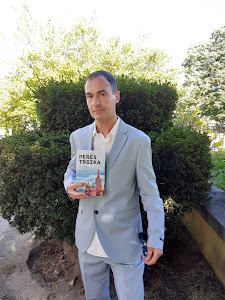
November 9 will mark the 35th anniversary of the fall of the Berlin Wall that once separated communist East Germany from democratic West Germany. While this event may sound like ancient history to some younger readers, I have vivid memories of watching in astonishment the TV news reports of the wall’s dismantling. Today, this act is seen as symbolic of the collapse of the Soviet Union’s style of communism, the collapse of that nation and its Eastern European satellites, a collapse hastened by the political reform movement in the Soviet Union known as “perestroika.”
The downfall of communism in the USSR and Eastern Europe is the subject of Portuguese writer João Cerqueira‘s latest novel, Perestroika: An Eye for an Eye, a Tooth for a Tooth. The novel tells the story of a fictitious Eastern Bloc nation, Slavia, that is caught in the social and political upheavals of that era.
Cerqueira is the author of nine books that have been translated into eight languages, as well as several short stories and other writings. In Perestroika and his other novels, he employs satire and humor to address human nature and contemporary problems. In today’s Friday Five, Cerqueira gives us a glimpse at his approach to writing, the story behind Perestroika and what lessons it holds for our world today, and a peek into his work in progress.
1 – What inspired you to write Perestroika?
The novel Perestroika results from the profound impact of the images of the fall of the Berlin Wall and people demanding freedom in the streets of communist countries. In addition to bringing freedom to half of the Europeans, Gorbachev’s Perestroika ended the Cold War and the threat of nuclear war. However, oddly enough, the topic was forgotten. To my knowledge, there is no film, TV series, or novel — except mine — that addresses one of the most important changes of the 20th century.
Furthermore, I visited Cuba three times and saw with my own eyes how a communist country works: there is no freedom of expression, there are no free elections, there are no human rights, and anyone who protests is arrested.
Additionally, some characters in the book are taken from European history:
The painter Ludwig Kirchner, Lia Kirchner’s father, was inspired by the German expressionist painter of the same name, whose works Hitler considered Degenerate Art.
The People’s Commissar for Culture, Zut Zdanov, was inspired by the Stalinist leader Andrei Zhdanov, responsible for culture in the USSR, who defended socialist realism in art and banned modernism.
President Alfred Ionescu was inspired by the playwright Eugène Ionesco, creator of the theatre of the absurd — which brings us back to the absurdity of communist regimes.
2 – What is the primary message of this novel and why do you believe it is relevant to readers today?
Anne Applebaum’s latest book, Autocracy Inc., is, in the author’s words, “”an alarming account of how autocracies work together to undermine the democratic world, and how we should organize to defeat them.” The world is divided into dictatorships and democracies, and the dictatorships are winning. Communists, populists and religious fanatics are united against the Western world which, together with Japan and Korea, are the only places where freedom exists and human rights are respected.
In this sense, Perestroika is a novel about the struggle between freedom and tyranny.
So, because of Russian aggression against Ukraine and the threat of a third world war, I think this book addresses issues of critical interest in discussions about the problems of the world today.
3 – What two or three writers have influenced you most and why?
For writing Perestroika, the writers that influenced me are George Orwell , Aleksandr Solzhenitsyn, Mikhail Bulgakov, Victor Kravchenko, and Arthur Koestler. Each of them denounced the violence and horrors of Communism. In addition to their literary quality, their books are a form of resistance and a warning to readers who did not live under these regimes. With Perestroika I tried to follow their example.
4 – Tell us a bit about your current creative project. Is there a new novel in the works?
My latest novel is a post-apocalyptic story. The concept of a world-ending “apocalypse” dates back to the Old Testament with the Flood that destroys humanity; and continues in the New Testament with John’s Apocalypse. In 20th century fiction, the main causes of the end of the world are frequently nuclear wars or alien invasions. In more recent, 21st century novels, the end of the world is often attributed to climate change or pandemics. However, I prefer not to specify a cause for the apocalypse — most survivors aren’t sure what happened — because that could imply a solid scientific basis.
It was the most difficult book I’ve written so far because I had never addressed this topic. It’s difficult to inject some humor in a world similar to that of The Walking Dead.
5 – What advice would you offer anyone interested in writing a novel?
Read also translated fiction and never give up.
*
Follow João Cerqueira on X/Twitter at @bujoom. Read some of his short stories and chronicles here.

 Andrew Careaga
“Mr Gorbachev tear down this wall!”