
Thoreau had his Walden — that wilderness refuge where he sought inspiration and “to live deliberately.” Today’s National Poetry Month featured author, Molly Remer, also took to the woods for creative and spiritual inspiration, and with fruitful results. Unlike Thoreau and his transcendentalist brethren, however, Molly pursues the practice of “inscendance,” which she describes more in the Q&A below.
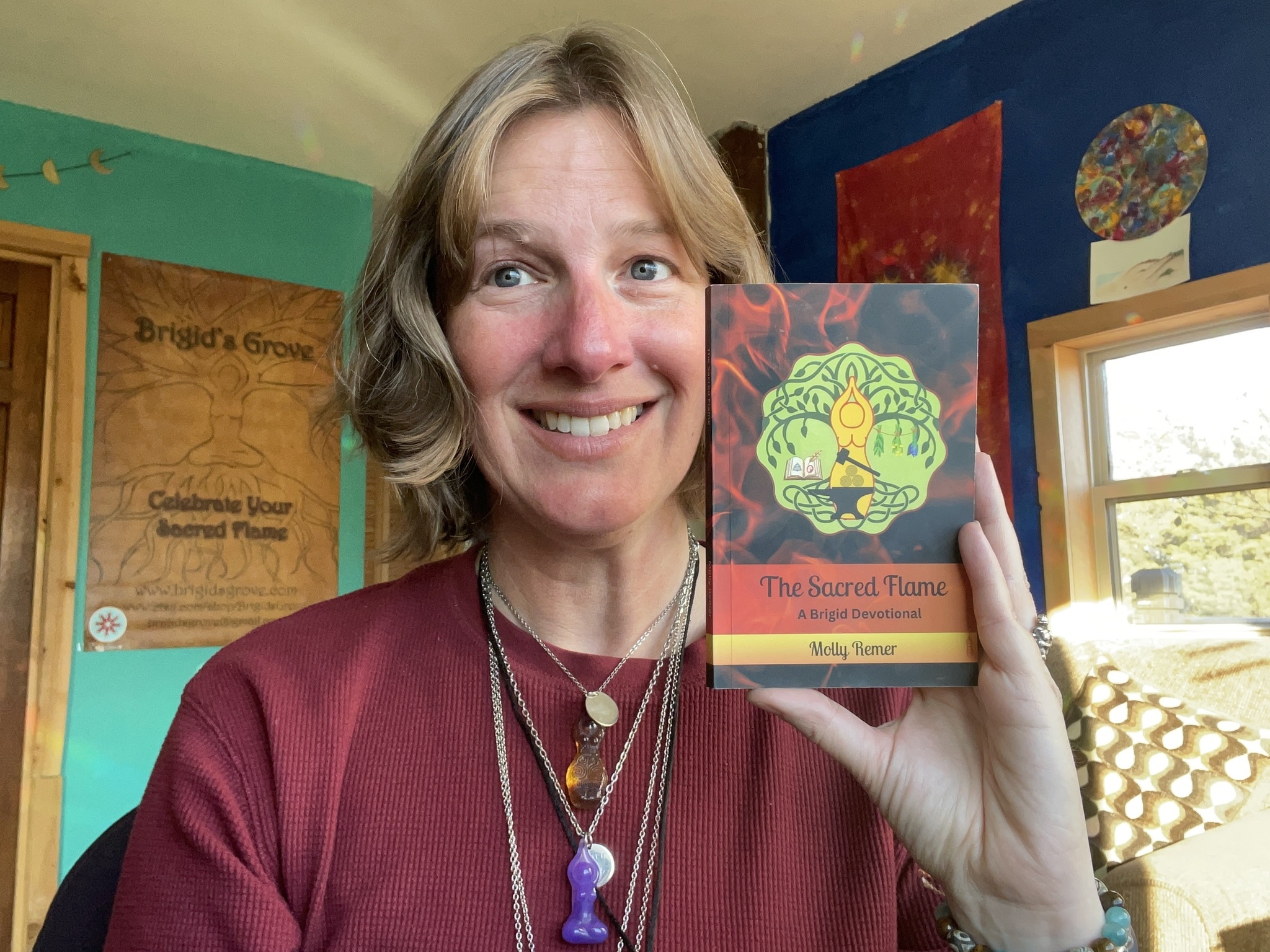
A prolific poet whose works are deeply rooted in goddess spirituality, nature, and the sacredness of everyday life, Molly is also a priestess and mystic. Living not far from me here in rural south-central Missouri, Molly holds Master of Social Work and Doctor of Ministry degrees and has authored 15 books, including Walking with Persephone, Whole and Holy, and 365 Days of Goddess. You can find her books and other works on her Etsy page.
Molly and her husband Mark also co-create Story Goddesses at Brigid’s Grove, producing original goddess sculptures and ceremony kits. She is the founder of the devotional experience #30DaysofGoddess. Her passion for celebrating small magic and everyday enchantment in life comes through in her poetry, which blends thealogy, nature, and practical priestessing, reflecting her deep connection to the divine feminine.
Read on to learn more about Molly Remer’s poetry, what inspires her, her thoughts on nature, mysticism, and inscendence, and the importance to writers of finding their “power spot.” Read on to the end to discover a poem from Molly that is quite relevant to the state of the world today.
1. Your poetry often feels like a sacred conversation with nature and the divine feminine. What’s the spark—maybe a moment or a place—that most often inspires you to write?
In 2012, I made a promise to myself that I was going to sit in the woods in the same place every day for a year and see what I could learn. This promise evolved into my first book of poems, Earthprayer, and continued as a daily practice of observation, engagement, learning, and witnessing that has persisted to this day. My place of witnessing has changed several times. First, I sat on the rocks in the woods every day. Later, an ankle injury led me to switch to sitting on my back deck. And, then sitting on the deck somehow became sitting on the porch swing instead. In addition to my daily walks and what I learn while walking, my own porch swing, back deck, and the woods behind my house are the things that most inspire me to write. I refer to this as a union between “sacred sameness” and “infinite experiencing” and I find that when we create or cultivate a relationship with a “power spot” in our lives, we come to deeply trust the insight that arises from a repeated practice of return to the same place of belonging. One of my books, Replenish, is dedicated to my porch swing, thanking it for being a “portal to the infinite.” Another one of my books, In the Temple of the Ordinary volume 1, is dedicated to the land I walk on, “thank you for carrying me in every day.” My own landscape of living is the most potent source of inspiration and support in my life.
2. You’ve written about finding the holy in the ordinary, like in In the Temple of the Ordinary. How does your writing process itself become a spiritual practice for you?
My writing practice and my spiritual practice are one and the same. My daily practice of writing every single morning is a way of dialoging with divinity for me. Christina Baldwin, the author of Life’s Companion, explains that the practice of keeping a spiritual journal is to come into communion with the sacred, to communicate with the sacred in your life and this has most definitely been true for me.
Life itself is where the magic is. In one of my unpublished poems, I explained that to be a poet is to be willing to walk right into the heart of life, willing to write it down. This also brings me to a quote I love from Thomas Berry: “Inscendence is the impulse not to rise above the world (transcendence) but to climb into it, seek its core.” Spiritual practice, and my writing practice, are practices of inscendence.
Christina Baldwin also writes: “Spirituality is the sacred center out of which all life comes including Mondays and Tuesdays and rainy Saturday afternoons, in all their mundane and glorious detail. The spiritual journey is the soul’s life commingled with ordinary life.” That really sums it up for me and my writing practice grounds and centers me in the reality of the soul’s journey comingled with ordinary life. Baldwin also says that the spiritual journey comes to us all mixed in with life’s dailiness and the spiritual journal is written all mixed in with life dailiness as well. I often tell the members of my Patreon this, that our spiritual lives aren’t something we save for a tiny box on your altar or for the special perfect moment; instead your spiritual connection is woven through all of your days. Your life can be permeated with small sacredness and with moments of magic. Baldwin goes on to say that “spiritual writing expands the interior conversation of consciousness to include your relationship with the sacred, you are no longer alone on the quest or on paper, you are in conversation with something you perceive as either beyond or deep within yourself or both. It is this inclusion of the sacred that spiritualizes the writing. Sometimes we assume that spiritual experiences, or at least experiences that we define as deeply integrative, happen only to saints, martyrs or mystics. We wait to hear and fear to hear Joan of Arc’s voices. We believe that following a burning bush is more significant than writing in a journal…[however] as we take up writing the sacred responds by using writing as a way to appear and interact in our lives. The journal becomes an open channel [to the sacred].” I step outside each morning and sit down with my pen and in so doing, I step into the sacred.
3. Goddess mythology weaves through your work—Persephone, Brigid, and others. How do these archetypes show up in your creative process, and what do they teach you about your own life?
I find there is great value in what I term the mythopoetic storying of our lives. In an article I wrote for Feminism and Religion many years ago (“Everyday Inanna“), which later became part of my book, The Great Between, about the goddess Inanna, I explained that when we story our realities, we find a connection to the experiences and courage of others, we find the patterns in our own lives, and we find the strength of purpose to go on. We can see ourselves, our experiences, our insights, and our journeys, reflected in larger, grander, mythical stories and this both helps to root or ground us and to support us, to see our lives and stories as part of a larger whole, with meaning and value. If, for example, we look at Persephone or Inanna’s story and see how she has descended into the underworld and then risen once again, we find a strength of purpose for our own underworld journeys as we become “everyday Inannas” in our own lives. I think we can see ancient stories and symbols as alive in our own lives, right now, and that they can both inspire and guide us as we tell our own stories. We do, I firmly believe, each have a story worth telling. In my book Walking with Persephone, I explained that to draw upon goddess mythology in our own lives is to weave an understanding of how her story, values, experiences, and symbols intersect with your own.
4. Your poems have a grounded, earthy quality, yet they soar with enchantment. What’s one challenge you face in balancing the everyday with the mystical, and how do you overcome it in your writing?
My most challenging experience is how the never-ending to-do list tends to rush in to fill all the available corners of my life. I overcome this by prioritizing what I most value first in my days. This means I go outside with my journal and my pen as the first thing I do in the morning (well, after using the bathroom and brushing my teeth). I leave my phone inside, face down, without looking at it once. I ground the beginning of each day in an experience of enchantment, a brush with the mystical, an encounter with the sacred, and then this fuels and inspires the rest of my day.
Like anyone else, I am challenged by the realities of suffering, of political discord, of disconnection, of overcommitment, of distraction, of human rights atrocities unfurling, of environmental destruction, of violence and greed. I find, however, that despite all of these things, there is beauty even here, there is magic, even here. And this contact, and this trust, in what I call the “current of the sacred that underlies all of our lives,” every single day provides the foundation by which I remember, reclaim, and return again and again. I’ve included a poem below my responses that speaks to this balance.
5. For someone just starting to write poetry, what advice would you offer to help them find their voice and trust their words?
In addition to finding a “power spot,” a spot you return to every day to observe, to listen, to draw inspiration from, my very favorite practice is what I call the “six word poem.” This is based on a promise I made to myself six years ago in which I promised that I would write something every day even if it was just a six-word poem. If you feel stumped on what to write or how to write, start with the words: “this is my six-word poem…” and then proceed to list out things you noticed, experienced, or thought about that day (or even dreamed about). This practice will help you start to see your own life as a poem, every day. The liberation possible in this “six-word poem concept” is not that you literally only write six words — rather the freedom inherent in only needing to write six words becomes a type of metaphor that frees you from thinking you must only write shimmering words of sparkling genius. If you only “need” to write six words, suddenly the door of possibility flings wide open and you are free to explore your life poetically without pressure to produce or perform. My own six word poems usually become fifteen to thirty line poems, but freedom begins with the commitment to only writing six words. Our lives are our poems. You’re already living yours right now, you just need to write it down. And, finally, as I mentioned in an earlier answer, we all have a story worth telling. You can trust your words because you want to write them. That is reason enough.
Reaching Out
By Molly Remer
I know we are weary,
overwhelmed by how much damage
can be done
by sweeps of pen
and distant deciding,
callous disregard
seeming to seep into
all the edges
and change how the world feels
to live in.
We may feel frozen with indecision,
unsure of what to do
or how to help
or what to say.
So much asks for our attention
and our time,
asks us to look
and to not turn away.
We wonder what there is to celebrate
in the face of so much anger
and so much need.
It is hard to feel so small and human,
hard to keep hoping,
to trust in our own inherent magic
and that goodness and beauty
are still at work
amid the pain.
The truth,
however,
is the same as it has always been.
We can start where our feet are.
We can refuse to surrender
what we know to be true,
just, and generous.
We can reach out.
We can hold on.
We can keep gathering bits of beauty
and scraps of magic
and offering them
to one another.
We can keep weaving a web of magic
with all that refuses
to drop their strands.
We are here.
This is courage and celebration enough
for this day.
We are brave
to keep reaching out
our hands.

 Andrew Careaga
I like this. (The “Like” button does not respond to my clicks.)
Sorry the like button isn’t playing nice today — but appreciate the comment!