
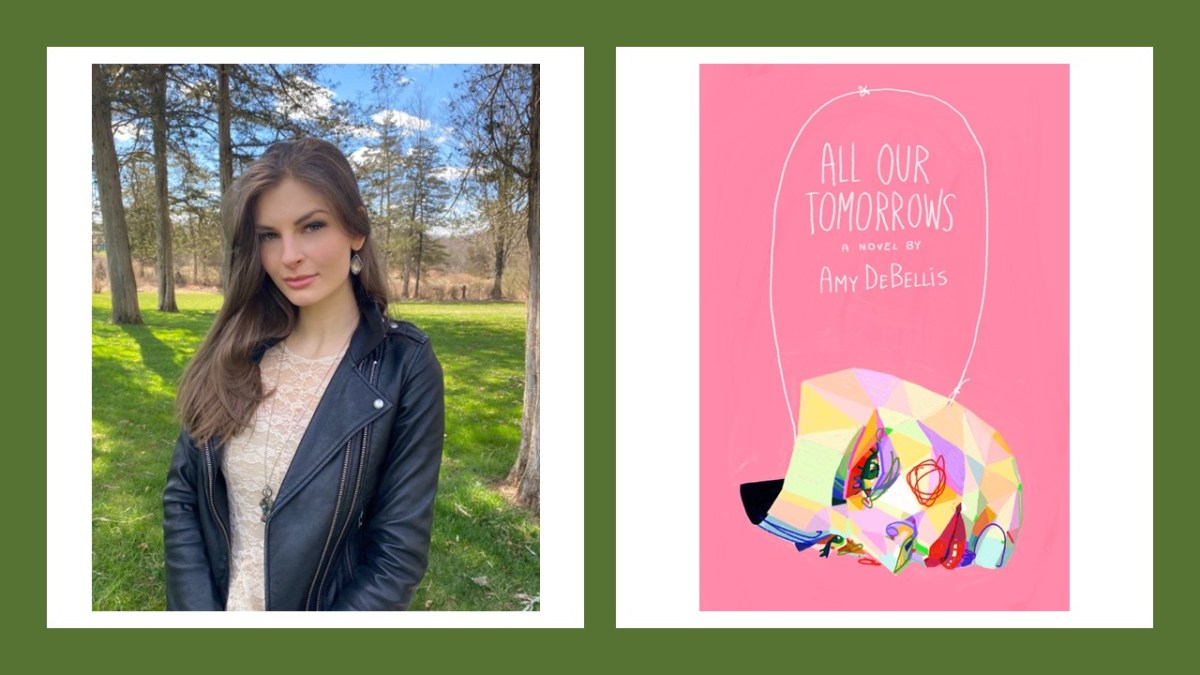
For Amy DeBellis, “writing is a way to express negative emotions: fear, grief, rage,” she says. “I also find that makes for more interesting stories.”
To call Amy’s stories interesting is like calling Stephen King’s novel Christine a book about an old clunker. Her short stories may glimmer on the surface, but beneath that veneer, the gruesome and bizarre are exposed, but not in an overt, obvious horror-genre way. She also sets many of her writings in a dystopian near future–one not so far off from our current world and circumstances, just enough to help us imagine what those current circumstances can lead to.
Amy’s astounding debut novel, All Our Tomorrows (CLASH Books, 2025), explores the lives of three Gen Z women navigating late-stage capitalism in a near-future New York City.
Her second novel, The Widening Gyre, is set to be published in June 2026. Her short fiction and nonfiction, nominated for the Pushcart Prize and Best of the Net, have appeared in publications like X-R-A-Y, Pithead Chapel, and Vol. 1 Brooklyn. She holds a BA in English from NYU and is passionate about raising awareness for chronic illnesses like Long Covid and ME/CFS (Myalgic Encephalomyelitis/Chronic Fatigue Syndrome), a subject she discusses with brutal honesty in one of her favorite nonfiction pieces.
1. Your debut novel, All Our Tomorrows, explores the lives of three Gen Z women in a near-future NYC under late-stage capitalism. What inspired you to write this story, and how did you approach blending speculative elements with real-world issues to create its unique setting and narrative?
I was inspired by a couple of things: a pessimistic Reddit comment about climate change, which informed the first conception of Janet’s personality, and a book called The Uninhabitable Earth by David Wallace-Wells. That book is haunting, and a few phrases jumped out at me, most notably: “At 8°C [of warming], humans in the tropics would not be able to move around outside without dying.” It’s not melodramatic or emotional. The scientific (but still accessible) way in which it’s written is what makes it so unsettling. That book—and the Reddit comment I mentioned—both left me with a uniquely unsettled feeling that I wanted to encapsulate in a book. And then the biggest challenge lay in making it hopeful, too.
I’ve always enjoyed writing speculative fiction, but I didn’t want to set this story too far in the future, because I still wanted people to be able to relate to it. I wanted people to feel almost uncomfortably seen. So I decided to set it in a murky “almost-present” that’s not easily dated by a ton of pop culture references or, say, the mention of who’s President. I wanted this story to be able to endure for a while.
2. You’ve written numerous short stories, with your work appearing in outlets like X-R-A-Y and Pithead Chapel. Could you share two or three of your favorite stories you’ve written and explain what makes them particularly meaningful to you?
My favorite stories probably happen to be the most controversial ones. One of my favorites is “What’s So Horrible,” which appears in Hobart. It’s told from the viewpoint of a bulimic teenage girl. We also meet her anorexic brother, and their mother, who is completely in denial about climate change, as well as the fact that her children are slowly dying. The siblings’ destruction of their bodies mirrors the destruction of the planet—and the girl is definitely aware of the destruction of the planet. Images like those of the tick-infested “ghost moose” and men guarding the last white rhinos from poachers run on repeat in her head, along with those of her brother secreting food in a book at dinnertime, and her throwing away a piece of tooth that’s come loose from all the stomach acid. I’m really proud of how the writing flows in this story; there’s a rhythm and beauty to the sentences that I can’t always achieve, but when I do, I know I have something special. It’s also a fairly gruesome story. I’ve never, to this day, read a piece that goes into such detail about the process of self-induced vomiting, and that’s probably because most places would never publish them. I am grateful to Elizabeth Ellen for running this story.
Another favorite story of mine is “His Body,” recently published in X-R-A-Y. It’s about a new STD that spreads in the form of gruesome spots all over the body. It’s set in the near future, where “the administration loves SL-29. It’s sexually transmitted, so what better punishment for the whores and sluts and single mothers than to have our loose morals branded on our faces forever?” Yep. That future. Our protagonist discovers a spot on her husband’s face and then realizes that he has spread the disease to her through cheating. (We slowly learn more about the world they’re in as the story progresses.) But she has a very…specific punishment in mind. The last line of that story came to me very early on in the process, and I smiled the most evil-looking smile when I thought of it. You’ll understand when you read it.
The last one isn’t a story at all, but creative nonfiction. It’s called “Oblivion,” published in Pithead Chapel, and although it was published in Spring 2023, I still get messages to this day from readers about how much it affected them and how grateful they are to me for writing it. It’s about my experience with very severe ME/CFS in 2022. When I wrote it, I was more severe than I am now. But in 2022 I couldn’t write at all, aside from a text message here and there. It’s a description of the worst time of my life, and I had to be very careful not to make it too self-indulgent or self-pitying—or too scientific-sounding and boring. I wrote it because I could finally write again at that point, and I wanted to bring awareness to this terrible disease. And I wanted it to read like a nightmare, because that’s how it felt.
3. Your writings often address complex emotional and societal themes. Where do you typically find inspiration for your writing, and how do you translate those ideas into fully realized stories or essays?
I find inspiration everywhere—in a dream, in a throwaway comment I make and then think, Hey, this could be a story, in a newspaper article. But it’s typically not any one of those things. It’s a bunch of things blended together. For example, for “His Body,” I wasn’t inspired by, say, an article about STDs. I was mostly inspired by the now infamous “Your body, my choice” saying that circulated after the results of the election came in, as well as the novel The Scarlet Letter (which I haven’t read since high school, but some things stick in your brain).
You can see that writing is very rarely a way for me to express joy. When I’m joyful, I can still write, but I tend more towards escapist fantasy stories rather than stories like “His Body” or “What’s So Horrible.” For me, writing is a way to express negative emotions: fear, grief, rage. I also find that makes for more interesting stories.
4. As someone passionate about raising awareness about the chronic illness ME/CFS, how do you incorporate this advocacy into your writing or public platforms, and what challenges have you faced in bringing attention to these often-misunderstood conditions?
On my public platforms, I try to maintain a blend of who I am. I don’t like the idea that I have to focus on one facet of my life and then only talk about that. People say it helps with getting higher engagement, but I’m a full person, not just one “thing.” I have faced some backlash when talking about ME/CFS on Twitter, so I rarely do that—but I don’t use Twitter that much anyway anymore. People tend to be nicer on Instagram, and that’s where the “fullest picture” of me can be seen: my writing, my illness advocacy, and random stuff about my life that doesn’t fall into either of those categories.
I’ve received messages from other authors, saying that I’m so brave for being open about my illness, and that they have the same illness as me. I go and look at their profile and there’s nary a whisper of them having the illness. Sometimes I think I’m being unwise by being so open about this disease; it would probably be smarter to never have spoken about it at all, and have just branded myself as an author who can’t go to in-person events due to “health issues” but doesn’t shout from the rooftops about ME/CFS or Long COVID advocacy. But then I think of all my friends who are in far worse situations than me. I think of the woman who died just days ago, in what I believe is the fourth death in the ME/CFS community this month, and among her last tweets was one saying that people just disappear when you don’t get better. I think of myself in 2022, when I needed help to sit up in bed. I can’t imagine staying quiet about an ongoing crisis that affects millions of people, including me and the people I care about so deeply.
5. What advice would you offer aspiring writers about honing their craft, navigating the publishing world, or staying motivated through the challenges of becoming a fiction and creative nonfiction writer?
In order to hone your craft, read the kind of books you want to write. Otherwise you’ll have no knowledge of genre expectations. Also, read and submit to lit mags! Don’t be afraid to write stuff that’s mediocre. If you don’t write the mediocre, you can’t build up to the good and the great.
Navigating trad publishing is tough. There’s a very long list that leads to publication. First you need to finish writing a book, get it beta read, find an agent (the “query trenches” are rough and somehow getting rougher every year), do edits with that agent, go on submission with editors, and prepare for the very real possibility that your book may fail to get picked up by any editor and simply “die on sub.” (It happened to me twice!)
Staying motivated can be difficult with all of the challenges I listed above. In fact, even looking at that paragraph makes me a bit nauseous. The thing you have to remember is that the process of writing should be its own reward. I’m not in this because I want to get rich or famous from writing; I don’t think it’s possible for 99.99% of us. I’m in this because I need to write and, to a lesser extent, I need to share my writing with the world. That’s what it all comes down to. When I was well, I’d get up in the middle of the night to write; I’d write on the subway, in between classes. I can’t do those things anymore, but on good days I can write for hours, and it’s the closest I can get to feeling healthy and whole again.
Follow Amy DeBellis on Instagram (@amykatherrine) and X/Twitter (@amykdebellis).

 Andrew Careaga