
Just as the premature rumors of Samuel Clemens’/Mark Twain’s death were greatly exaggerated, so it is with UK writer u.v. ray. Never mind that his official author’s bio on Amazon claims he “went missing during a sail-boat trip in the Bermuda Triangle” last February, soon after he completed his chapbook Speed Trials ’94. He’s alive and well–or alive and writing at least–and is about to launch a new novel, Druggernaut, into the world. Currently Spinners editor Roual Galloway and u.v. are making final preparations for the book launch. It will be available very soon from 5767 Productions.
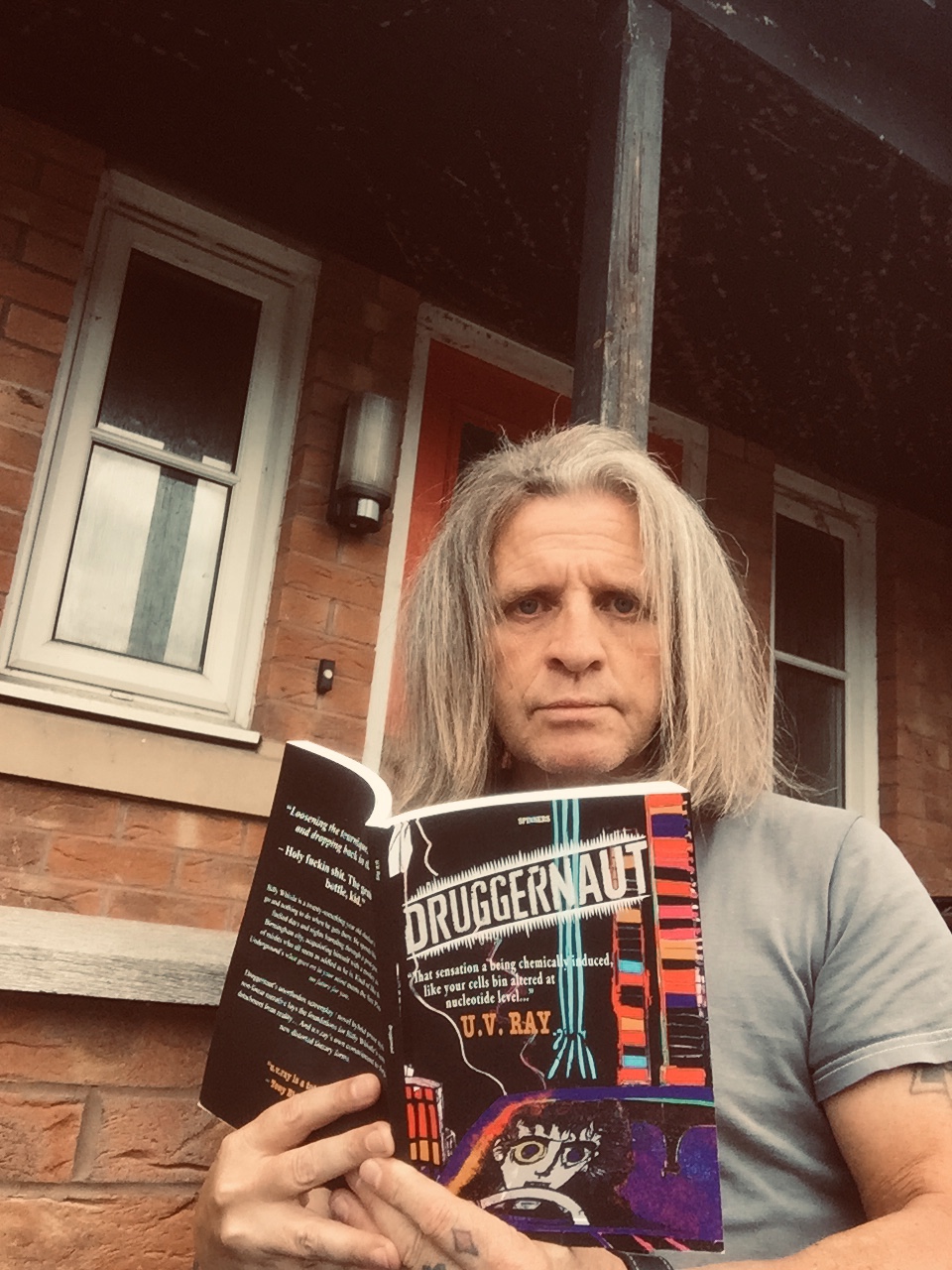
Born in Birmingham, England, u.v.’s raw, gritty fiction and poetry evokes comparisons to writers like Charles Bukowski and William S. Burroughs and others who captured the dark world of society’s underbelly. After dropping out of school at 15, he spent decades drifting through bars and nightclubs, experiences that fuel his works like We Are Glass (2012) and Drug Story (2019). His writing, published in numerous underground magazines, portrays a visceral exploration of alienation and fleeting redemption.
1. Your forthcoming book, Druggernaut, is written in the raw, gritty fashion that seems to be your signature style. It’s also written as what you call “a story/screenplay hybrid.” What inspired this project, and what can readers expect from its exploration of life on society’s fringes?
Literature has become stale. Writers have been working to a blueprint for decades. And in addition we now we have a demon standing in our midst. It’s the spectre of AI. And that’s something that’s got to be combated and our advantage there is that we have something this vacuous critter does not–we have minds and imaginations, and imagination is one of the higher faculties. In an age when we are not overrun with writers of determined imagination the field is wide open for those who forge new and more meritorious works of literature. This is what will WIN in the end.
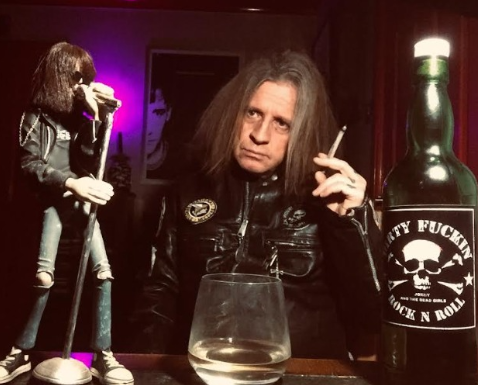
We don’t just need writers with new creative ideas. We need publishers who’re able to recognise it when they see it. But mainstream publishers at least have become acquiescent to mediocrity. The problem, at least part of it, is these little pissants who’ve dug themselves in as our literary gate-keepers have been allowed to dictate the zeitgeist.
Where I grew up it was rough. The kind of sprawling city suburbs where the girls are up the stick at the age of 15 and kids set fire to cop cars. Or their neighbour’s houses if they’d gotten into a dispute. In any case, something always seemed to be on fire. You couldn’t own shit because if you did it’d get robbed. My own background forms much of what I write. Though I have of late been introducing a higher degree of fiction, much of my work is highly autobiographical.
2. Your recent short story, “On Celluloid,” published in Citywide Lunch, has a cinematic quality to its narrative (as alluded to in its title). How did the idea for this story come about, and what was your process for crafting its unique atmosphere or perspective?
Readers are often saying my books should be made into films. I suppose that gave me the idea to write these what I call my story / screenplay hybrids. I very much like the visual aspect it brings to the writing. But it’s also part of my aim to forge new literary styles. I’m very much an underground writer. I’ve been at this far longer than the onset of the internet and online literary platforms. It doesn’t look like I’ll ever break into the mainstream. And that’s fine by me. I’d much rather write something that becomes a cult classic than a best-seller. Now maybe I’ll fall on my face but at least I can hold my head up and say I fucking well tried to do something.
3. How does your background–a native of Birmingham, high school dropout, etc.–influence your writing style and the themes you write about?
Speed Trials ‘94 is an 8,000-word short story in chapbook form. It’s short and sharp and continues with the drug theme, minimal punctuation so as not to slow down the 100 mph amphetamine charged pace of the narrative. I’m very pleased with how it turned out because it exemplifies what I’m saying about not writing to a blueprint. I wrote what I wanted to write and how I wanted to write it. When I talk about giving the literary troglodytes the middle finger, that chapbook is it.
My books have been frequently referred to as existential. But I don’t write existential angst, I write existential rebellion. In fact they blend fiction and reality, which even in my own mind the lines are blurred. But there’s always plenty of autobiography in them, Drug Story and Black Cradle being my most autobiographical, which I think accounts for their dissonant structures. They do have a framework holding them together but those books are more Jackson Pollock painting than cinematic.
4. What two or three writers have most influenced or inspired your own writing, and how do their styles or themes resonate with your approach?
Well, I’ll tell you. Jack Kerouac is not one of my favourite writers. However, I still consider him one of my biggest influences because after getting out of school at the age of 15 he was the one who taught me you don’t have to follow the rules. School was boring us to shit with the stuff they foisted upon us. What fucking interest a 14-year-old boy in the late ‘70s / early ‘80s got in Shakespeare? Then I started reading a few of the Beats. I’m not a major fan of any of them. But they were important in 20th Century literature, of course. In their era, they broke new ground.
More recently, Donald Ray Pollock’s Knockemstiff is the best book I’ve read in 30 years.
Overall, twentieth century American lit has influenced me far more than anything here in the UK. Harry Crews, Carson McCullers, Charles Willeford–those Southern Gothic writers.
5. For aspiring writers drawn to your gritty, unfiltered style, what advice would you offer about finding their voice, navigating the challenges of the writing world, or staying true to their vision in an often commercialized industry?
You’ve got to have a purpose in life. A mission. Something you want to achieve at the cost of all else, something you’re willing to sacrifice everything else for. Everything is secondary to your life’s goal. I wouldn’t say be at war with a mainstream literary scene but make it your intention to be a thorn in their side. You’ve got to break down their walls. But if you want to be a writer nothing will stop you anyway, you just have to be willing to pay the price. And the price is high.
BONUS QUESTION: As someone who has published extensively in underground magazines, how do you view the current state of underground literary zines, and what role do they play in giving voice to authentic, subversive voices in today’s literary landscape? Are they still relevant?
Recently I have been given hope with some of the online zines who’ve published me. Citywide Lunch based down there in Philly is putting up some great writers. I particularly liked Mather Schneider’s work there. Mister Bull Fiction, based in Georgia, as well are publishing some exceptional stuff. And lastly for the online zines, Revolution John.
Here in the UK Spinners (a print zine) are knocking out some gritty works in the mag and are now putting out books–including Druggernaut, which is all but ready.
Writers have an obligation to uphold free speech. This is a fight we must win.
Follow u.v. ray on X at @uvray_deceased.

 Andrew Careaga