

This summer has not been kind to my writer self.
I could blame my lack of productivity on a hundred things, but the crux of the matter has been that I’ve been too focused on the wrong things as a writer.
Instead of planting my butt in the chair and cranking out some shitty first drafts (Anne Lamott’s term), I’ve been paralyzed by my desire for perfection. So much so that at times I’ve decided to not write at all, even when conditions were conducive to writing. Perfectionist me convinced the rest of me that writing was pointless, and that my time could be better spent on other pursuits.
Things got so bad that when my audiobook queue ran dry, I decided to listen to Mark Manson’s book The Subtle Art of Not Giving A F*ck, a book I’ve picked up and thumbed through many times at bookstores ever since it came out nearly a decade ago. Every time I was tempted to buy it, though, I set it down, thinking to myself, “I already give very few F’s about so many things, so why should I give one about this book?”
But the audiobook version was free for me (thanks to the Libby app and my local library), so I thought, why not give it a listen?
I’m glad I did, because it helped me re-establish a mindset.
I can’t say the book was amazing, but I must give props to its opening chapter, because it focuses on a writer who struggled with many of the things writers struggle with–and many things I hope most of us writers will never struggle with.
Manson opens his book with a vignette about Charles Bukowski, the hard-drinking, hard-living hero of underground writers everywhere, who struggled for years to become successful as a poet and novelist. Struggling through the ’40s and ’50s to get his work published, he held numerous low-level, low-paying jobs, making just enough money to get drunk and high, pay prostitutes, and find an occasional room in a flop house. As Manson explains in his opening chapter of The Subtle Art…:
… as the stacks of rejection slips piled up, the weight of his failures pushed him deep into an alcohol-fueled depression that would follow him for most of his life.
Bukowski had a day job as a letter-filer at a post office. He got paid shit money and spent most of it on booze. He gambled away the rest at the racetrack. At night, he would drink alone and sometimes hammer out poetry on his beat-up old typewriter. Often, he’d wake up on the floor, having passed out the night before.
Thirty years went by like this. … Then, when Bukowski was fifty, after a lifetime of failure and self-loathing, an editor at a small independent publishing house took a strange interest in him. The editor couldn’t offer Bukowski much money or much promise of sales. But he had a weird affection for the drunk loser, so he decided to take a chance on him. It was the first real shot Bukowski had ever gotten, and, he realized, probably the only one he would ever get. Bukowski wrote back to the editor: “I have one of two choices—stay in the post office and go crazy . . . or stay out here and play at writer and starve. I have decided to starve.”
Bukowski would make it as a novelist and poet. He would go on and publish six novels and hundreds of poems, selling over two million copies of his books. His popularity defied everyone’s expectations, particularly his own.
The Great American Dream, right? Rags to riches, right? Triumph over adversity and all of that.
Not exactly.
Bukowski continued to be the same kind of person he was before he became famous. He continued to struggle with drugs and alcohol and womanizing. But he did tap into something that many of us writers desperately need to grasp. It’s right there on his tombstone: the epitaph that reads, “Don’t try.”
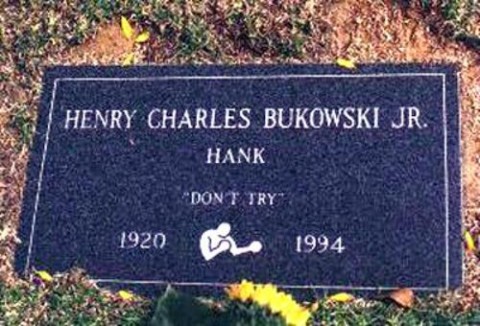
What did Bukowski mean by “Don’t try”? According to a couple of letters he wrote, portions of which are cited in this Open Culture article, the philosophy boils down to:
Waiting. “You don’t try. That’s very important: ‘not’ to try, either for Cadillacs, creation or immortality. You wait, and if nothing happens, you wait some more.”
Not striving. “We work too hard. We try too hard. Don’t try. Don’t work. It’s there. It’s been looking right at us, aching to kick out of the closed womb. There’s been too much direction. It’s all free, we needn’t be told.”
If movies are your thing, take a clue from the wise Jedi Yoda, who echoes Bukowski in The Empire Strikes Back:
“Do. Or do not. There is no try.”

Coincidentally, this past weekend’s article in Polymathic Being, one of too many Substacks I subscribe to–but one of the few I take the time to read, at least a little bit, every week–was all about not trying. Its title: “Just Stop Trying.”
The authors, Michael Woudenberg and Chris Guest, are cerebral types who explore these topics not through the vein of pop culture or even literature, but usually through validated research. So it is with this article, in which they expound on something called “The Law of Reversed Effort,” which can be summarized as follows:
The harder we try with the conscious will to do something, the less we shall succeed.
“The Law of Reversed Effort is about as counterintuitive as you can find,” they write, “but also deeply rooted in philosophical traditions from around the world.”
The hard part, like any good philosophy, is to apply it to our lives. The best approach is to take a tactical pause, recognize that intentional non-action can be a helpful tool, and identify where your effort isn’t working.
The next step is ‘simple:’ stop putting effort there and see what happens next. Sometimes you find that what you thought would fall apart doesn’t. Sometimes it will fall apart, and you realize the consequences you imagined didn’t happen. Sometimes you realize you do need to keep making an effort, for now, until you find a better way. Just Stop Trying is permission to take the first steps in ensuring your effort is investigated, impactful, and intentional.
Does this mean that we, as writers, should just give up? Should we not try to write our stories, our poems, our novels. Should we stop submitting to journal and magazines in hopes that our work will catch the attention of some editor, eventually?
Not at all.
What I get from all this is that we should not care so much about the wrong things. I touched on this in my recent writer’s declaration of independence, where I vowed to myself I’d be independent of chasing after the fleeting acclaim that comes from getting published in the “right” journals, or of writing to conform to the ever-shifting market trends, and so on.
So, let’s agree to not try, and just do.
Top image via Pexels.

 Andrew Careaga
This is a great blog post–thank you!
I loved how you wove so many things together. I’m a fan of The Subtle Are of Not Giving a F*ck as it’s a compilation of so many other psychological concepts. I recommend it as a starting point to a lot of people. I also enjoyed how you tied that into writing. I’m kicking my own butt for not kicking off my next book but…