
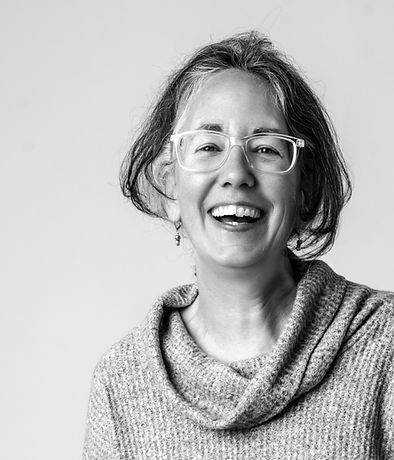
On her website, Emily Rinkema introduces herself as a “writer of short things.” But if the cliche “good things come in small packages” applies to the craft of flash and micro fiction, Emily’s work exemplifies it.
Take this gut punch of a first paragraph from “Amy’s Mom,” which took third-place honors in Frazzled Lit‘s 2025 short story contest:
After Amy’s mom drops dead, like literally drops right in her driveway, groceries spilled all around her, we sit in my basement and get high and plan what to do if ours do too. Meaning our moms. Meaning if they just drop dead.
Emily Rinkema, “Amy’s Mom”
When writers and writing instructors talk about “hooks“–those techniques that draw the reader in and make them want to keep reading–we’re talking about opening paragraphs like that one. And that is not atypical of Emily’s stories. She knows how to hook a reader and pull them into a good yarn.
Emily is a Vermont-based writer and educator whose short fiction has been featured in numerous venues and included in several anthologies, including the 2019 Best American Nonrequired Reading anthology and the Bath Flash and Oxford Flash anthologies. In 2024, she won the Cambridge Prize for her short story “Next Exit” and the Lascaux Prize for flash fiction for her story “Five Things.” In addition, her story “Driving my Seven-Year-Old Nephew to Visit His Mother at Rehab” earned second place in the Bath Flash Fiction Award. Her recent work has appeared in X-R-A-Y, Variant Lit, Flash Frog, and Mudroom Magazine. Read on to learn how Emily has advanced from writing about extraterrestrial burnt burned rabbits to consistently award-winning fiction.
1. On your website, you say you first became interested in writing at age 11. What inspired you to take up writing at such a young age, and who or what has inspired you along your journey?
My first story at 11 was a bit of a nightmare, actually. I spent days on it…way more time than the assignment called for, and was so proud of what I created. It was a story about an alien species of “burnt rabbits” that came to Earth because their planet had been destroyed (in a fire, of course). There was lots of death and destruction and grief and violence. I was so proud of it. I even illustrated it. When I got it back from the teacher, she had written all over it in red pen (so cliche). Not a single positive comment, or any comment, actually, she just crossed out every “burnt” and wrote about it “burned.” And I had used the word “burnt” probably a hundred times…and she crossed out every single one of them, which, you’ve got to hand it to her, took some focus. But clearly, the deep, not-so-subtle meaning of my story had been missed by my primary audience.
2. Congratulations on your recent third-place finish in Frazzled Lit‘s short story contest for your flash fiction piece, “Amy’s Mom.” How did you come up with the idea for this short story, and how much time did it take for you to complete this, from first draft to submission? What steps were involved?
Thanks! I’m really proud of that story. I came up with the first sentence while out walking, which is pretty common for me, and by the time I got back home, I had a rough idea of the characters and the situation they were in. It’s a really voice-driven story, so the first draft unfolded pretty quickly as I got into the narrator’s head. I was in SmokeLong Fitness at the time (which is the best thing that has ever happened to my writing!), so I was able to get a really rough first draft in front of readers pretty quickly, which is always helpful because it highlights potential challenges before I get too invested in a draft. After that, I revised and continued to return to it each week with fresher eyes. In the earlier drafts, my narrator was the only fleshed out character, so each time I returned to the story I tried to focus on a different character, on imagining their lives outside of this story to make sure what they did and how they acted in the story made sense and felt real. It did take me a bit to figure out what the story was really about, and once that clicked into place, I went back and made shifts so that the whole story moved more cohesively towards the ending. Overall, this one was a pretty quick process from first draft to submission–about two months–which is not always the case!
3. Why are you more interested in writing flash fiction as opposed to other forms of fiction, such as traditional-length short stories or the novel?
I love everything about flash fiction, as a reader and as a writer. As a reader, the length allows me to really take my time with the reading and to go back in when I’m done and re-read. I can savor the author’s style and so quickly dive in and explore how they did what they did. Since I’ve started reading flash, I’ve found myself reading so much more often because I have the time to commit. I usually read a few stories over coffee in the morning, and when I have a few minutes of downtime, I go to my favorite flash journals rather than scrolling through news or reels on my phone. It’s much harder to commit to a full-length short story or novel if I only have a short amount of time (I still read those, but only when I know I have long chunks of time). I also love how flash lets me try new voices or styles or genres as a reader in a super safe way. It’s like going to a restaurant and ordering tapas–you get to taste lots of stuff without committing to a single dish. And when I find a bite I like, I can go find that author’s work elsewhere or read more from that particular journal.
As a writer, I think it’s similar. Flash allows me to fully commit to a story or a character or an idea without getting lost in something too big. I often have multiple stories going at a time and can bounce from one to another. I also love the ability to focus on craft with flash, to play at the word level and the narrative level at the same time. So much of flash is about what’s not on the page, and that’s really fun to try to get just right–the balance between too much and not enough.
Maybe most importantly, I have fallen in love with the flash community. These writers are some of the most talented, funniest, kindest, supportive people I know. We all raise each other up and commiserate over rejections and push each other to keep getting better. I have not met a single one of this community in person (yet!), but I feel like they are real friends.
4. Where do the ideas for your stories come from? How much, if any, comes from personal experience?
Well, spoiler alert: most of my stories have dead mothers, and it doesn’t take years of therapy to realize that I’m likely trying to work through the death of my own mother when I was 15. For a while, early in my writing life, my stories just didn’t have mothers, which was a rather conspicuous absence. Now that I’m older and wiser and way more self-aware, I often have mothers in my stories, though I tend to kill them off at a disproportionate rate.
There’s always a seed of personal experience in my stories, whether an emotion or a character or a thought, which I think is universal, but I find it pretty easy to get out of my own life. I have been writing a lot about parenting lately, even though I am not a parent. I think there’s a freedom in writing characters who are parents when you’re not one because there’s no worry that one of your kids is going to read what you write and be upset!
5. What advice would you offer to aspiring writers of flash fiction to help them find their voice and better craft concise yet powerful prose?
My first advice would be to read. Find online journals that you love and go to them every day and read. There are so many wonderful sites and so much incredible flash fiction out there right now, and committing to reading at least a few stories a day (more if you have time) is such a great way to learn the craft and find what you love about the genre. You’ll quickly find the journals or sites that speak to you and your style, but I also encourage people to read outside their own styles. For example, I’m not a speculative writer, but reading speculative flash helps me push the edges of my own writing.
My second piece of advice would be to find a community of writers, in person or online (I am a huge introvert, so I prefer online). It’s so easy to isolate, and having a team to share challenges and successes with has been more rewarding than I imagined. Over time I have built relationships with other writers who give me brutally honest feedback, who make me laugh, and who can give me advice, and offering those same things in return has not only made me a better writer, but a better person (cue cheesy music).
My last piece of advice is to have fun. Ben & Jerry’s Ice Cream has a motto, “If it’s not fun, why do it?” While this is crap life advice, I think it’s pretty good long-term flash writing advice. There are times when it all sucks and I think I’m a fraud and I wish I could un-submit everything I’ve ever written, but these are usually short-lived. Overall, I have so much fun with the entire process, from coming up with ideas to writing drafts to getting feedback to revising to submitting. I get excited to check my email in the mornings because maybe there’s an acceptance! And most times there’s nothing or there’s a rejection, but every once in a while there’s that magic email subject line “re: your submission” and the tiniest bit of the email is visible and you see that “congratulations” or the personal opening that leans towards it being an acceptance…or at least a tiered rejection, and it’s just such a high, to think someone read your story and liked it enough to share it with their readers. And then the even more magical moment when some stranger online reads your story and takes the time to let you know they loved it. Yes, sure, it reeks of my inner adolescent needing external validation, but who cares! It’s so much fun.
Follow Emily on X/Twitter at @emilyrinkema, Instagram at @emilyrinkema, and BlueSky at @emilyrinkema.bsky.social.

 Andrew Careaga
Thank you for another great Friday Five!