
Content warning: interview contains language some readers may find offensive.
“There’s a specific kind of masochism in picking an industry built on rejection,” says Viv, one of the main characters in Kirsti MacKenzie‘s debut novel Better to Beg (Sweet Trash Press, November 2025). It sounds like something a writer might say as they hope against hope that their works will be picked up by literary magazines or agents in their quest for a bit of fame, if not fortune.
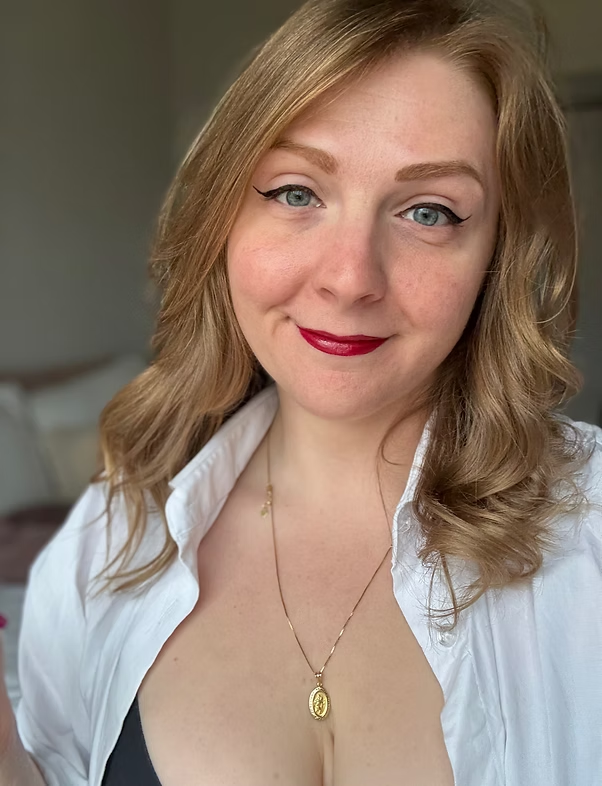
Viv and her partner in music, the British expat Hux, are also on a quest for fame. The two form the fictional indie band The Deserters, and they are riding the crest of underground popularity, thanks to music bloggers and file-sharing services. They embark on a cross-country rock’n’roll/road trip fueled by enough dope to make Hunter S. Thompson consider rehab. Learn more about the novel and Kirsti in this excellent interview on X-R-A-Y Literary Magazine.
A writer from northern Ontario, Kirsti also creates superb short fiction (see this page for four years’ worth of stories) and is the founder and editor of Major 7th Magazine, a literary mixtape composed of short pieces related to specific songs. Read on for more about that litmag, Kirsti’s debut novel, and her thoughts on writing.
1. You’ve had great success writing short works of fiction these past few years. Why did you decide to write a novel—and in particular, why this novel?
I actually wrote Better to Beg prior to publishing online, after about five years of trying to publish short fiction in a traditional way (print magazines, snail mail). I wrote it, quite honestly, to see if I could. That tiny thing in you that says okay, let’s fuck around. This is kind of embarrassing, but I started the first draft as just a series of scenes and impressions built on a card deck of prompts. Two characters started to pop out, loosely based on my favourite band. By the time I was done with that draft, I had a better idea of what I wanted the novel to be and I threw the first draft out, all but one scene. I was very interested in the dynamic between these two people, in exploring their energy and interiority, so I ran with it. By the time I was publishing with these online lit mags and blogs I was sitting on a manuscript.
2. What were some (two or three) of the biggest challenges you faced in making the switch from writing short fiction to writing a novel?
The biggest challenge was learning how to structure the novel in a coherent way. When structure is done correctly, it feels like a light touch. It’s the thing that keeps the story moving, keeps it from losing momentum. People have been telling and hearing stories their whole lives. They may not know exactly how or why, but they know when a story grows boring. They know the exact minute they lose interest. So it was important to me to learn story beats, to learn how to structure the acts, to have a well-defined entry point, midpoint, climax, etc.—as a courtesy to the reader, whose attention is precious and hard-won. If you are asking someone to spend time with your work, you’d better make it worth it.
That’s not to say you can’t fuck with structure; people smarter than I am do it well. But I’m a firm believer that you have to learn structure, to respect it, before you fuck with it. Innovating within structure is the great genius pop artists have in common. To take a formula and make it fresh. Short fiction is a bit different in that it can meander a bit, that it can be a bit playful with form and the structure can be a bit loose. Longer forms tend to demand more coherence and flow, even in experimental or stream-of-consciousness works. There still has to be an organizing principle.
I don’t know that this was a challenge per se, but novels need a great deal of immersion. Years of your life to write, to revise, to edit, to make it even passably good. Years still to get it into a reader’s hands, if ever. You have to have a deep, abiding love—obsession, even—with the story, with seeing it through. I loved the process of writing a novel. It felt like untangling a giant knot, pulling on all the strands to see where they lead. But I remember the last days of the draft were charged and draining, because my brain was so wholly dedicated to sorting out the puzzle. I lost a lot of sleep, but I felt very alive.
I was very lucky to have a partner that understood; he was doing his medical residency at the time. He would sometimes say to me, “sorry that I’m not a person right now,” because his training demanded so much of his presence and mental energy. I remember turning to him at the end of the draft and saying, “sorry that I’m not a person right now,” and he understood completely.
3. You are remarkably skilled at infusing a unique style and tone—a sense of voice—in the dual narrators of Better to Beg and in your short fiction. For writers who (like me) sometimes struggle with developing that narrative voice, what advice can you offer?
This is a hard one to provide advice, but I’ll do my best. I’m lucky in that voice comes very naturally to me. It just comes out whether I want it to or not. That is not to say it can’t be developed, but it is one of those things people seem to have sharply, or not. I think that depends on a few things. If they are gifted oral storytellers, if they are willing to clown a bit to keep people’s attention, they likely have a strong voice. If they are very attuned to the storytelling around them—accents, regionalisms, dialogue, slang, anecdotes in their households, bars, parties, airports, workplaces, coffeeshops—they likely have a strong voice. It also depends on the degree to which they let it out. Don’t get hamstrung by being formal on the page. Tell it like you would to a friend.
My very favourite writers are voice-driven; I studied their work more keenly because they drew me in right away, because I felt as though they were speaking to me. Distance gets bridged between reader and narrator when it feels as though they are “hearing” the voice. I distinctly remember work by Irvine Welsh, Marlon James, Lynn Coady, all because of their voices. Strong voice is, to me, a signature. Like hearing a particular singing voice, or a production style, or playing guitar. Only that person could do that thing. You know immediately who it is, based on the phrasing, the tone, the style. It’s a huge compliment when people say they know it’s me on the page, but that only came through years of mimicking and learning from my favourites. Miles Davis said “sometimes it takes a long time to sound like yourself,” and he was right.
4. Tell me a bit about the literary magazine you edit, Major 7th. Where did the idea for creating a literary mixtape come from?
I read a piece on Hazlitt years ago called “Nine Short Essays About Someone Great by LCD Soundsystem”, by Sasha Chapin. What Chapin did so well was write not directly and only about the song, but around it. There are all these bits of detritus attached to the song that are specific only to Chapin’s memory and experience. We all experience music this way, with interiority and specificity and memory. I thought, jeez, I’d read a million of these if I could. So why not start a lit mag dedicated to them? My favourite pieces tend to be the ones where the song or artist isn’t explicitly mentioned. Maybe the song was playing during a key moment—a colonoscopy, a kiss, a subway ride. You don’t write about the song, you write about the memory. It’s implied that the song was playing. Half the fun is imagining it during the moment the piece captures.
5. What two or three writers have most greatly influenced you as a writer? And since music informs much of your writing, what musicians or bands influence you?
Only two or three! My god. Lynn Coady is a big one for me, specifically her collection Hellgoing. Reading her helped develop my voice, gave me permission to chase ‘funny’ on the page, to know that literature could be profound and deeply, hysterically goofy at the same time. Victor Hugo’s Les Misérables made me want to study literature. I remember reading it on the floor of my high school library, in the stacks, like a big nerd. I’d be remiss if I didn’t mention Kyle Seibel—his excellent work was my window into American indie lit, where I met a community that seemed wholly dedicated to having fun with writing. In many ways, I wouldn’t be here talking to you, have published as much, or have met as many wonderful people, if not for Kyle. So I’m very grateful to him.
The Kills are my favourite band, and their ethos and artistry heavily informed the writing of Better to Beg. Keep on Your Mean Side is a perfect album—ragged and messy and simple—and they are so relentlessly themselves. They have never, for one second, seemed preoccupied with fame or success; just making art they’re proud of. Otherwise I am heavily inspired by Tim Bergling, known to most as Avicii. Bergling was this sensitive kid, a genius composer who got eaten up and spit out by fame. He could have churned out mindless club bangers and had a milquetoast career, but he always had an eye to innovating while remaining in conversation with his influences, with genres outside his own. He was fearless and experimental, yet his work always retained his signature sound. One of those pop artists who mastered the form then made it his own. I listen to his sets a lot while writing, because they are impeccably structured. He dealt with a lot of darkness in his short life, but his work was unfailingly optimistic, full of love and hope. That’s the kind of mark I want to leave, I think. If I’m lucky, maybe I will.
BONUS QUESTION: What are a few of your favorite short stories by other writers?
- Glenn Orgias’ “Mrs Beatrix,” published with X-R-A-Y Lit Magazine. One of the best I’ve read in ten years at least. Subject matter isn’t for the faint of heart, but it’s a haymaker of a story and worth the pain (literally).
- Andrew F. Sullivan’s “Wolverine House”, published with Long Con Magazine. Andrew’s work is dark and brutal, and he’s a keen observer—and critic—of masculinity, and all the ways it wounds the men groping for it.
- Lynn Coady’s “Body Condom.” Sadly I can’t find a copy of this online, but it’s one of my very favourite short stories. A deeply funny story about the relationship between a cynical woman and a sweet himbo of a man who’s full of joy despite a brutally sad past. I remember reading it and thinking holy shit, if I ever write anything this good. I keep trying. Maybe one day!
Follow Kirsti MacKenzie on X/Twitter at @KeersteeMack.

 Andrew Careaga