
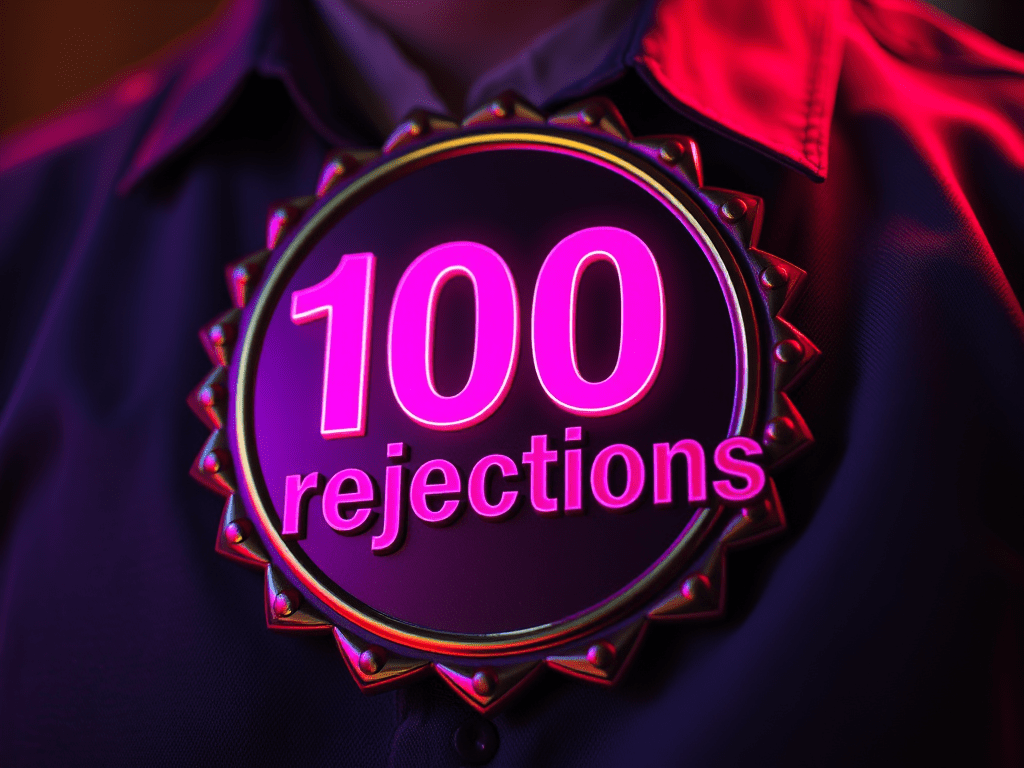
While analyzing my submission and publication activity of this year, I discovered than I am now a member of the 100-rejection club. I’ve actually surpassed that milestone by receiving 101 rejections of my submitted writing in 2025.
Should I be despondent about this high number of rejections? Not at all. In a twisted, perverse sort of way (and aren’t most writers twisted and perverse?), I see it as a badge of honor.
I’m not the only one who sees rejections this way.
In her 2016 LitHub essay “Why You Should Aim for 100 Rejections a Year,” Kim Liao writes:
I see rejection as a conversation: for every piece that is rejected, at least one other person read it, thought about it, and really considered whether it would be a good fit for publication. What’s more, it’s a conversation between two minds that truly love literature, as the financial margins of journals and small presses are slimmer than the sheaf of pages that I carry with me each day to revise before going to my day job.
Liao says she actively aims for rejections rather than acceptances. With that mindset, “I no longer dread submitting,” she writes. “I don’t flinch (much) when I receive inevitable form rejection emails. Instead of tucking my story or essay apologetically into a bottle and desperately casting it out to sea, I launch determined air raids of submission grenades, five or ten at a time. I wait for the rejections, line up my next tier of journals, and submit again.”
While I submit every piece with the hope of acceptance, I take a similar approach. Having worked in public relations for many years, I became accustomed to rejection. I’d pitch press releases and news tips to reporters and editors, and nine times out of ten, they’d say, “Thanks, but no thanks.” That was just the way it worked.
The same holds true in the literary world. There are more opportunities to submit our stuff than ever before, and in the digital realm, it’s easy to do. But, as with traditional media and traditional publishing, the audiences are becoming more segmented, more niche, and less interested in reading for pleasure.
Like Liao–and, I suspect, like many writers–my ego “only wants to be loved and accepted, to have my words ring out from a loudspeaker in Times Square while a neon ticker scrolls the text across a skyscraper.” But it also “resists mustering up the courage to submit writing to literary magazines, pitch articles, and apply for grants, residencies, and fellowships.”
Pitching and submitting, however, “are necessary evils if we are ever to climb out of our safe but hermetic cocoons of isolation and share our writing with the world.”
“Perhaps aiming for rejection, a far more attainable goal, would take some of the sting out of this ego-bruising exercise—which so often feels like an exercise in futility,” Liao writes.
Whether you actively seek out rejections for your work, realize rejection will come. It’s a part of the process. So why not embrace it? Why not wear rejection like a badge of honor?
Image generated by AI.

 Andrew Careaga
Congratulations on hitting your 100th rejection–your productivity and discipline are inspiring!
Thank you!
An interesting approach to aim for rejection. I don’t know that I could ever think of it that way. But planning for the inevitable rejections and responding with a certain number of further submissions seems like something that would work for my mind.
we are if the same mind about this, Nat. I don’t strive for rejections, but I obviously do put a lot of my stuff out there, believing the law of averages will eventually reward me.