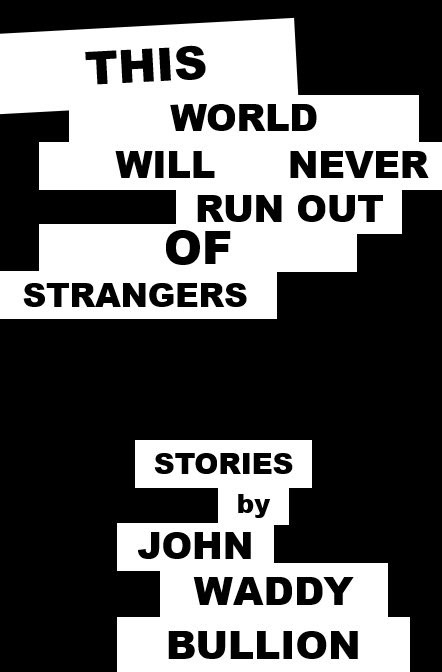
I started reading John Waddy Bullion‘s exceptional short story collection This World Will Never Run Out of Strangers in late December, after I’d already posted my year-end roundup of favorite books. I was only a few stories into this book, which came out from Cowboy Jamboree in November 2025, when I wished I’d either a.) read it sooner so I could’ve included it in my year-end list or b.) waited until I finished reading it to run that post so I could’ve included …Strangers, even if it meant delaying my 2025 list until 2026. It is just that good. To atone for this omission, I reached out to Jack (that’s what he goes by “Jack” in everyday life) and asked to feature him in this, the first Friday Five Q&A of 2026.
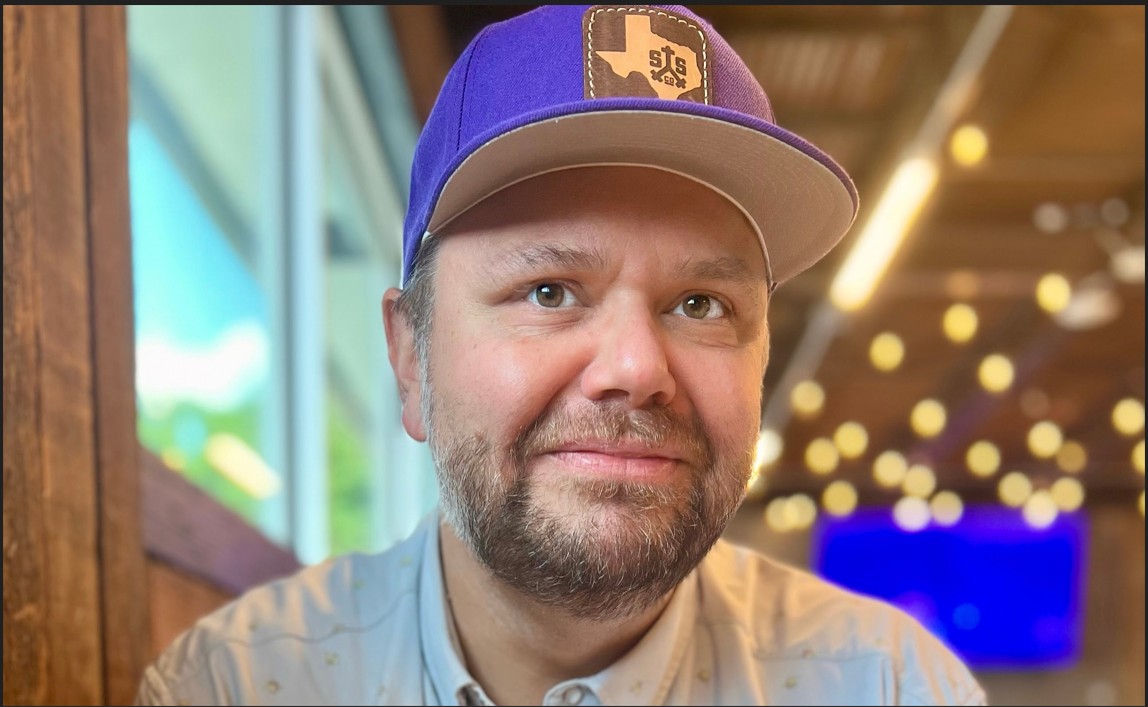
Jack grew up in Columbia, Missouri–the same college town where I learned to commit journalism–then headed to Texas for college (Fort Worth), grad school (San Marcos), and more grad school (Denton). He now lives in Fort Worth with his wife and two daughters. In addition to his debut short story collection, his writing has appeared in BULL, HAD, the Texas Review, Maudlin House, Hunger Mountain, and Vol 1. Brooklyn, among other fine places.
He also cohosts a podcast called Sprawlmaggedon: Tantalizing Texas Towns podcast, where he and some buddies “get together on a completely random basis to rate and review Texas towns.”
1. Tell us briefly about your origin story as a writer. When did you know you wanted to become a writer? Were there any particular influences, or a triggering incident that led you down this path?
I’ve wanted to be a writer for as long as I can remember. Actually, that’s not quite true: I actually wanted to be a football player first. I talked about, read about, and watched football constantly and religiously, from a very early age. Understand that I went to this Montessori school much like the Gaylord character in This World Will Never Run Out of Strangers did. All the grades mixed together, into Older Group and Younger Group. One day my Younger Group teacher asked me what I wanted to be when I grew up. Before I could say anything, a girl at my table piped up and said, He’s just going to say he wants to be a football player. No, I said, all indignant, I don’t want to be a football player. I want to be–and here I just grasped for the first thing that came to mind–a writer. Luckily it became a sort of self-fulfilling prophecy. (I’m still convinced I could be a football player, if I put my mind to it.).
2. Before reading this collection, the title grabbed me. Now I know that it comes from a line in one of the stories (I won’t say which) but I’m curious: Why did you choose that title for this collection? Did you consider other titles?
Oh, we can spoil it—it’s a line from “How to Ask a Stranger to Buy You Beer” (I just won’t reveal where the line appears in the text). Under any other circumstances, that line would’ve been the title of the story, except for the fact it’s written in the form of a “how to” manual and the title has to do the heavy lifting to prepare the reader for that. But I loved that sentence so much—and it had such resonance across the nine stories—that I knew I had to use it for the whole collection.
The received wisdom of naming short story collections is that you’re supposed to give the whole thing the title of one of the stories and then add “…and Other Stories.” I started digging through my personal library to see if I could find any examples of short story collections that veered away from what seemed like a hard and fast rule. I found tons of examples. Jesus’ Son is named after a line from “Heroin” by The Velvet Underground. Hemingway’s In Our Time is lifted from the Collect for Peace in The Book of Common Prayer. More recently in our indie-lit world, Kyle Seibel’s Hey You Assholes is a callback to a line in a story of his that didn’t even end up in the finished product. Your collection title doesn’t have to share a title with one of your pieces, it just has to work. That’s all that matters.
3. In your acknowledgements, you list several writing teachers, including a couple of my favorite writers, Barry Hannah and Tim O’Brien. What two or three writers do you also consider influential–that is, your contemporaries we should be reading regularly–and why?
Barry Hannah and Tim O’Brien exerted less of an influence over me as writers than they did as teachers—I was extraordinarily lucky to have them both as instructors while they served as endowed chairs in Texas State’s creative writing program, which is where I earned my MFA. Barry Hannah’s mantra was “get in, get out, be surgical”—he helped me take strings of set pieces that were pretty but inert pictures and adrenalize them with narrative momentum. Tim O’Brien was a line-level taskmaster, and made me challenge every sentence, every word I put down on the page. Both are amazing writers for sure, but the lessons I learned from them as teachers were even more enduring.
George Singleton was the first writer I encountered who “sounded” like I wanted my writing to sound. Most of Singleton’s stories take place in these flyspeck South Carolina towns and boast dazzlingly eccentric narrators. But his sentences are also incredibly knotty and information-packed, and he niftily balances humor with striking emotional depth. The vibe of a George Singleton story is very much like a literary version of a King of the Hill episode. More people should read George Singleton. His stories “Show and Tell,” “How to Collect Fishing Lures,” and “Richard Petty Accepts National Book Award” all directly influenced several pieces in TWWNROOS.
I’m going to cheat a little on my second answer and list a bunch of talented contemporary writers I consider influential. Just pick any one of these names, search up their written output online, buy their books, and I guarantee it will be time (and money) well spent: Nathan Dragon, Shane Kowalski, Parker Young, Julián Martinez, Kirsti MacKenzie, Kyle Seibel, Mike Nagel, ZH Gill, Jonathan Danielson, Aaron Burch, Jillian Luft, Joshua Hebburn, Emily Costa, DT Robbins, Tom Williams, Jason Bredle, Claire Hopple, Sean Ennis, Glenn Orgias, Daniel Miller, Daren Dean, Justin Carter, Shy Watson, Kevin Grauke, Colin Brightwell, Mark Leidner, Benjamin Drevlow, Kevin Maloney, Sheldon Birnie, Jon Doughboy, Austin Ross, Zachary Schomburg, and many, many more but I’m running out of spa
NOTE: Kirstie MacKenzie, ZH Gill, and Aaron Burch are among the writers featured in previous Friday Five interviews.
4. Several of the stories in this collection are intertwined, featuring common characters (the boy/young man Gaylord, his divorced parents, and maternal grandfather). This approach stylistically reminds me of how Tim O’Brien structured his collection, The Things They Carried. I like that approach, because it gives the reader a chance to see characters at different ages, different stages of development, and sometimes from different perspectives. Have you considered writing a novel in stories with these characters (or others)?
I absolutely considered making this a more fully fleshed-out novel in stories. George Singleton, who I mentioned above, has written most of his novels in this fashion—as linked stories—because it’s easier to market a novel made up of linked stories than it is to market a collection of fiction. So I made outlines, index cards, and tried to block out this larger story. I even wrote a whole novella-length piece that I ended up scrapping. The thing about this style of writing is that it takes a very long time to write. It’s also not very fun. “Fun” has become very important to me when I write—in fact, it might be the most important thing. And frankly it wasn’t very fun to write this way, where everything felt predetermined and drained of all spontaneity. “Two Bibson Geefeaters” was the last story I wrote for this collection. Once I’d finished it, the whole thing felt complete—there was a connective tissue between the stories that were obviously linked and the stories that were disconnected but still occupied the same universe. All that said, perhaps I might return to these characters in future stories; I am never in the habit of saying never.
5. What advice would you offer short-story writers who are interested in compiling their work into a collection?
Ordering a collection—sequencing all that raw material—is surprisingly tricky, so don’t be afraid to ask for some help. Kirsten Reneau was immeasurably helpful in giving me an idea of how this collection could be sequenced. Reach out to writers in your network and see if they might be willing to offer you some insight. Put yourself out there. If you believe in your work, there’s someone out there that will believe in it too.
BONUS QUESTION: What one piece of writing advice would you offer a new writer?
My one piece of advice to new writers is to read. Read widely. Read online mags. Find ones you like and spend a day or two reading not just their new stories but also their archives. Read print journals–believe it or not, you don’t have to shell out hundreds of dollars in subscription fees. And you don’t necessarily have to read them in print, either: your library (public or academic) may have access to academic databases that contain whole collections of these legacy print journals that are treasure troves of both new and old writing. Find stories you admire and copy them down word for word, preferably in longhand. Keep a log of everything you read, and highlight the stuff you like, so you can come back to it later, take it apart and put it back together, to see what makes the thing tick.
Follow John Waddy Bullion on X/Twitter at @JonWaddy and on Instagram at @JohnWaddy.

 Andrew Careaga
The first “Friday Five” of 2026 is fabulous–THANK YOU!