
Radio plays have been around for a century or more, practically since the advent of radio. They thrived during the 1930s, ’40s, and ’50s–an era sometimes called the Golden Age of Radio. In his latest novel, Count the Dust (LEFTOVER Books, December 2025), writer and literary magazine editor Adam Van Winkle taps into that approach to create a distinctive story designed for radio but equally enjoyable as a good read.
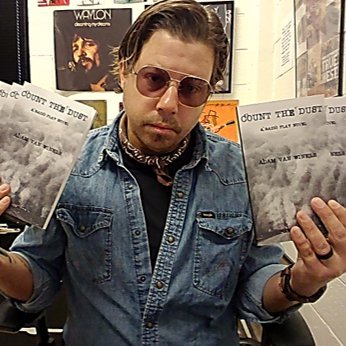
Count the Dust is set in a nameless small town in southern Oklahoma or north Texas. It’s modeled after the place where Adam grew up, Texoma, but, as he writes, it could be any of the “many small Oklahoma and Texas towns I’ve been in and through that center around a filling station on a state highway.” It’s a murder mystery, told over two time periods–1967, the year of the murder, and 1997–as well as a story of “the persistence of offspring in unideal circumstances.”
“These places, like places I grew up in and around, with little money, little resources, drugs, guns, violence, strained marriages and poisonous relationships, they still find a way to produce progeny. People still meet through the circumstance of life, new people still get born.”
To add a further twist: the story was inspired by the notes of a small-town reporter who was investigating the murder but died in a car crash. The narrative is carried by a strong radio script, written in the colloquial voice of the region and interspersed with laconic dialogue from characters with some of the most original names I’ve seen in any novel lately (for instance, there’s Shorty–not so unusual–and his son Squat and grandson Last).
Born and raised in Texoma and named for the oldest Cartwright son on the 1960s TV series Bonanza, Adam now lives with his wife and two sons in South Carolina. He is the founder and editor of Cowboy Jamboree Press and Magazine. In addition to publishing his short fiction, poetry and creative nonfiction online and in print at places like Revolution John, Pithead Chapel, Cheap Pop!, BULL Magazine, The Dead Mule School of Southern Literature, Roi Faineant, The Gorko Gazette and Red Dirt Forum, he has published several novels and plays with Red Dirt Press, Cowboy Jamboree Press, and LEFTOVER Books. His novel Abraham Anyhow was named the June 2017 Read of the Month by The Southern Literary Review, featured in the Monkeybicycle “If My Book…” series and nominated for a Puschart Prize.
Adam also teaches Creative Writing, American Literature, World Literature and Composition at York Technical College in Rock Hill, South Carolina.
Read on to learn more about Adam’s approach to writing Count the Dust, his reasons for establishing a grit lit magazine and book press, and the writers and musicians who influence him.
1 – You took an unusual approach to writing Count the Dust, creating a novel in the form of a radio play. Why did you decide to write it as a radio play instead of taking a more conventional approach?
I’ve written plays before. Dylan Quick is a Dairy Queen Don Quixote was previously published by LEFTOVER Books. It’s mainly Sam Shepard’s fault. First, I love Shepard’s stories–he’s absolutely one of my favorite writers. I find his (and Arthur Miller’s) plays to be very much for the reader. They can and have been staged of course, but some of their character notes and stage directions are almost meant to be read as they represent philosophical reflection. The idea became intriguing for me: write a play to be read. It became a radio play after reading and listening to Terry Allen’s radio plays. He wrote several for American Public Radio in the ’80s and ’90s. It’s hard to imagine a world where a publicly supported radio series paid authors to write radio plays, but it happened. So, again, I thought about it as why not write a radio play to be read? And bonus, wouldn’t it be great if the audio version did get produced?
2 – One of the things I loved most about Count the Dust was the voice. Not only the laconic, colloquial dialogue, but the radio read voiceover sections that move the story forward. That voice stays consistent throughout. How do you manage to capture and create the orality of these voices into the written word?
I appreciate that. And it’s hard to answer. I mean, I teach creative writing and teaching the idea, or getting students to think about “voice” in writing, is one of the toughest parts to get across. A short answer is, I guess it’s the narrative voice I’ve developed over the years. If I think about it more critically, I think it’s everyone real in my past that my fiction has generally been based on pouring through me. I’ve heard those people all my life (even if most of them are only in my head now). Thinking about them that I’ve been so intimate with as a jumping off for writing, I think, creates a more authentic voice.
3 – In 2015, you established Cowboy Jamboree Press to “publish and promote gritty rural and rough hewn stories.” What inspired you to create this publishing house and companion literary journal?
Part of it was naiveté. I knew I was really digging, and trying to model my fiction after Larry Brown and Dorothy Allison and Harry Crews and Bonnie Jo Campbell and Barry Hannah and such (owing as well and always to my two most frequented masters: Larry McMurtry and Sam Shepard). And I thought, there’s not really just a “grit lit” or “rough south” publication out there. My wife, Constance, came up with the idea: Why not make it? She also suggested the name, Cowboy Jamboree, based on an old book of folk songs she’d given me. I thought it was perfect because I dig old country and rural folk and Texas country music and it’s always been an artistic influence for me too. That’s how the online magazine started. I wanted a place that published stories by the next Donald Ray Pollock say.
The press started because I was helping out at another independent press, learning the ropes I guess, and two Cowboy Jamboree authors, Sheldon Lee Compton and Benjamin Drevlow, submitted books to that press during its open submissions period. That press was not putting out many books overall and couldn’t find space for them, so at that point I thought fuck it: I’ve got some publishing cachet (this was 3 or 3.5 years after the magazine had launched), I’ll turn Cowboy Jamboree into a press and publish these guys myself. It’s been a great ride since. And our books get better and better both in terms of returning authors and new ones and in terms of design. It’s nice several have now been finalists for significant awards.
4 – You mention several “grit lit” authors–Harry Crews, Bobbie Ann Mason, Denis Johnson, among others–as influences for the works you like to publish in Cowboy Jamboree Press. What two or three writers have most influenced you in your own writing?
Well, as I’ve already given away, McMurtry and Shepard are my all timers. McMurtry’s hometown isn’t far from where I grew up. His contemporary Texas novels (the Duane Moore series and the Houston series) are just the best novels and at times McMurtry feels like a lost uncle. His Texas characters remind me of people I grew up with, people who tend to populate my stories in one way or another.
Shepard’s plays and stories introduced the idea of magic in a realistic way. Don’t get me wrong, his plays and stories are gritty and true. But he’ll have these moments, where like a field of corn grows overnight or two brothers seem to swap personalities in the middle of a story, that made something more possible in my own literary realism. He’s good at clever leaps. He’s also good at leaving things unsaid or unresolved. I’ve tried to take that to heart as well.
Number three is a tossup and I guess I refuse to commit. Larry Brown and Harry Crews and Terry Allen are all part of that conversation and for different reasons. I guess this is where I say a good writer is a voracious reader, so why limit it?
5 – Music, especially country music, has been a major influence in your creative life, even to the point where you’ve included a soundtrack for Count the Dust. I’m cheating here by asking two questions: a.) How did you come up with the songs for that particular playlist (did you create that simultaneously with your writing, before or after, or in some other fashion?), and b.) In broader terms, what role does music play in your writing (do you listen while writing, for example)?
I do love music.
A.) The soundtrack for Count the Dust came at the request of my publisher, Patrick Trotti (who is doing wonderful work with LEFTOVER Books). The previous play, Dylan Quick is a Dairy Queen Don Quixote, had a jukebox that worked a bit like a Greek chorus, suddenly turning on with a particular country or old rock song that matched the mood of the moment or happenings in that scene and faded out as the scene faded to black. When Patrick asked for a soundtrack to go with the radio play, I thought it would be cool, if this were produced on the radio, to have songs that station might play coming in and out of breaks. This particular list where songs I felt fit the mood, the plot, or a particular character in Count the Dust. I didn’t make it as explicit as Dylan Quick is a Dairy Queen Don Quixote by connecting the songs to specific scenes, I’ve left that a bit more for the reader to imagine. I think if those songs were listened to in that order, it would evoke, I imagine or hope, a similar mood to reading Count the Dust.
B.) I don’t purposefully put on music to write or purposefully turn it off to write. If a record is going on a turntable when inspiration strikes, I’ll let it spin itself out. If the music tab is open on my browser and playing, again, I don’t pause it to write. If no music is playing, I don’t make sure to put it on before I write. However, I do think about music often as I write. I definitely think about what kinds of music and songs my characters would listen to (and this is certainly not always what I listen to). In fact, that’s an exercise I do with creative writing students as part of a character profile: what kind of music does your character listen to? Are they casual fans of it or very intense fans of it? etc.
I also just think that years of listening to Dylan and Merle and Willie and Terry Allen and Guy Clark and Lyle Lovett and Robert Earl Keen and Joe Ely and Iris DeMent and Townes and Hank and Patsy and EmmyLou lyrics must have infiltrated my writing style, and voice, the way the authors I’ve mentioned herein have.
*
Find Adam Van Winkle and his publications online at www.adamvanwinkle.com and on social media at @gritvanwinkle.

 Andrew Careaga