
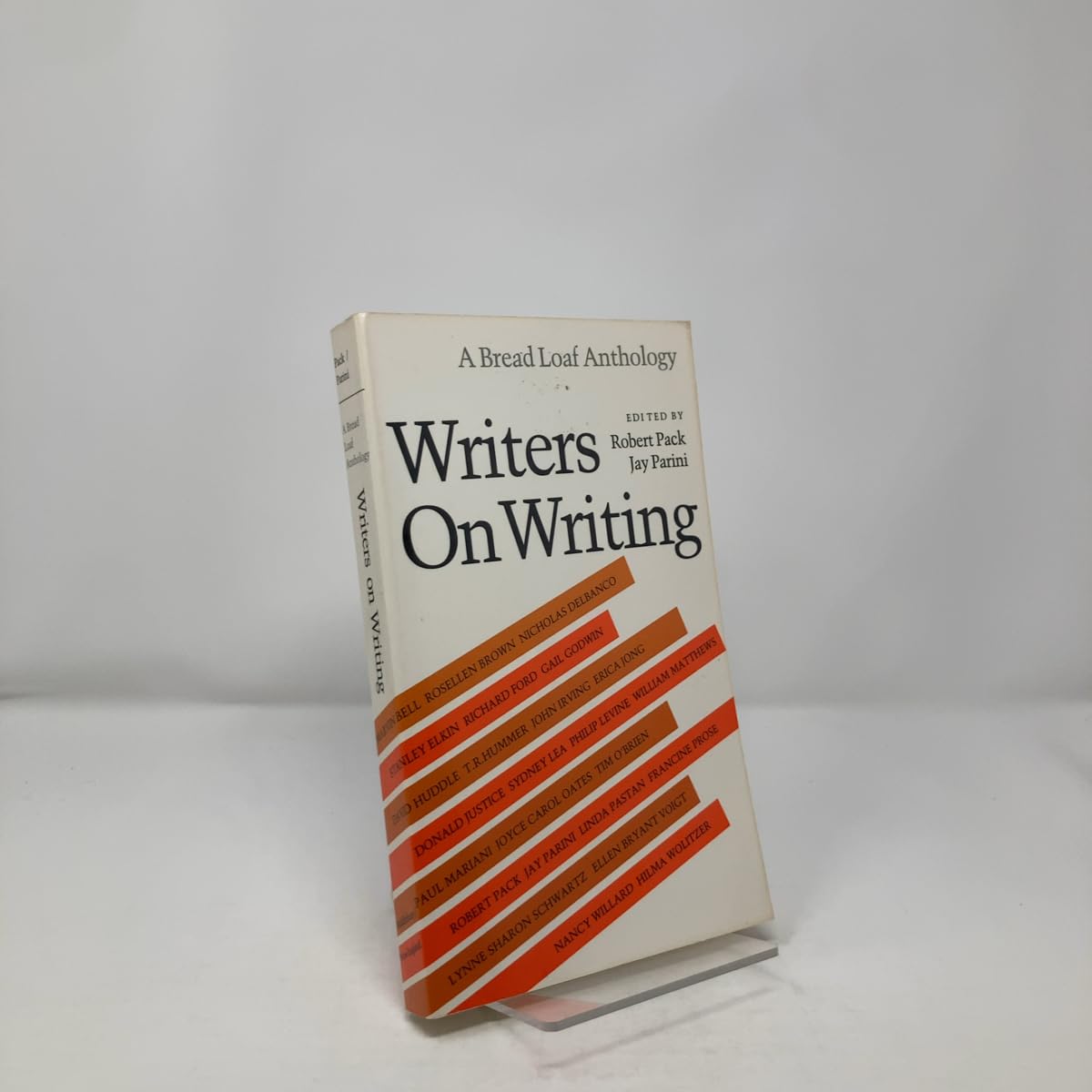
It was a cool winter’s day and I was on a minor dusting spree when I discovered tucked away in a far corner of my bookcase a paperback called Writers on Writing: A Bread Loaf Anthology. Published in 1991 by Middlebury College Press and edited by a couple of Middlebury English professors, Robert Pack and Jay Parini (neither of whom I’d heard of), the list of authors displayed on the cover piqued my interest. There, presented on a slant, a graphic treatment no doubt trendy in the late ’80s and early ’90s, was an all-star cast of writers I recognized–Stanley Elkin, Richard Ford, John Irvin, Erica Jong, Joyce Carol Oates, Tim O’Brien–along with many names I didn’t. Holding the book in my non-dusting hand, I studied the cover and concluded I must have purchased it at some long ago library book sale, then tucked it away for safekeeping. (I’m always a sucker for books about the writing craft, and buy any I find, especially if they’re cheap.)
I set aside the dust rag and began reading. Dusting would have to wait.
What a treat and a treasure this book is, even nearly 40 years after publication. For several weeks, I read and re-read 90 percent of its essays with highlighter in hand. (There were a couple of essays I tried to read but just couldn’t get into. But what I gleaned from the ones I read more than make up for what I might have missed in those I passed by.) The lessons and reminders I gleaned from this book hold up well today.
Here are five highlights from Writers on Writing that affected me most deeply:
1. On simile and metaphor
Simile and metaphor are two of the most useful tools on a writer’s toolbelt, and I like to think I know how to handle them. But I haven’t thought so deeply about them in a while. That all changed with the opening essay, “Three Propositions: Hooey, Dewey, and Loony,” by Marvin Bell (1937-2020), Iowa’s first poet laureate who was teaching at the University of Iowa at the time. His essay is not about simile or metaphor, but about “turning from our reasonable, pragmatic selves long enough to idle our way into the imagination.” Poet that he was, his essay probably appeals mainly to other poets. But he offers up a phrase–“Make the like unlike and the unlike like”–that should benefit any writer of prose. What more is simile than that?
Seventy-six pages later, I discovered “Against Metaphor,” an essay by another poet, T.R. Hummer, who was at the time editor of The New England Review and on the faculty at Middlebury. I could write an entire essay about Hummer’s chapter, but a key takeaway for me–as both a writer and a reader–is his warning that we understand how powerful and dangerous metaphor can be. “It requires a vigilant mind, sometimes, to be aware of the differences among metaphors, lies, and statements of fact,” he writes, adding: “Another danger of metaphor is that it may allow or even encourage us to forget literal truths.” An important thing to keep in mind in our era of disinformation.
2. On keeping a journal (or diary)
I’ve written here before about how journaling is an important part of my writing routine. Two contributors to Writers on Writing, the celebrated authors Gail Godwin and Joyce Carol Oates, offer glimpses into their journaling practices. In “A Diarist on Diarists,” Godwin’s description of why she keeps a diary resonates with me.
“I need to write a diary, just as I need to write fiction, but the two needs come from very different sources. I write fiction because I need to organize the clutter of too many details into some meaning, because I enjoy turning something promising into something marvelous; I keep a diary because it keeps my mind fresh and open. Once the details of being me are safely stored away every night, I can get on with what isn’t just me. … I had to keep a diary for many years before I could begin writing fiction.”
– Gail Godwin
In her essay, “Excerpts from a Journal,” Oates offers snippets from some July 1989 journal entries. Most are ideas about writing. A couple I’ve highlighted: “art is not an escape from experience, still less from reality: it is experience, it is reality, in its own inviolable terms.” And, “Why write? To read what I’ve written. Why read what you’ve written? Because, for all its possible flaws and omissions, no one else could have written it.” More from Oates below.
3. On rhythm, voice, and beat
Joyce writes, in one of her journal entries: “… What we love in those writers we love, and in those works of our own we love, or are still mesmerized by, is of course rarely content/subject matter but voice. Voice/rhythm/pulse/beat. The indefinable/unmistakable beat.” And rhythm, voice, and beat, of course, are among the many virtues of Oates’s writing.
In “Beginnings,” poet Paul Mariani writes not about how to start a poem or short story–what I assumed the essay would focus on–but about his own origins as a poet and the critical role listening to rhythm and beat plays in his writing process.
“That it would take a lifetime of listening to the play of the wind through the shagged pines, the arrhythmia of one’s self breathing, and the phrasal modulations that constitute another’s unique voiceprint, as well as attending to the shifts and jagged countershifts present in all sorts of music, from country to Buddy Holly to Bessie Smith to Mozart and Debussy and back to Charlie Bird Parker, as well as Catullus and Virgil, Dante and Chaucer, Keats and Whitman, Williams and Berryman and Lowell, could not then have occurred to me. In the beginning, I could only hear and register the percussive strokes of the snare and marching drum, or the tic-tic-tic of an engine’s valves and pistons, both as sharp and as defined as all ethical and moral issues then seemed to me, as they seemed to repeat their anapestic and comforting imperatives of ‘thou shalt, thou shalt not.'”
– Paul Mariani
Oates again: “… Why the universe, why the biological world, should be so governed by rhythm, by pulsations, by beat: what a mystery. Thus the powerful appeal of poetry and music.”
4. On knowing the story
I can’t say I agree with all of John Irving‘s advice in his essay, “Getting Started,” but who am I to argue with John Irving? The guy’s written nineteen novels, including one that just came out last fall (Queen Esther). He gets right to the point in this essay with some practical advice: “Know the story–as much of the story as you can possibly know, if not the whole story–before you commit yourself to the first paragraph.”
When it comes to plotters versus pantsers, Irving’s approach falls squarely on the side of the plotters. (I’m more of a pantser myself. But again, not in the same league as John Irving.) But he doesn’t dismiss pantsers completely. “… to begin a novel without an ending fixed in your mind’s eye, you must be very clever, and so full of confidence in the voice that tells the story that the story itself hardly matters.”
Regardless of approach, a writer should “be humble,” Irving writes. Also: “Don’t be enthralled by the sound of your own voice; write with a purpose; have a plan. Know the story, then begin the story. Here endeth the lesson.”
5. On learning from Chekhov
What a wonderful, pitch-perfect essay the aptly named novelist/essayist/short story writer Francine Prose offers us in “Learning from Chekhov.” In this piece, she discusses the Russian master Anton Chekhov’s minimalist approach to writing descriptions–how, in his own words, “a true description of Nature should be very brief and have the character of relevance”–and how crucial it is for a writer to be, in his words, “an unbiased observer.”
Related to that is “this matter he keeps alluding to in his letters: the necessity of writing without judgment,” Prose writes. She appreciates Chekhov’s great restraint, as do I (as did Hemingway and Steinbeck and so many others who wrote with that journalistic perspective). What sticks with me most from Prose’s essay, as a writer who sometimes (okay, much of the time) struggles to neatly resolve a story, is that, in Prose’s summation, “lives go on without change, so why should fiction insist that major reverses should always–conveniently–occur?” Yes! Sometimes a story doesn’t resolve.
Now, let’s give Chekhov the last word: “It is time for writers to admit that nothing in this world makes sense. Only fools and charlatans think they know and understand everything.”
~~~~~
Thus endeth the blog post.
Although there’s so much more I could write about the lessons this concise (under 300-page) craft book offers a writer, I think it’s best to end here and recommend you pick your own copy. It’s available online (linked above to Thrift Books but also on Amazon and eBay, where I grabbed the above photo). Who knows? Maybe you’ll find a decent copy at the next library book sale you go to. Keep your eyes peeled.

 Andrew Careaga