Content warning: strong language.
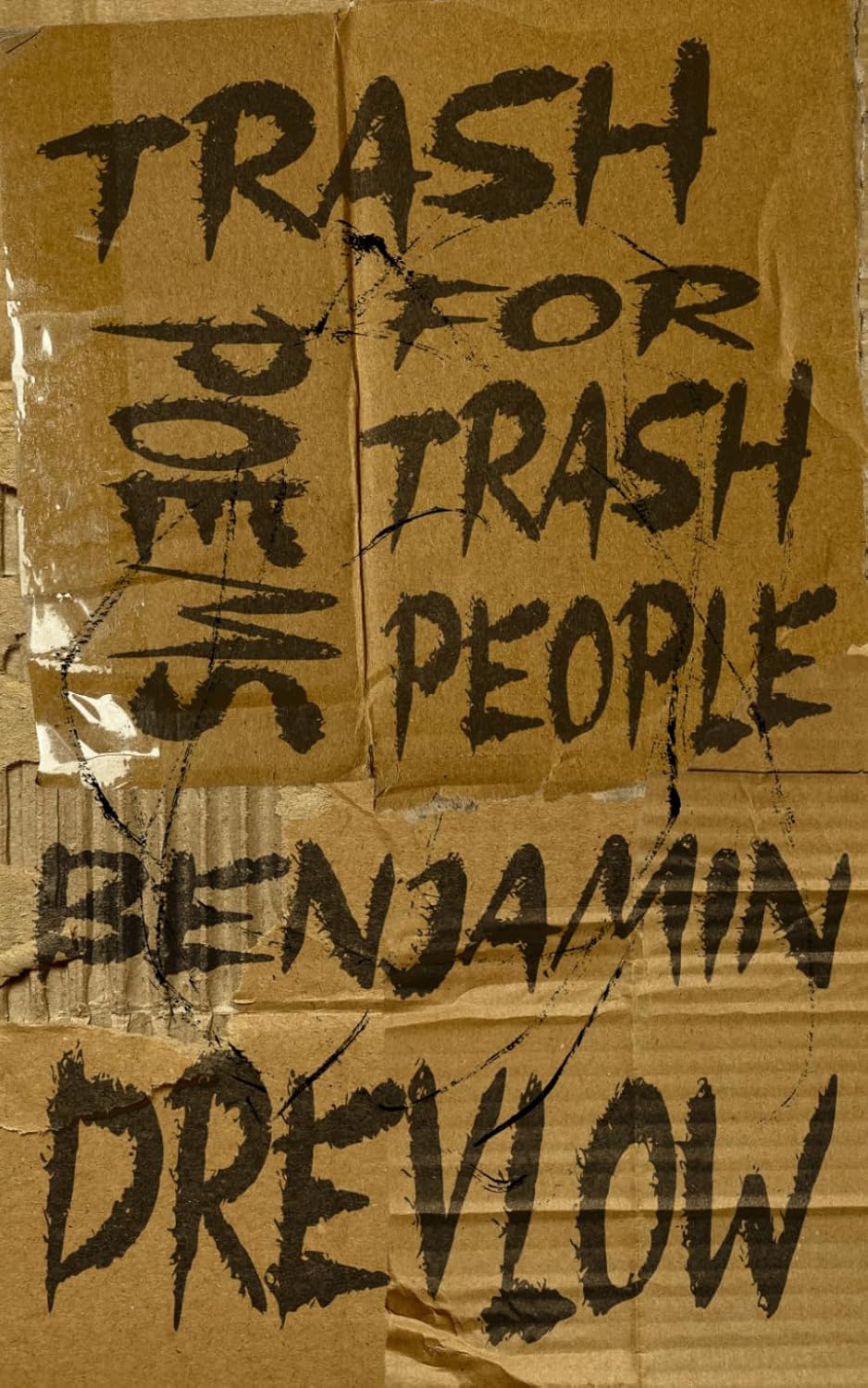
Reading Benjamin Drevlow‘s new collection of poems/pomes, Trash Poems for Trash People, put me in remembrance of my grandfather who, on walks home from his job at the shoe factory, had a habit of picking up items others left on the curb and bringing them home, thinking he might somehow find a use for them. The idiom “One man’s trash is another man’s treasure” also sprang to mind as I read through this collection. That phrase aligns with the opening words of this volume’s epitaph:
Trash only becomes trash if you throw it away
Let it grow and clutter and climb and spread wings and fly.
Suddenly it becomes the hot new home decor.
Like some weird sort of alchemist, Drevlow, who is also the editor-in-chief of a great literary magazine called BULL and the author of several other books, turns trash into treasure with the poems in this collection. At least I think it’s treasure. Does that make me one of the trash people? If the old, discarded boot someone tossed at a dumpster and missed fits this misfit…
Read on to learn more about his reasons for writing this book, his work at BULL, his influences, his teaching gig at Georgia Southern University, and more.
1. – What inspired or motivated you to write Trash Poems for Trash People?
When Covid really closed everything down, I was at a weird place. The shutdown had given me the final motivation to finish The Book of Rusty, an autobiographical novel about my childhood which had taken me 18 years and had at one time ballooned to 1,300 pages before I finally cut it down to 375.
I wasn’t exactly keen on starting another 18-year epic. I was also tired of writing about my family and childhood, which was what Rusty was all about.
I’d always loved poetry but I was no good at it. Then I found the writer Sam Pink. I read his book 99 Poems and then his other book The Early Stuff and though I knew I couldn’t write like him, he at least gave me the inspiration that I could write some shorty stuff that didn’t really look or sound like poetry and still call it poetry anyway like a fuck you to everybody who thought poetry had to be just this one thing with line breaks and big metaphors and shit. I could just write these little anecdotes and random collection of stream-of-conscious weirdo rants that I decided I’d just call pomes. With pomes meaning not-yo-mama’s poems.
That and I actually thrived during Covid. It turns out when you’re an introvert and a homebody, the social isolation thing just gave me more time to write and walk my dogs, and while I’d walk my dogs at three in the morning (because when you have three dogs, that’s when they wake you up), I’d have a lot of interesting conversations with the types of people who are up at three in the morning all while listening to audio books about serial killers.
As depressing as Trash Poems might come off, it was actually me writing from a pretty good place in my life–probably the best I’d felt in a long long time. Which then gave me the perspective to write really depressing poems as jokes-–at my own expense. Hence Trash Poems for Trash People (and Trash Dogs).
Of course as people are now reading it and talking about it, I’ve realized just how depressing it is, but to me all the depressing parts are actually pretty hilarious. But then that’s been my problem as a writer–-I find it very funny to make fun of how depressing I am. Even if other people don’t see it that way. Which is also part of the joke on me–-laughing at my own depressing jokes, while other people stare at me blankly.
2. – Beyond the obvious unifying theme of “trash” or “trashiness,” these poems all connect almost like a series of short stories or vignettes, told from the point of view of a single narrator. How autobiographical is this collection? For instance, do you have three dogs (a rotty, a pitbull, and one other that I don’t believe is mentioned by breed in the collection)?
Yeah, it’s pretty heavily autobiographical. The dogs (the last one being a chocolate lab and Boykin spaniel mix which was too complicated to put in the book… update we now have a fourth dog that someone abandoned at the park in the middle of the night in the snow, so now we are complete crazy dog people and have earned your skepticism).
The main thing that’s fictional is that as opposed to the book, my wife and I are still happily married (and bless her heart, she gave me permission to write about her having divorced me), which I did because this book is in many ways a sequel to my book Ina-Baby, which is a collection of connected stories about my wife leaving me (which again, bless my wife’s heart, she gave me permission to do that). This is because almost all of my writing is based on my anxiety brain-–me thinking oh my god all these bad things are gonna happen to me because I’m a bad person who has these bad thoughts about things like my wife leaving me because I deserve to be left.
As for the narrative part, that was my way in to writing pomes. I never really had the confidence at first that any of my pomes could stand on their own, that they were never good enough to be read as “poems.” Eventually, I just gave myself the permission that maybe none of the pomes by themselves would be worth anything but maybe all of them together would be something.
That and during Covid, I just started writing a pome a day. Some of them were just two lines. Some of them were three pages, but I’d decided to write for like twenty or thirty minutes a day and whatever popped in my head, I’d go with it, no matter how shitty it might be.
I wasn’t necessarily trying to write a larger narrative and the pomes in the book did not come out in any order-–just randomly–-but it turns out if you’re not very creative and you write every day, you end up with a lot of connected pomes about walking dogs because that’s all you do.
And then you call them “trash pomes for trash people” and how that people will be in on the joke and not take them too seriously, but at the same time, appreciate shitty poetry.
3. – Tell me a bit about your role as editor-in-chief of BULL. (No need to repeat what is posted on BULL‘s About page, but you can summarize salient points if you wish.) How long have you been EIC? What advice do you have for writers who want to see their work in your lit mag?
BULL is basically a place for fucked up people to tell fucked up stories about fucked up masculinity. The main thing is simply that I wanted to be a place to publish writing that is ugly and complicated that wouldn’t get published by a lot of other places. I wanted to be like an AA meeting as literary magazine. Everybody has a fucked up story and I want all those people to be able to tell their story and read other people’s stories, rather than getting caught up in men versus women and white versus black and straight versus gay, etc., I just wanted BULL to be a place where everybody could share and other people would be like, Fuck masculinity is fucked up, but it’s also complicated and hard to break free from-–for everybody.
The only rule: no preaching. No propaganda. No easy answers. No black and white–-all shades of gray. Because if it was so simple as to just dismiss everything to do with masculinity, we would’ve solved this shit a long time ago.
That and for people to see how absurdly funny toxic masculinity is. So we can all laugh and be like, yeah, that’s fucking crazy but it’s true.
That and sentences. I’m a sentence nerd. If you can give me kooky sentences from start to finish, I’m a sucker.
I’ve been running BULL since 2016. It was founded in 2009 by Jarrett Haley.
4. – Who are the two or three writers who have most influenced your writing journey, and how have they done that?
Tim O’Brien’s The Things They Carried is the first book where I thought: Oh shit, I can actually try to use stories to try to salvage something out of all my fuckups. There’s somebody else out there who understands how weird and complicated and fucked up masculinity is and is trying to find meaning through stories. “How to Tell a True War Story” is the single most important piece of writing I’ve ever read. It’s mostly my bible for why art matters but also why art doesn’t necessarily save you from your bullshit.
Thom Jones’s The Pugilist at Rest is the second most important thing I’ve read. Both the book and the story. I didn’t know you could write like sentences like that-–like you talk, like the people I know talked.
“Hey Baby got caught writing a letter to his girl when he was supposed to be taking notes on specs on the M-14 rifle. … Hey Baby paid for the letter by doing a hundred squat thrusts on the concrete floor of the squad bay, but the main prize he won that night was that he became forever known as Hey Baby.”
– Thom Jones, The Pugilist at Rest
To make it clear, I’ve never been in the military, but in military stories there was an excuse to write the way the men I knew growing up really talked–-all the ugliness but also all the poetry of it and all the humor of it.
Larry Brown was kind of the same thing. I read Big Bad Love and it wasn’t anything to do with military, it was the same thing–guys talking like the people I knew talked, having grown up around farmers. So much of my early writing was an ode to the farmers I knew from my dad and brothers hanging out with them. In a lot of ways, my earliest writing was trying to find a way to write stories that these farmer guys who never read–or at least never read fiction–would actually maybe get into–or at least see themselves in and see the humor of it.
The grit lit of Larry Brown, even though it was the south, felt so true to the rural like I grew up with that it gave me an excuse to write about all the weird farm shit I’d been around growing up.
And then Sam Pink which I’ve already mentioned. He kind of gave me the wrongheaded belief that I could write poetry. I could write poetry that wasn’t really poetry–at least to poet snobs. To be clear, I’m no Sam Pink. If anything, my writing is a bad rip off of Sam Pink, but it’s kind of like me teaching myself to play the guitar. I’m never gonna be in a band or sing in front of people; I just want to be able to sing shitty covers of my favorite singers.
I think the good news is that my writing is so shitty that people won’t actually recognize how much I’m trying to rip off Sam Pink, my hero, who I read every day like the bible.
5. – As an English professor at Georgia Southern, you obviously interact with a lot of students. How do you see your university teaching and advising interacting with or complementing your writing?
I’m the fuckup uncle of writing professors. I’m the one who tells you the things that your “parents” don’t want you to know.
I’m the guy who slips in a bunch of transgressive lit up in between the Carvers, Hempels, Saunderses, Lorrie Moores, et al.
Have you ever heard of this writer named Chelsea Stickle? Check out this weird toxic lesbian relationship story with actual ghosts of dead babies and a woman who killed herself in a wedding dress.
Have you ever heard of Sarp Sozdinler? Here’s a story titled “A Deeply Personal Vending Machine” that gives you what you want even if what you want is your ex-girlfriend back and even if it only gives her back to you in parts, one coin per part at a time, her heart her arm her leg, etc. even if she’s never the same as what you wanted.
Shh! I tell them. Don’t tell your “parents” that literature can actually be weird and fun and still be really important and change your life–just not in a way that’s actually trying to do that. It’s not calling attention to how important and literary it is. It’s just talking about people like you dealing with a weird absurd world that you’re living in.
That’s transgressive writing to me–writing that shows you what writing can actually be when you stop worrying what writing should be.
That’s what I am as a writing teacher. The fuckup uncle with bad advice. Sh! Don’t tell the parents.
Find Benjamin Drevlow on X/Twitter at @thedrevlow. Follow BULL there too at @MRBULLBULL.

 Andrew Careaga
This is a GREAT Friday Five–his students are lucky to have such a subversive mentor!
Indeed, M’del. I wish I’d had such a professor back in my college days (or better yet, high school days). Maybe then I would have discovered some of the great transgressive writing I discovered later in life.