

BREAKING: Bad Intentions is now available for pre-order. Be the first on your block to purchase it! A portion of proceeds will support Philadelphia-based nonprofit Philabundance.
***
When I found out last December that Literary Garage was looking for crime stories for an anthology of crime stories inspired by the legendary musical master Warren Zevon, my heart sank like a stone. Because, even though I’m a longtime Zevon fan, I assumed poor, poor pitiful me would have no chance in landing a spot in that book, since I hadn’t written any sort of crime/noir fiction since a Perry Mason story I wrote, probably on a Big Chief tablet, in third grade. Even so, I gave it a shot, and now, as I’ve mentioned here before, my Zevon-inspired crime story is one of fifteen to make it into this anthology.
Through this process, I’ve gotten to know more about the guy put in charge of selecting the stories for this anthology (called Bad Intentions), Michael Downing. Originally from New Jersey (land of Springsteen, as Michael will proudly tell you) and now living in Georgia, Michael is an accomplished writer himself. His latest book, Saints of the Asphalt, published last year, is available online and at select bookstores. (Here’s an excerpt.) Over the past twenty years Michael has written plays, published several books, and has had short stories published in numerous literary publications. His work has been nominated for the Pushcart Prize three times, and his fiction appears in several anthologies, including Under the Thumb: Stories of Police Oppression (ed. S.A. Cosby), On Fire and Under Water: A Climate Change Anthology (ed. Curtis Ippolito), and Six Sentences Volumes II & III (ed. Rob McEvily).
A literacy advocate, Michael also is the founder and former creative director of StoryTellers, a community-based literacy organization in Asbury Park, New Jersey, and Rome, Georgia, dedicated to helping underserved teens and young adults develop confidence through creative writing and self-expression.
He now lives northeast of Atlanta with his wife Helen, but remains unmistakably New Jersey—attitude, edginess, and Springsteen songs (just not Bon Jovi). Read on to learn about his writing, his work with Bad Intentions, his literary advocacy, and his thoughts about the music of Warren Zevon.
1. Talk a bit about your experience as editor of the Bad Intentions anthology. First of all, how did you get roped into this? :) And given that, as you say in your introduction to this anthology, Warren Zevon’s “influence runs through all of it, but not in a literal way,” how did you decide which stories would make it into this book?
I’ve always been a bit of a Zevon fanatic (I wore out my turntable playing Excitable Boy in college and did the same with the Sentimental Hygiene CD years later). In my opinion, Zevon’s always been an underappreciated talent because his songs are built on storytelling. His lyrics are literate, character-driven, and feel like short stories set to music.
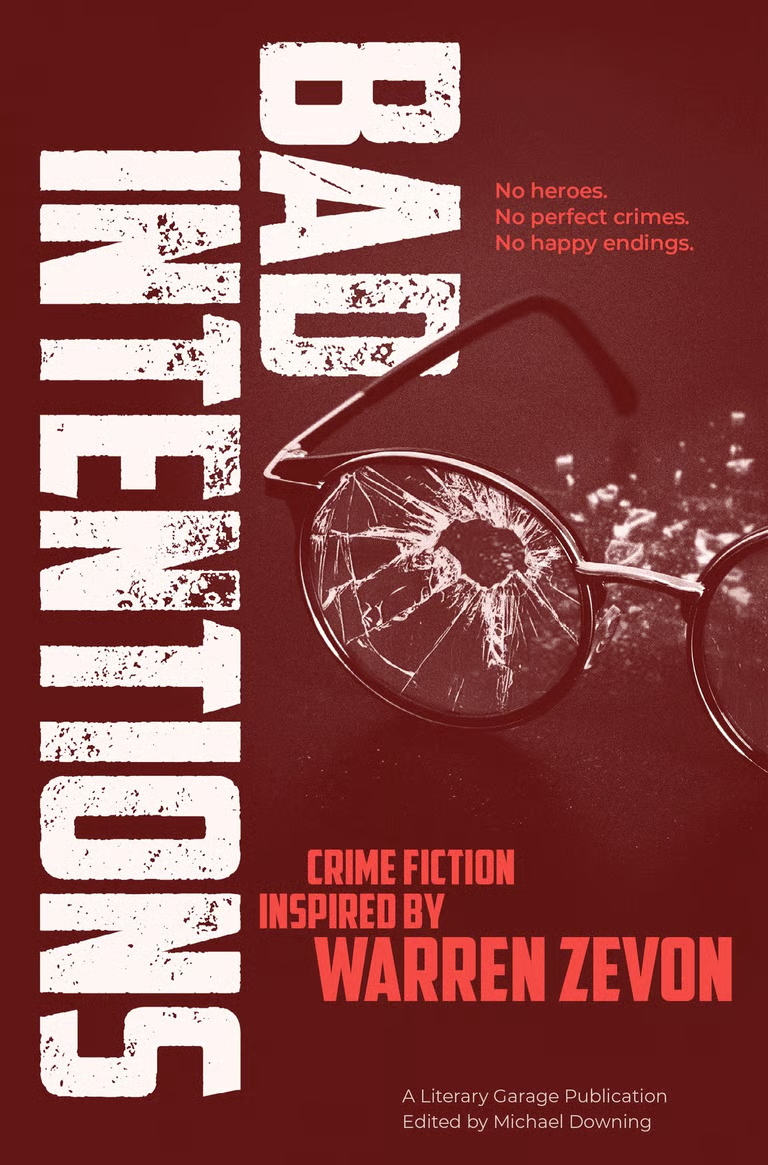
K.C. Michaels, the EIC at Literary Garage, shares that appreciation, and we’d often trade Zevon lyrics back and forth depending on how our days were going (“Poor, Poor Pitiful Me” and “Splendid Isolation” are always quite popular with him). One day we were talking about how “Jeannie Needs a Shooter” is practically a crime novella, and I mentioned how cool it would be to put together an anthology of crime fiction inspired by Zevon’s music. K.C.’s response was simple: “Run with it.” At the time, I had no idea a Zevon-inspired crime anthology had been published a few years earlier (Lawyers, Guns, & Money). Had I known, this project might never have gotten off the ground. I’ve always hated discovering that my brilliant idea was somebody else’s brilliant idea first.
Putting the anthology together was a great experience. The response was overwhelming for a publication that isn’t yet one year old. We received more than 200 submissions. To keep the process fair, each story was assigned a number and all identifying information was removed before I read it. Every submission was evaluated blind, so reputation, publication credits, and personal relationships never entered the equation.
I wasn’t looking for the best Warren Zevon references. I was looking for stories that captured the spirit of his work. The strongest submissions gave us memorable characters, authentic emotion, dark humor, and that unmistakable feeling that one bad decision could change everything. Just as importantly, I wanted fifteen stories that worked together as a collection. A great anthology is more than fifteen good stories. It’s fifteen stories that create something larger when placed side by side. What was tougher was that a few excellent stories didn’t make it into the anthology through no fault of the writing–it had to do with placement. (Note: As a run-up to the Bad Intentions release, Literary Garage is posting some of those stories on their Substack as bonus content.-AC)
One of the most interesting challenges was building the sequence. I wanted the anthology to have momentum, variety, and emotional range while maintaining a consistent tone throughout. In the end, I think we assembled a collection that captures many of the qualities that made Zevon such a remarkable storyteller: flawed people, difficult choices, and consequences that aren’t always what we expect.
2. How would you describe your own writing style?
I write character-driven stories about ordinary people facing difficult choices. Whether it’s crime fiction, literary fiction, or something in between, I’m interested in what happens when people find themselves at a crossroads and have to make difficult choices. Those choices decide who they really are.
Most of my stories take place in working-class communities and focus on characters carrying some combination of regret, hope, loyalty, loss, addiction, or guilt. Crime often appears in my stories, but it’s usually less about the crime than the consequences that follow.
Stylistically, I try to stay out of the reader’s way. I’m drawn to straightforward prose, a strong sense of place, and characters who feel authentic. I’m not writing sentences that call attention to themselves, and I’m certainly not chasing linguistic fireworks like David Foster Wallace. My DNA is probably closer to Elmore Leonard, Daniel Woodrell, or Pete Dexter—writers who trusted character, voice, and story to do the heavy lifting.
If there’s a common thread running through my work, it’s my belief that even damaged people are capable of change, even though that change rarely comes easily. Or at all. Or without a cost. Or without a little blood. Or a lot of it. Just because somebody’s capable of change doesn’t mean they can or will change. My characters are people trying to get back up after life has knocked them down, and trying to figure out if redemption is still possible once the dust settles.
3. Where did the idea for your novel, Saints of the Asphalt, come from?
I’m a Jersey guy. I grew up just outside Atlantic City and watched the city go through several different identities. By the time I was old enough to pay attention, Atlantic City was usually described as a faded resort town. Then legalized gambling was approved in the late ’70s, which brought in casinos and the promise of revival. There was a real sense of optimism that the city was about to reinvent itself.
In some ways it did. In other ways it didn’t. Mostly, over the past thirty years it’s just crashed and burned.
What was interesting to me was the contrast between the different parts of Atlantic City once the casinos were built. You had the glamour of the casinos, the neon lights, the high rollers, and promises of easy money. Then you’d walk a block or two away and find people struggling to get by, neighborhoods that had been left behind, and lives that looked very different from the image being sold on the Boardwalk.
As the city changed, I watched the influence of organized crime evolve. It was never the Hollywood version people imagined, but it was always there in one form or another, woven into the fabric of the city. And I knew some of those guys and felt they would be great characters in a story.
Eventually I realized I wanted to write a book about second chances. Atlantic City was rebuilt on the idea of reinvention. It was constantly trying to become something new, something better. That led me to the main character in Saints, Timmy Davenport. Timmy was the kid everyone thought would make it out but life had other plans, and his demons caught up with him. When the novel begins, he’s back in Atlantic City trying to figure out what comes next after his dream has already died.
People think Saints of the Asphalt is a basketball novel or a crime novel. It’s really crime-adjacent and sports-adjacent. Those elements are there but at its heart Saints is a story about redemption. It’s about what happens when you’re forced to rebuild your life after becoming the person you never thought you’d be. In many ways, Timmy and Atlantic City are on the same journey. They’re both searching for a second chance.
4. You co-founded and previously served as creative director of the organization StoryTellers. What is that organization all about, and what inspired you to create it?
StoryTellers was inspired by Ed Johnson, the former Mayor of Asbury Park. I was living there and looking for ways to make a difference in the community. At a city council meeting, Mayor Johnson said something that stuck with me: “If each person does only one thing, together we can all make a huge difference.” For me, that one thing I could do was literacy.
StoryTellers was never just about reading and writing. It was about self-empowerment through self-expression.
I’ve always believed that people change when they find their voice. When someone can tell their own story—whether it’s a child struggling in school, a teenager trying to find a direction in life, a gang member looking for a different path, or a survivor of domestic violence reclaiming their identity—they begin to change their own narrative. Writing gives people the opportunity to define who they are and imagine who they might become. And take steps so they can do that.
In Asbury Park, we partnered with organizations like Big Brothers Big Sisters, and later in Georgia with One Hundred Men, to work with underserved youth and young adults. We used reading, writing, mentoring, and storytelling as tools to build confidence, communication skills, and self-esteem. Some of the most rewarding work involved helping survivors of domestic violence and sexual assault tell their stories. Many had spent years feeling powerless or unheard. Giving them a safe space to tell their story in their own words wasn’t just a writing exercise. It was a way of helping them reclaim something that had been taken from them.
Literacy opens doors, but the real goal was helping people discover the strength and power of their own voice. Once people learn that their story matters, a lot of other things become possible.
5. What one piece of advice would you offer to anyone who is just starting out in the creative writing field?
There’s no shortage of writing advice out there. Ask ten writers and you’ll get twenty different answers. Some will tell you to read constantly. Others will tell you to write every day, study the craft, find your voice, or learn the business side of publishing. All of that’s good advice.
For me, though, the most important thing a writer can do is find a community.
Surround yourself with people who love books, stories, and written words. Find other writers who can celebrate your successes, encourage you through the inevitable rejections, and—most importantly—give you honest feedback when a piece isn’t working. While family and friends are wonderful supporters, they aren’t always the best critics. My mother thought everything I wrote was amazing. She was wrong, but I appreciated the enthusiasm.
Early in my writing journey, books like On Writing by Stephen King, Telling Lies for Fun and Profit by Lawrence Block, and On Moral Fiction by John Gardner helped shape my thinking about the craft. But books can only take you so far. The people who help you grow are the ones willing to tell you when a story needs another draft, a character isn’t convincing, or an ending misses the mark. Better to find that friend willing to say, “This story sucks,” before a reviewer says it in public.
Writing is a long game. Talent matters. Persistence matters. Craft matters. But having a community that believes in your work enough to be honest with you is the most valuable resource of all.
BONUS QUESTION:
What do you love most about the music of Warren Zevon?
Warren Zevon is a brilliant storyteller.
His songs are funny, heartbreaking, cynical, and brutally honest, sometimes all at once. Zevon songs are stories. His lyrics are filled with memorable characters, vivid imagery, and a deep understanding of human nature. What always stands out is that he rarely wrote about heroes. He wrote about criminals, outcasts, dreamers, failures, addicts, mercenaries, losers, gamblers, and people hanging on by a thread. Most of them made terrible decisions that forced them to live with the consequences. I recognize that. Appreciate that. We’ve all made mistakes. We’ve all wanted a second chance.
You listen to “Poor, Poor Pitiful Me” or “My Shit’s Fucked Up” and say, “Yeah, been there. Done that.”
One of the things that frustrates me is when people reduce him to “the guy who wrote the werewolf song.” He had a wicked sense of humor, but he was capable of incredible depth. Songs like “Accidentally Like a Martyr,” “Tenderness on the Block,” and “Searching for a Heart” carry a tremendous amount of emotional weight. Those lyrics are gut-wrenching and filled with pain.
Zevon wrote stories with intelligence, empathy, dark humor, and emotional intensity (and I was glad to see that the Rock & Roll Hall of Fame recognized that).
***
Follow Michael Downing on Twitter/X at @KMWriter01, on Bluesky at @kmwriter01.bsky.social, on Instagram at @kmwriter01, and on Threads at @kmwriter01.

Congratulations on getting your story selected to be published in the Anthology. That’s great!
The ‘Bad Intentions’ book sounds good. Like something I’d like to read
Have a great weekend Andrew!
Thanks so much, Mark!