
Graduation season is upon us, and that means colleges and universities across the nation are trotting out celebrities, writers, thinkers, journalists and public intellectuals to deliver commencement addresses to the newest crop of graduates-to-be.
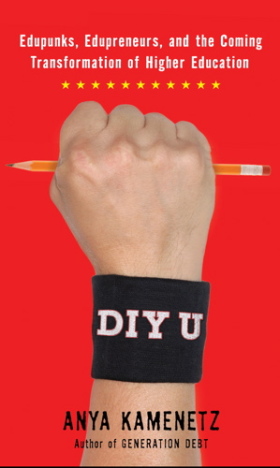
Likewise, the message of Kamenetz’s new book, DIY U: Edupunks, Edupreneurs, and the Coming Transformation of Higher Education, probably comes across as nails on the chalkboard for many college administrators.
DIY U is a timely call for our nation’s higher education system to embrace the power of technology to expand access. Even though college campuses were among the first institutions in the world to embrace Internet technology, when it comes to using it effectively as an educational tool, we’re behind the curve.
Kamenetz envisions an alternate university. What if students, rather than following the traditional path of higher education (four-year bachelor’s degrees, hour-long lectures), were able instead to cobble together their own learning path from course materials readily available online? This kind of “do-it-yourself” approach is gaining ground among a growing number of “edupunks” and “edupreneurs” who see technology as the answer to the rising costs and inefficiencies associated with traditional college.
Those who know a little bit about my affinity for all things punk — the music as well as the ethos* — know that I could never resist picking up a book with “DIY” in the title and “punks” in the subtitle. As soon as I heard about Kamenetz’s book (thank you, Mark Greenfield), I ordered it. And while I wasn’t completely satisfied with the book’s conclusions, I’ve got to give DIY U high marks for stimulating thought and discussion about the state of higher education today.
First of all, despite the book’s title and punk-inspired cover art (a clenched fist holding a pencil), Kamenetz isn’t exactly Johnny Rotten. She has an Ivy League pedigree (Yale, class of 2002) and a steady gig as a journalist at a respectable business magazine, Fast Company. DIY U is her second book; it’s a logical follow-up to her first, Generation Debt, which discusses the crushing student loan debt load modern-day college grads take on.
Kamenetz’s journalistic technique shines in DIY U. She expertly weaves together seemingly disparate data points into a solid narrative that places today’s higher ed challenges in historical contextg. DIY U is very well researched, as evidenced by the detailed end notes. (This is a plus, in my opinion.) It’s also a quick read. Take away the end notes, bibliography, index and resource guide (an outline for pursuing a do-it-yourself education beyond the walls of the academy, complete with web links and other information), and the book comes in at a mere 135 pages — more monograph than academic tome. That’s probably for the best, because even with its exhaustive annotation, anything beyond the book’s six chapters, resource guide and back matter would be filler.
Kamenetz lays out her book in six terse chapters. Part One of the book — “How We Got Here” — opens with “History,” a survey of how the American university came to be and how the notion of “college for all” became interwoven into the American Dream. From there, Part One moves on to “Sociology” and “Economics.” Part Two — “How We Get There” (“There” being the technology-transformed university of the future) — begins with “Computer Science” (a discussion of technology’s advantages) and moves on to “Independent Study” and “Commencement.” (Kamenetz offers chapter 6, Commencement, on her DIY U blog.) Once you walk across that stage at the end of chapter 6, instead of a diploma you get Kamenetz’s resource guide.
Along the way, you pick up some interesting tidbits of knowledge, or re-learn some things you may have forgotten over the years. For example: the idea that higher education should be open and accessible is as much a myth as the American Dream itself. Despite expansion over the years, college is still beyond the reach of many Americans. At the same time, due to the loss of manufacturing jobs and the decline of labor unions over the past 20-30 years, more young Americans are looking to college as a means to a better life. High school graduates who in the past may have gone to work at the local auto plant are now looking to enroll in community college or one of those for-profit private universities that spend big bucks to market their services. To afford the cost, they take on unmanageable debt — betting on a future that doesn’t look so rosy.
“Traditional colleges are trapped in an unsustainable cost spiral,” she writes in chapter 3 (“Economics”). While college tuition rose more slowly than household income in the 1940s and 1950s and at about the same rate from the ’50s through 1980, the cost of going to college “leaped 439 percent from 1982 to 2007, after inflation.”
But, Kamenetz argues, college could be made more affordable and accessible if only traditional public and private campuses would leverage technology — offering more coursework online and allowing students to customize their learning plans. She discusses the work of a radical monk named Ivan Illich, whose book Deschooling Society forms the foundation of some edupunks’ alt-education ideas, and presents examples of how edupunks and edupreneurs are incorporating DIY techniques in traditional universities and non-traditional programs.
“The promise of free or marginal-cost open-source content, techno-hybridization, unbundling of educational functions, and learner-centered educational experiences and paths is too powerful to ignore,” Kamenetz writes in her “Commencement” address. But, she adds, “these changes will not automatically become pervasive. Many existing institutions, especially those with the greatest reserves of wealth and reputation, will manage to remain outwardly, physically the same for decades, and to charge ever-higher tuition, even as enrollment shifts more and more toward the for-profits and community colleges and other places that adopt these changes.”
So, for Kamenetz, the future of education may lie with innovative for-profit schools like Grand Canyon University and the University of Phoenix. (Interestingly, both Phoenix and Grand Canyon were prominently featured, not too favorably, in the recent PBS Frontline special, College, Inc. The program was billed as an investigative report on “how Wall Street and a new breed of for-profit universities are transforming the way we think about college in America.”) She doesn’t rule out traditional colleges from innovation, but points out that change will be more difficult for them, and that the lower-tiered private schools will have it toughest of all. She picks on Hofstra University in particular, noting that it “happens to be in the worst value-for-money quadrant in higher education: private, yet nonelite.”
There is, of course, a difference between information and knowledge. In the Internet age, information is plentiful. But sifting through it all and developing a plan for true education will require a little more than a do-it-yourself approach — that is, if you want to attain an education for some tangible purpose, rather than for the love of learning itself.
That is the other issue with the DIY approach. Anyone with an Internet connection can learn about just about anything. But will that learning be certified? If students are after some sort of legitimate certification, then “legitimate” institutions, degreed instructors, accreditation agencies, etc., will still be needed.
DIY U is an important book for anyone in the higher ed business to read. As a commenter mentioned in one of my recent Seth Godin posts, “Higher education is at a crossroads. It does need to think differently.”
Recently, the University of California System announced plans to expand its online education program, due to its fiscal crisis. Kamenetz talks about California in the early portion of her book, describing how the university’s ambitious California Master Plan for Higher Education broadened access to more students in the 1960s. Perhaps the California system’s new effort will lend legitimacy to virtual education and make it acceptable for other institutions to follow suit.
Hey, it worked for punk rock.
* * *
* I’m aware of the contradictory nature of my typical consumerist lifestyle with the true DIY ethos many punks embrace. But it is as the Clash put it in “Death or Glory” (YouTube), “Now every cheap hood strikes a bargain with the world.” I’ve struck my bargain with the world, thank you very much.
 Andrew Careaga