
Friday Five: social media-savvy schools

Sometime during the Winter Olympics, CollegeSurfing.com decided to host some winter games of its own and came up with the Web 2.0 College Olympics to identify the most social media-savvy campuses for prospective students. But instead of limiting their competition to single gold, silver and bronze medalists, the CollegeSurfing.com folks listed their top “50 social media innovators in higher education.” Here are the top five from that list, with links to their Twitter feeds. If you’re looking for examples of how to do social media in higher ed, these are the top of the top — the gold standard.

  1. Tufts University gets kudos for its twittering dining halls, vibrant Facebook group and my favorite, Spark, a site devoted to the campus’s social media tools.
  2. Johns Hopkins University is cited for its “prolific” Twitter feed and “gets props for letting the Twitterverse in on its tongue-in-cheek swine flu lexicon.” (After these Olympics, Johns Hopkins earned my further admiration by pulling off the cleverest and most elaborate university April Fool’s prank of 2010.)
  3. Ithaca College is lauded for a lighthearted approach to Twitter “and more than a dozen blogs are easily accessible from the school’s home page.”
  4. Butler University. “Kudos to Butler for letting its mascot, an adorable bulldog, run his own Twitter account.” ‘Nuff said.
  5. Case Western Reserve University’s Frances Payne Bolton School of Nursing. The only school within a university to earn gold medal status, this school earned notice for live-Tweeting a disaster drill for flight nursing camp students and for their own YouTube channel.

Special thanks to Georgy Cohen (@radiofreegeorgy), who first pointed this out several weeks back.
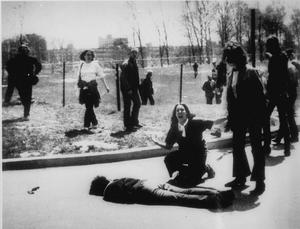
Kent State, 40 years later

On May 4, 1970, National Guardsmen opened fire on a group of anti-war demonstrators on the campus of Kent State University. The guardsmen killed four students and injured nine others.

The iconic image: Mary Ann Vecchio kneeling by the body of a student lying face down on the campus of Kent State University, May 4, 1970. (AP photo/John Filo)

Forty years later, Kent State is best known in the minds of many for that tragic event. The Kent State Massacre, as it became known, was memorialized in song by Crosby, Stills, Nash & Young and has become practically synonymous with hippie-era campus unrest over the Vietnam War.

Today the university recognizes the 40-year anniversary of those shootings with a new May 4 Walking Tour (dedicated yesterday) and a two-hour Remembrance Day Observation starting at noon Eastern. These and other events occur in the midst of Kent State’s yearlong commemoration of the tragedy. Also today, the national media are shining their spotlight on the university, representing it as an institution that remembers and learns from the lessons of the past.

In some ways, the events of May 4, 1970, seem to have happened eons ago. The United States was a much different country then. There was the draft, which put the war effort at the forefront of many college students, whose academic standing was the only thing that kept some of them from mandatory service. And we had a president — Richard M. Nixon — who was elected two years earlier in part because of his tough law-and-order stance, a stance that was itself a response to anti-war and civil rights protests.

In other ways, though, the world really hasn’t changed much. The United States is again at war (although the draft is no longer a threat to college students) and our nation is just as divided politically as it was during the Kent State era — the days of student protesters and the “Silent Majority.” Perhaps we are even more divided now, even though the protests are not occurring on college campuses as much as they are at Tea Party gatherings.

Many of today’s college students may be only vaguely aware of what happened at Kent State, and a large majority of them — even at Kent State — may “feel a disconnect” with the event and that generation of college students, as this CantonRep.com article about the 40th anniversary points out.

Still, in today’s world and in the midst of our divisive national political arena, there is at least one lesson we can draw from the events of May 4, 1970.

As Carole Barbato, a Kent State student in 1970 who is now a communication studies professor at that university, told CantonRep.com: “We want students today to know the facts that we know, we want them to remember.

“But there are greater lessons here, and that is that the rhetoric that incites violence is never the answer.”