
Measuring what works in social media

A recent post by Karine Joly, titled Why #highered is NOT there yet with social media marketing, took a skeptical but realistic look at some reported results about the state of social media in higher ed.

Delving into the UMass Dartmouth study on social media adoption in higher education — which shows what most of us assumed anyway: practically every college and university everywhere is using social media in some form — Karine compares some of those findings with the results of a couple of other studies on social media in higher ed. Her analysis suggests that all may not be so hunky dory in our social media world.

Just because survey respondents report that their social media efforts are successful doesn’t necessarily make it so.

Yes, the UMass Dartmouth study reports, “respondents have consistently raved about their [social media] experience, especially Facebook (95% success) and YouTube (92%).” But as the original .eduGuru Kyle James points out in his summary of the study, measurement is sorely lacking. “The only surprising negative,” Kyle wrote, “was that only 68% are listening to what is being said about them online by monitoring the internet for news, conversations or buzz about their institutions.”

How can you declare victory in the social media sphere when you aren’t paying attention to what is being said about your institution there? That is a problem.

KPIs to the rescue

All of this data leads Karine to conclude that there is “a real need to go beyond the ‘social media checklist’ tactic and adopt a more strategic and measurable approach in higher education.” I agree. I suspect many of you do, too, judging from the comments on Karine’s blog post. I know Michelle Sargent does. She nails it with her response to Karine’s post: “The focus needs to be on how this compares with business analytics and KPIs. We need to always be exploring and investigating previous business performance to understand what it is we want to achieve through future strategies.”

KPIs, or “key performance indicators,” are sorely lacking in our business. But we could learn from other sectors and apply their social media KPIs to our efforts.

According to another recent study (there sure are a lot of people studying social media these days), marketers in the tech, media/entertainment, and utilities and banking sectors have their favorite KPIs, many of which would be easy to follow in higher ed. The include some relatively easy KPIs, such as impressions and reach, social media “likes,” and microblogging (Twitter) followers, as well as more challenging or expensive to measure indicators, such as customer satisfaction scores and brand sentiment. Here’s a chart of most used KPIs from those sectors.

kpichart

These KPIs are not necessarily a panacea, but perhaps this could be a place to start.

P.S. – Thanks to @azurecollier for pointing me to the eMarketer study about KPIs.
What KPIs do you use to measure your social media measurement and engagement?
Friday Five: Klout, PeerIndex and influence

There’s been a lot of talk lately about the importance of influence as an element of brand positioning in the social media sphere.

But this is really nothing new for brands. Having influence — or being perceived as having influence — was important for brands long before social media came of age.

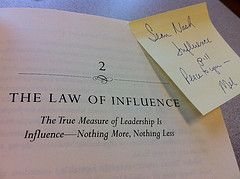
IMG_4757Influence is a key trait for effective leadership — for organizations and individuals alike. Influence is how the best leaders get people to join together for a common cause. So an organization wanting to strengthen its position in the marketplace ought to work on being as influential in its niche as possible.

Brands wanting to be perceived as leaders need to be perceived as influential.

So a number of different services have sprouted up to help organizations and individuals measure their influence. One of the most talked about is Klout, which, despite quite a bit of criticism, seems to be staking its claim as a leader in the contest to be the standard for measuring influence in the social media world.

But as K.D. Paine suggests toward the end of a recent blog post, Klout is more effective at measuring activity (read: Twitter chatter) than influence. “If you are in the B2B space, or in a market that doesn’t care about celebrity, or have influencers that don’t compulsively post their every activity, you aren’t gaining anything but skepticism in the board room,” she writes. “The downside is that while you’re focusing on the popularity contest, your real fans and prospects are growing bored and looking for other places that are really interesting.”

Meanwhile, an upstart called PeerIndex is trying to unseat Klout in the battle for most influential yardstick of influence. The folks at TechCrunch think PeerIndex might have a chance. As TechCrunch reported recently, PeerIndex is gaining on Klout. PeerIndex recently logged its 45 millionth tracked Twitter profile — breathing down the neck of Klout, which tracks 60 million. Moreover, TechCrunch explains, “While Klout gives us an overall score for an individuals’ influence, PeerIndex goes after the actual subjects people are expert in and ranks them accordingly with a proprietary algorithm.”

But like Klout, PeerIndex is also Twitter-centric. (Although Klout can also be used with Facebook pages.) So how effective is it, really, in measuring influence in the broader realm of social media? Twitter may be the hangout of choice for the so-called super socials, but if the tool is measuring only Twitter activity, it is recording only a sliver of the action.

Nevertheless, it appears that these two tools are the main ones slugging it out in the influence measurement game. (I’m talking about free, easily accessible tools. Other propriety tools exist that may provide better measurement than either of these.) So, in the interest of determining which is the more influential, I conducted my own less-than-scientific analysis of these two tools. I used five criteria. Here are my exclusive findings:

1. Domain name. When I went to pull up the PeerIndex website to reference during this blog post, I typed peerindex.com into my browser, only to be directed to a link farm. The real PeerIndex is a dot-net. Klout is a dot-com. A major fail of PeerIndex’s part. Winner: Klout.

2. Google fight. This old-school approach to compare search mentions is a longtime favorite of mine. I pitted the two services against each other in this fight, but the match between Klout and PeerIndex was no contest. Klout scored 128,000 to PeerIndex’s 21,200. Winner: Klout.

3. Klout score. Since we’re talking about these services as tools to measure influence, why not use them to measure the influence of their own Twitter accounts? The Twitter handle @klout has a Klout score of 81, while @PeerIndex’s is 66. While PeerIndex’s Klout score is respectable, the upstart loses again. Winner: Klout.

4. PeerIndex scores. Klout’s composite PeerIndex score is 29. PeerIndex’s is 30. Winner: PeerIndex by a nose. (Interestingly, PeerIndex’s “realness” score — which the company says measures “the likelihood that the profile is of a real person, rather than a spambot or twitter feed” — was a perfect 100, while Klout’s was 0.)

5. Positive Twitter sentiment. Using the Twitter sentiment tool, we see that @Klout has a positive sentiment score of 74 percent compared to only 67 percent for @PeerIndex. Looking at the brand names without the @ yielded higher positive results for both — 90 percent for Klout and 83 percent for PeerIndex — but the result is the same. Winner: Klout.

* * *

If leadership boils down to influence, then it would appear that Klout — the leader in this influence-measurement contest, based on sheer numbers of profiles — is also the more influential of these two. But what will the case be six months from now? I plan to revisit this question on New Year’s Eve and, using the same criteria, see how these players face off. If they’re both still around.

In the meantime, maybe we shouldn’t worry so much about the tools for measuring influence. Maybe we should just think about the four most important elements of influence — the old-fashioned virtues of trust, authority, value and connection — and make sure we are applying them to our social media efforts.

Photo: Influence, by nashworld.