
Books that matter: Mark Greenfield reviews The Cluetrain Manifesto

Note: With this post begins a series of book reviews of “books that matter” — or should matter — to higher ed PR/marketing/branding folks, as determined not by me, but by others in the higher ed marketing/PR/branding field. A few posts ago, I asked readers to submit their choices for the single best book that should be required reading for all higher ed marketing, branding and public relations practitioners. I’ve received several very good responses, and so I asked some respondents to write a review about their pick. (If you’d like to share your selection and perhaps write a review, there’s still time to complete the questionnaire.)

The first review in this series comes from Mark Greenfield (@markgr on Twitter). Mark is one of the most well-read higher ed marketing practitioners I know. He’s also a brilliant presenter, a lover of great rock’n’roll, and an all-around terrific person to know. I’m happy to kick off this series of “books that matter” reviews with Mark’s take on why his top pick, The Cluetrain Manifesto, matters for higher education.

The Cluetrain Manifesto

Review by Mark Greenfield

cover187-cluetrain-10th-0465018653I am a voracious reader.  My goal for the past 35+ years has been to read at least 50 books a year and I usually hit that goal. The majority of these books are work-related. So when Andy asked about the best marketing book of all time you might think that I would need some time to think about it. But this is an easy question to answer.  The Cluetrain Manifesto, by Rick Levine, Christopher Locke, Doc Searls and David Weinberger, is simply the single most important book ever written about the web and marketing.

First published in 1999,  Cluetrain is best described as a cross between In Search of Excellence and Fear and Loathing in Las Vegas. Provocative, pretentious and brilliant, this seminal book describes how the Internet means the end of business as usual.  And if you dig deep enough it also means the end of higher education as usual.  It’s influence on me can not be understated.  I consider it my job manual.

Taking a page from Martin Luther, Cluetrain is structured around a list of 95 Theses.  My favorites include:

#15 – In just a few more years, the current homogenized “voice” of business—the sound of mission statements and brochures—will seem as contrived and artificial as the language of the 18th century French court.

#16 – Already, companies that speak in the language of the pitch, the dog-and-pony show, are no longer speaking to anyone.

#23 – Companies attempting to “position” themselves need to take a position. Optimally, it should relate to something their market actually cares about.

#25 – Companies need to come down from their Ivory Towers and talk to the people with whom they hope to create relationships.

The book opens with a very important question. “What if the real attraction of the Internet is not its cutting-edge bells and whistles, its jazzy interface, or any advanced technology that underlies its pipes and wires. What if, instead, the attraction is an atavistic throwback to the prehistoric human fascination with telling tales? The web is touching our most ancient of needs: to connect.” Long before the terms Web 2.0 and social media entered our vocabulary, Cluetrain was talking about “markets as conversations,” transparency, authenticity, trust, and the need to speak human.

‘What if the real attraction of the Internet …

is an atavistic throwback to the prehistoric human fascination with telling tales?’

Cluetrain does a great job of explaining the historical context of marketing and public relations and how the web will return us to the days of the ancient bazaar, when marketing was based on creating relationships — and why this is a good thing.  “The first markets were filled with people, not abstractions or statistical aggregates; they were the places where supply met demand with a firm handshake.” But the “Industrial Interruption” came along. Mass production led to mass marketing, which led to mass media.  And therein lies the problem. “Corporate speech became mass produced messages jammed into a one-way spam cannon.  Messages are worse than noise. It’s an interruption. It’s the Anti-Conversation. The awful truth about marketing is that It broadcasts messages to people who don’t want to listen.  In today’s world the broadcast mentality isn’t dead by any means.  It’s just become suicidal.”

The web changes everything. “The long silence — the industrial interruption of the human conversation — is coming to an end.”  The only advertising that was truly effective was word of mouth and the “Word of Web offers people the pure sound of the human voice, not the elevated empty speech of the corporate hierarchy.”

My favorite rant in Cluetrain is about public relations. “Public Relations has a huge PR problem. People use it as a synonym for BS.  The standard press release describes an ‘announcement’ that was not made, for a product that was not available, quoting people who never said anything, for distribution to a list of people who mostly consider it trash.”

Cluetrain takes direct aim at marketing jargon. “We have to stop using techno-latin which is a vocabulary of vague but precise-sounding words that work like blank tiles in Scrabble: you can use them anywhere, but they have no value. In TechnoLatin, a disk drive is a “data management solution.”  A phone is a “telecommunications device.”

While many people may think Cluetrain is anti-marketing and anti-PR, that is not the case.  Marketing and PR just need to return to their origins. The best of people in PR are not PR types at all.  They understand they aren’t censors, they’re the company’s best conversationalists.  “In the age of the web where hype blows up in your face and spin gets taken as an insult, the real work of PR is more important than ever.”

Cluetrain was the first web book I read that emphasized the importance of telling stories. “Most of our conversations are about stories. Stories are a big step sideways and up from information. We are human. Stories are how we make sense of things.  Anything else is just information.” During the course of my consulting work, I always challenge the school I’m working with to rewrite their missions statement as a story.

‘Stories are a big step sideways and up from information.’

So is the Cluetrain applicable to higher ed? Absolutely.  One of my favorite presentations is called “The Cluetrain Comes to Higher Ed, Will Anyone Take Delivery?” When I was developing this presentation I spoke with Cluetrain author Doc Searls on Twitter and he responded, “Gotta say the higher ed is a tough nut to crack”.  IMHO, higher ed is about to implode and the institutions that follow the principles of Cluetrain are the most likely to survive.  I’m thinking it may be time to dust of this presentation and present it again in 2013.

I’ve seen the future, and it’s The Cluetrain Manifesto.
Friday Five: Immutable branding laws, revisited

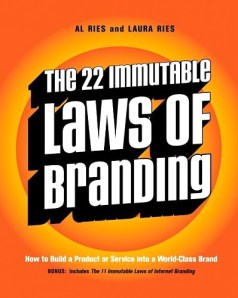
ImmutableLawsAs 2012 drew to a close, I spent some time revisiting some reading material that has informed my life, both personally and professionally. One of those materials was a book by Al and Laura Ries called The 22 Immutable Laws of Branding (affiliate link). Perhaps you’ve heard of it? In my opinion, it is one of the most important books ever written on the subject of branding, and anyone who does any sort of marketing, public relations or brand management for a living should read it. For that matter, anyone who does any sort of communication work who wants his or her message to stand out should read it.

The Rieses present in concise form, chapter by chapter, 22 branding “rules to live by” that organizations ignore at their peril. They cite example after example of big brand names that follow or violate these rules, and provide plenty of evidence of why a brand’s tactic worked or failed, in the context of one of these 22 laws.

Before going forward, it’s important here to distinguish between the ideas of branding and marketing. I find that people, even people in our business, tend to use the terms interchangeably. The 22 Immutable Laws of Branding is not a marketing book, although the laws it contains do matter — greatly — to marketing people. Just bear in mind as you read on that branding is about an institution’s identity and its promise to the customer, while marketing is about delivering the product or service that institution offers to the customer. With any luck and strategic forethought, the products and services being taken to market also embody the promise of the brand that offers those products or services.

As the Rieses point out in chapter after chapter, companies have seen short-term success by violating a branding law or two. (For example, when Bayer introduces its Bayer Select line of “aspirin-free” products, in violation of law No. 10, The Law of Extensions.) But the damage to their brand eventually outweighs those short-term marketing victories. The lesson for marketers and brand managers is that what may look appealing from a marketing standpoint in the short term could do permanent damage to the brand in the long term. As the Rieses write in the very first chapter:

Marketers often confuse the power of a brand with the sales generated by that brand. But sales are not just a function of a brand’s power. Sales are also a function of the strength or weakness of a brand’s competition.

Substitute “gifts” or “students” for “sales,” and you see how this applies to higher education marketing.

My copy of this book was published in 2002, which means that many of the examples cited are outdated. Also, there’s an additional minibook at the end titled The 11 Immutable Laws of Internet Branding which, being published in 2002, doesn’t take into account the changes wrought by social media. So if you pick up this book, I wouldn’t put too much stock in that section.

Like many branding experts, the Rieses talk about big, recognizable brand names. You won’t find any reference to colleges or universities in the book.

But that doesn’t mean these branding laws are irrelevant to higher education. If they’re immutable for the commercial sector, they should be immutable for our organizations, right?

Here are five of those laws that I think are most relevant to higher education. At the least, they serve as a reminder of best practices for our higher ed brands.

1. Law 1: The Law of Expansion.

The power of a brand is inversely proportional to its scope.The tighter a brand’s focus, the greater its success as a brand.

This is the big one and the most important law. No wonder they put it first.

Think about the most focused colleges and universities in the nation. How strong is MIT’s brand? How about Oberlin’s? Fashion Institute of Technology’s?

Now, think about how many “comprehensive universities” there are in the U.S. (There are a lot of them.) How many of them have strong brands for being “comprehensive”?

Certainly, comparing the number of degrees an institution offers to the lines of toothpaste Crest offers (38 at the time Immutable Laws came out) isn’t fair. But there’s an underlying principle that applies in both cases. If a college or university is known for something very specific, as MIT is for engineering, it could do some damage to its brand by extending into areas that are unrelated. (Obviously, MIT has very strong programs in business and other areas, but the connection to the institution’s emphasis on engineering and science is strong.)

The strongest brands are the most focused. (See also: Law 2: The Law of Contraction and Law 10: The Law of Extensions.)

2. Law 5: The Law of the Word.

When people think of your institution, what word or phrase comes to mind? A brand should strive to own a word in the mind of the consumer.

Back in the 1990s, before the university I work for changed its name from the University of Missouri-Rolla to Missouri University of Science and Technology, the University of Missouri System conducted a series of focus groups around the state in an effort to find out how much people of our state knew about each of the system’s four campuses. When focus groups were asked about our institution, the most common response was that we were known for “engineering.” That was the word we owned among the public of Missouri in the 1990s. And it’s the word we own today — even more so, now that we have a name that better reflects the intrinsic nature of our campus.

What about MIT or Oberlin? Does MIT own “great engineering school” on a national scale? Probably. Does Oberlin own “great liberal arts”?

In building a brand, Ries and Ries suggest you “forget about the laundry list of wonderful attributes your product has” and instead focus on owning a word in the customer’s mind. “The mind gives meaning to visual reality by using words,” they write. “To get into a consumer’s mind, you have to sacrifice.” This is hard to do for any organization, but especially for higher ed.

3. Law 7: The Law of Quality.

Quality is important, but brands are not built by quality alone. Here is where the issues of affordability and accessibility come in to play today, and will in the future as The Great Disruption in higher ed continues. (Moody’s negative outlook for the entire U.S. higher education sector, announced on Wednesday, will obviously play in to public perceptions of U.S. higher education as a “quality” product.)

One of my favorite TED Talks, which I’ve written about previously on this blog, is Life lessons from an ad man, by Rory Sutherland of the Ogilvy Group. Sutherland talks about the importance of advertising as a means of adding perceived value to products and services. He even talks a bit about the perceived value of higher education.

“The point is that education doesn’t actually work by teaching you things,” Sutherland says. “It actually works by giving you the impression that you’ve had a very good education, which gives you an insane sense of unwarranted self-confidence, which then makes you very, very successful in later life.”

Sutherland is exaggerating to make a point, and it’s a bit like saying the role of higher education is to be like Wizard of Oz and confer credentials in the form of a diploma to straw men. But the perception of quality is an important component in branding, and as The Great Disruption continues to turn educational products into generic commodities that can be purchased cheaply, or even obtained free of charge, institutions that emphasize quality will have to think about just how well they are selling this intangible to prospective students, as well as how great the demand is for such a, well, quality. And also, whether your brand is really built on quality.

“If you want to build a powerful brand,” write the Rieses, “you have to build a powerful perception of quality in the mind.”

The notion of affordability often flies in the face of quality. Institutions need to decide whether to build on quality or some other factor. You can’t be both cheap and great.

“The customer who wears a Rolex watch doesn’t do so to be more punctual,” write the Rieses. “The customer who wears a Rolex watch does so to let other people know that he or she can afford to buy a Rolex watch.”

4. Law 11: The Law of Fellowship.

Brand managers like to talk a lot about differentiation, about how our brands are distinctive. And this is important (see Law 22: The Law of Singularity). But in reality, you don’t want to be the only one of your kind in the marketplace. Then you wouldn’t have any competition.

Coke needs Pepsi. Staples needs Office Depot and Office Max. Southwest needs American Airlines and United. And so on.

In order to build the category, a brand should welcome other brands.

When the leadership at our university was building the case for changing our name, they developed a classification of 16 technological research universities — institutions that, like us, were heavily focused on the STEM disciplines but also conducted research and had graduate-level programs. (This process allowed us to exclude fine, undergraduate focused engineering schools like Rose Hulman and Harvey Mudd, so that we could further narrow our scope.) By focusing on these 16 institutions, we intentionally limited ourselves to a ‘fellowship” of similar universities. (We compete with others not in this grouping, but we differentiate ourselves from those institutions by our focus. We are one of an elite group of 16 — and the only one in the Midwest.)

5. Law 13: The Law of the Company.

Brands are brands. Companies are companies. There is a difference.

From my perspective, as one who works for one of four campuses that are part of a university system, this law bears great importance when it comes to building a distinctive campus brand apart from the system brand.

Think of a multi-campus university system as the “company” and the individual campus as the “brand.” (For example, the system is like Procter & Gamble and the campus is Tide.) Does the company name need to be part of the brand? Would Tide be a stronger brand if it were marketed as “Tide, by Procter & Gamble” or “Procter & Gamble’s Tide”?

Taking it down to a campus level: Maybe the brand is a school or college and the “company” is the campus itself. Does the S.I. Newhouse School of Public Communications have a stronger brand identity than, say, “Syracuse University’s S.I. Newhouse School of Public Communications”?

Sometimes, this law conflicts with other laws, such as No. 10 (The Law of Extensions). And when the brand managers (and deans) individual schools or colleges of an institution see their organizations as brands that are distinct from the academic institution, then problems arise. (See Law 14: The Law of Subbrands. What branding builds, subbranding can destroy.)

So Law 13 can be a tricky one to navigate, because companies are employee-oriented but brands are, or should be, customer-oriented.

Your turn

Have you read The 22 Immutable Laws of Branding? If so, what are your takeaways from the book? What law or laws that affect higher education have I omitted? Please share your comments.