 Full disclosure: I am a huge Bob Sutton fan.
I’ve been a fan since I was first introduced to his work by way of his book The No Asshole Rule, which was recommended by a speaker at some long-ago conference. In that book, Sutton pointed out some of the jerk-like tendencies I’d noticed in others (and, unfortunately, myself) and revealed to me a lot of things I needed to stop doing at work and in life.
Then I discovered his blog, which is a great resource for anyone who works in organizations.
And then Good Boss, Bad Boss came out, and I bought a copy as soon as I could. Once again, a Sutton book showed me more ways I could improve — both as a boss and as someone who works for a boss.
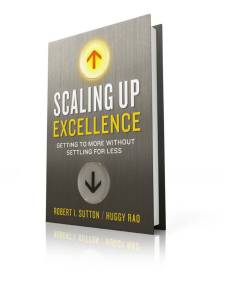
So, when I won a review copy of Sutton’s newest book, Scaling Up Excellence: Getting to More Without Settling for Less, through a Twitter contest sponsored by @goodreads, I was pretty stoked. (I was also happy that Sutton’s co-author for the book is Huggy Rao, who spoke last summer at the CASE Summit, and who has one of the best names of any business or leadership author around.)
In Scaling Up Excellence (official release date Feb. 4), Sutton and Rao switch gears a bit. The emphasis is not so much on the individual (the a**hole or boss). This time, the focus is on leading organizations to take what they do well and scale them. It’s a concept that most of us in the higher ed marketing, branding or public relations field can appreciate.
Scaling Up Excellence is the result of a seven-year quest by Sutton and Rao to discover the keys of scalability for organizations. The interviewed, met with and observed dozens of leaders and teams who were working on ways to scale up projects. They also consulted the literature. (Plenty of books and studies on organizational change, leadership, etc., exist, and they cite many good ones, familiar and foreign to me, to bolster their case.) Most of the examples and case studies in the book pertain to companies, but the principles apply to other organizations. Several takeaways pertain to higher education.
Scaling up branding and marketing
All of us who do PR, marketing or branding work want our efforts to be scalable. We want our marketing campaigns to have as much meaning and impact to a large audience as they do to a small, well-informed core. Although Sutton and Rao don’t offer easy “how-to” templates for us, they do offer some valuable guidelines to help us along the way to scaling up excellence in our own sector. Here are a few of them:
A Catholic and a Buddhist walk onto the quad… Organizations tend to operate on a continuum from the highly structured (Catholicism) to the more free-format (Buddhism). When the time comes to scale, an organization with a more Catholic culture may desire to continue a practice of “replicat[ing] preordained design beliefs and practices,” while the Buddhist organization may rely on “an underlying mindset [that] guides why people do certain things — but the specifics of what they do can vary widely from person to person and place to place.” The trick, when scaling up, is to allow flexibility to move more toward one end of the continuum when necessary. (Among the examples cited in the book is Home Depot’s difficulty translating its DIY brand and philosophy — as captured by its “You can do it, we can help” slogan — in China, where it clashed with a “do it for me” mindset. Home Depot had to learn to be less Catholic, and more Buddhist, in their approach to business.
The takeaway: Most higher ed institutions tend to fall on the Catholic side of the continuum. But as we scale our branding efforts — whether across cultures with international programs or across campus with brand identity standards — we must learn to be more flexible, more Buddhist, in our approaches. But as brand managers, we also have an obligation to ensure brand identity standards, from messaging to visuals and everything in between, are not diluted. We need to “strike the right balance between replication and customization.”
Hot causes, cool solutions. This is the first of Sutton and Rao’s “scaling principles.” And it presents a chicken-and-egg type of conundrum for marketers: Which comes first, the “hot cause” that evokes passion and inspires people to get on board, or the “cool solution” by creating behaviors or actions for others to mimic. To rally people around a cause, “you can stoke the scaling engine by targeting beliefs, behavior, or both at once. The key is creating and fueling a virtuous circle.”
The takeaway: In higher education, certain causes may arouse passion and lead to a “hot cause” that could inspire support. Other important issues require a different approach. That’s where the “cool solution” comes in to play. (When the university where I worked went through a name change and rebranding, we took the cool solution approach, laying out the logic of the name change, rather than trying to build on strong beliefs, since many alumni were not initially supportive of the change.) In scaling up your marketing efforts, consider carefully which approach to take.
Small teams, big results. We sometimes complain about our lack of staffing to accomplish our grand marketing visions. But in Chapter 4 (“Cut Cognitive Load”), the authors make an important point about the challenges of growth in organizational culture. This relates to growth in complexity, in bureaucracy, in staffing — all elements of a typical scale-up effort. Growth can be a good thing under the right circumstances. But it can also lead to performance issues and a disconnect between leadership and the worker bees. Making “subtraction” a way of life — or at least of doing business — will help ideas and projects scale. Breaking projects and teams into smaller chunks, and giving people the opportunity to focus on fewer tasks — Sutton and Rao discuss psychologist George Miller’s magical number (a concept work exploring in more depth at a later time) — could yield big results.
The takeaway: When looking at ways to scale up projects, look also at ways to keep teams as small as possible. (This is tough to do in the higher ed environment, where many must be consulted on even the most mundane of projects or steps along the way. But try to limit team membership for maximum results.)
You can get there from here. Scaling Up Excellence begins with seven scaling mantras that are woven throughout the book. These mantras are worth exploring, but I won’t get into them here. I would add an eighth mantra to the list, however, and it is another saying that finds it way several times within the pages of this book. In fact it is the essence of scalability:
What got us here won’t get us there.
That’s a paraphrase of author Marshall Goldsmith, who is cited in the very first chapter. There are “beliefs, behaviors, and rituals that once bolstered excellence but now undermine it,” write Sutton and Rao. Successful scaling requires that leaders remain vigilant about reviewing processes that helped to get the organization to where it is today, but won’t necessarily help move it along the next steps of the journey.
* * * * *
Follow Bob Sutton on Twitter at @work_matters. Follow Huggy Rao on Twitter at @huggyrao. Join the conversation about this book at #scalingup.


 Andrew Careaga