
Saturday Six: It’s like Friday Five, only a day later

April has been a crazy busy month. It always is. Still, I usually manage to sneak in at least one Friday Five during the cruelest month. But all of April’s Fridays have come and gone. So to atone for my oversight, I offer a tardy version of things that have caught my attention lately, with a bonus link.

  1. Education and the American middle class. You might have caught this New York Times Upshot post from earlier in the week about the decline of the American middle class. According to this report, median per capita income in the U.S. was $18,700 in 2010. Our neighbor to the north, Canada, caught up with the U.S., resulting in a two-way tie for first place. The author suggests that Canada has probably surpassed the U.S. in median per capita income by now, even though no research is available. Meanwhile, other nations are closing the gap. The first “three broad factors” contributing to this sluggish economic performance is  the fact that “educational attainment in the United States has risen far more slowly than in much of the industrialized world over the last three decades, making it harder for the American economy to maintain its share of highly skilled, well-paying jobs.” Perhaps this news could help higher ed marketers help rally people around support for higher education as an economic driver.
  2. What provosts think. Wonder what your provost is thinking? Inside Higher Ed‘s latest Survey of College and University Chief Academic Officers may offer some insights. For one thing, they’re worried about budget (no surprise there). For another, they really, really don’t like President Obama’s proposed college rating system.
  3. Senior managers and SOSThe “shiny object syndrome” (SOS) hits us all at some point, but top-level leaders seem to be more susceptible than the rest of us, according to this piece by leadership dude Art Petty. “One of the value killers found inside many organizations,” he writes, “is the out of control pursuit of too many new initiatives. The resultant too few resources chasing too many projects, is a sure-fire way to create organizational stress as initiatives fall short, inefficiencies skyrocket and employees, stakeholders and customers grow perturbed.” His advice: A disciplined approach and “intelligent filtering” of all new initiatives — whether you’re part of the leadership team or farther down the ranks, where the work gets done.
  4. 7 tips to managing critics online. Solid guidance from Spin Sucks on dealing with critics in the social media sphere, via @ErinHennessy.
  5. Is your brand at the center? Deb Maue of mStoner discusses the importance of bridging the gap between brand promise and brand experience — and of developing a brand-centered strategic planning process.
  6. Print-and-save social media checklist. Nice cheat sheet for social media posting from HeroX, via Brendan Schneider.
Adventures in meme-jacking

Updated again on April 3 with links to Karine Joly’s and Brian Fanning’s roundups, and sample comments from the university’s news site.

Updated April 2 with Storify archive of random tweets, posts, etc. in reaction to our April Fools’ Day shenanigans.

Pulling pranks on April Fools’ Day can be a risky venture for higher ed organizations. I speak from experience. A couple of years ago, we tried to be clever by turning our university homepage into a giant QR code. The joke fell flat. We were a little too clever, I guess.

But sometimes, the stars align, the Internet gods smile upon you, and your joke works. That was the case for us yesterday.

Doge_Wired

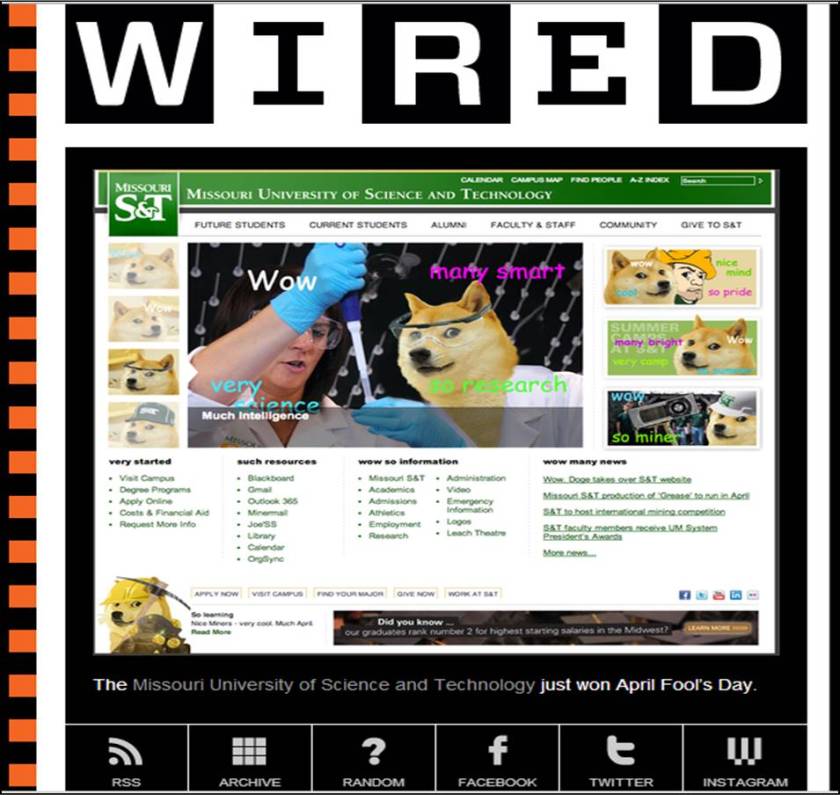
Our decision to doge-ify our website for April Fools’ Day 2014 turned out to be a winner. In my opinion, it’s also a great example of successful meme-jacking.

Meme-jacking, as this Ragan.com post defines it, is “the practice of hijacking popular memes for the benefit of marketing your brand or product.” It’s related to the idea of “newsjacking,” a concept PR authority David Meerman Scott describes in his book by that name. The idea in both cases is to position your brand to ride the wave of popularity of a news story or meme before it crests and crashes. That’s what we tried to do with the Missouri S&T website yesterday.

Doge — the Shiba Inu dog you saw all over our home page on April 1 — is a pretty popular Internet meme. But going into our 24-hour web redesign, we had concerns about whether Doge had become passe. Or, as one Twitter commentator put it, had we boarded the dead joke train?

Judging from the responses, however, Doge is still — to put it in Doge-speak — many relevant and such popular. We saw a lot of discussion of our brand and sharing of our web URL on Twitter and Facebook. We garnered some decent media coverage, too. Ashley Jost from the Columbia (Mo.) Tribune contacted me first thing Tuesday morning and wrote a nice blog post about our site. We also got mentioned on WIRED (who declared us winners of April Fools’ Day), Buzzfeed, Gawker, the Guardian, and our hometown newspaper, the Rolla Daily News. Even MuckRack journos were applauding our efforts, and higher ed bloggers Brian Fanning and Karine Joly included our site in their respective roundups.

But Twitter and Reddit were where much of the conversation was taking place. Reddit’s Dogecoin subreddit (don’t ask me to explain) was hopping with chatter. And countless thousands were talking about us on Twitter. According to SumAll, the Twitter reach for our @MissouriSandT account approached 340,000 on April 1. It’s not Lady Gaga, but it’s pretty good for us.

https://twitter.com/gr33nazn/status/450991809909366785

And my personal favorite:

(More examples to come in a this Storify we’ll be posting soon.)

What about results?

So, the obvious question is: Did it work? And the obvious follow-up: Was it worth it?

I would have to answer yes to both questions.

We also saw a nearly 16-fold increase in traffic to our website over the typical weekday traffic. (The same trend held for our prospective students’ website but I don’t know if any of those visits turned into actual applications.) Nearly one-third of those visitors were coming from social networks (Facebook, Reddit, Twiter and Tumblr were the top four, in order), and a little more than 10 percent were coming from referrals, mainly from media sites. I haven’t dug into all the data yet, but it’s clear that social media helped fuel the interest in our website.

Our moment of Internet fame also elevated our visibility slightly, if even for a moment, as a few of the comments from our news story about the joke point out.

And some of us who never even heard of MST before have now because it’s making it’s way around the Internet.

i found your site through tumblr. gods bless the interwebs. much entertain.

This is beyond awesome! I knew about your university, but now I know that you “get it”…

Proceed with caution

I won’t say that meme-jacking will always work. Like anything, it could fall flat, especially if you try to force it. In our case, we let the Internet do the heavy lifting. We just put it out there, tweeted and posted a few times, and let the Doge run free.

I also wouldn’t consider investing a lot of time and energy into jacking with every meme that comes down the pike. Consider the broader environment. April Fools’ Day lends itself to this type of tomfoolery. Not every occasion does. It also pays to be sensitive to the broader conversations occurring in social media. Today, for instance, I am writing this in the wake of a major earthquake in Chile, and other unsettling world events. There’s a time to be a prankster, and a time to keep silent. Know when to move forward and when to refrain.

But the Ragan story referenced earlier has some good guidelines on creating your own meme-jacking project. If only we’d known about these tips before April 1.