
 Maybe you heard the recent ballyhoo about the death of the RSS reader. And maybe you heard about it via your RSS reader, as I did. Ah, the irony.
The story took one news item — the announced shutdown of one RSS reader, Bloglines — and extrapolated that news into the entire RSS universe. And so the RSS reader, the humble workhorse behind the scenes of so much shared content, became the latest web tool to fall victim to the [InsertNameOfSocialMediaToolHere] is dead meme mill. (Remind you of anything?)
But the rumors of RSS’s death are greatly exaggerated. True, the use of traditional RSS readers is down (visits to Google Reader, which I use, are down 27 percent year-over-year), but that doesn’t mean people have given up on the service altogether.
Yes, with the advent of Twitter, I rely less on Google Reader. But it still holds value for me. Here are five reasons why:
1. News from trusted connections. With the crapflood of information coming at me via Twitter, Facebook, RSS and so many other sources, I rely on a cadre of “editors” (or curators, if you prefer) who share good information with their Google Reader connections. You know how I found out about this GigaOm article countering the RSS-is-dead meme? Via two of my trusted Google Reader connections: Georgy Cohen and Joe Bonner. I also subscribe to GigaOM’s feeds but I didn’t have to wade into that stream. Georgy and Joe shared an item of interest from that stream to me. Pretty neat.
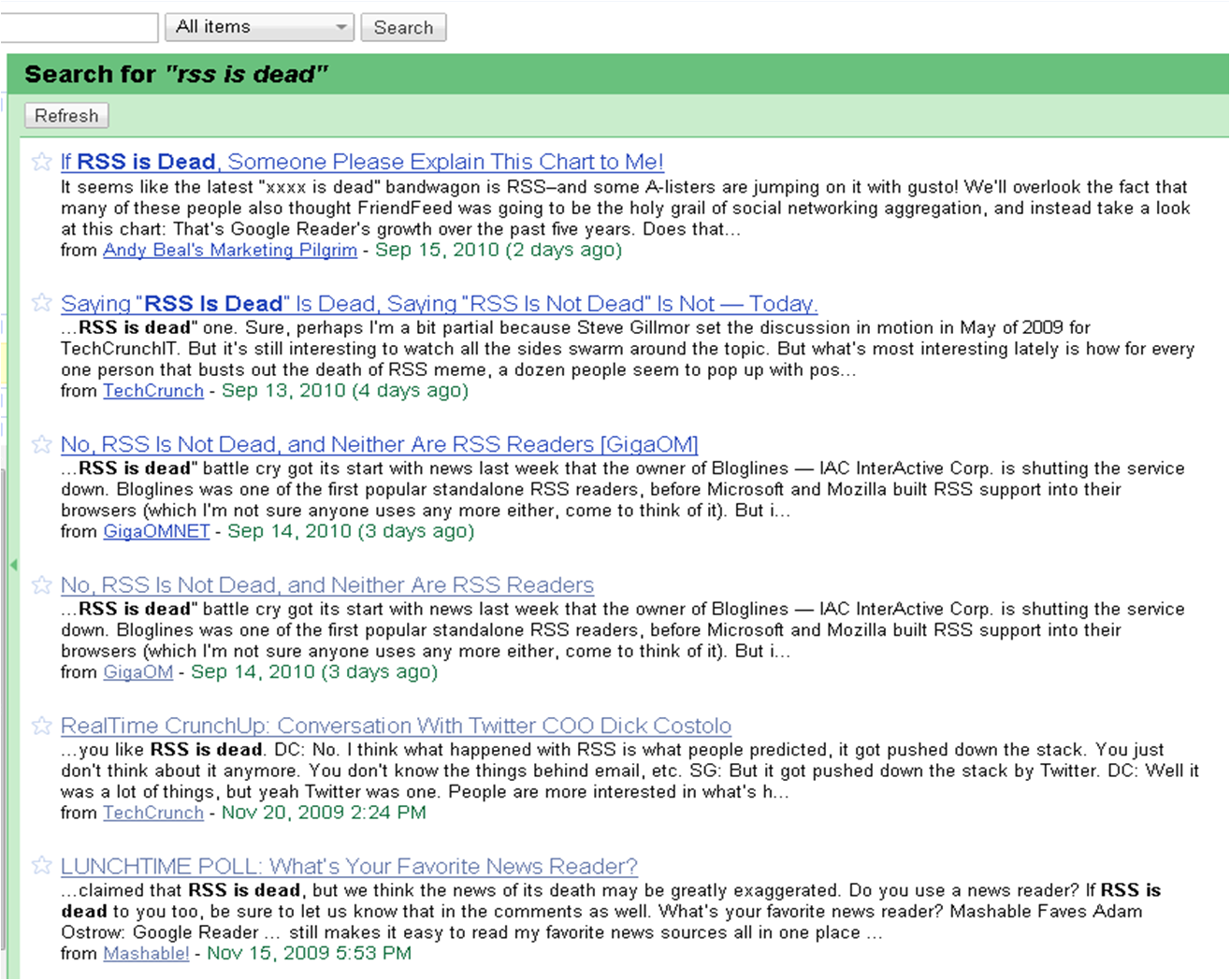
2. Searchability. If I want to find out what my RSS sources are saying about a subject, the Google search engine does the work for me. Below is a screenshot of a search for the term “RSS is dead.” Click to enlarge.
 3. Customization. I love the fact that I can organize my subscriptions into different categories.
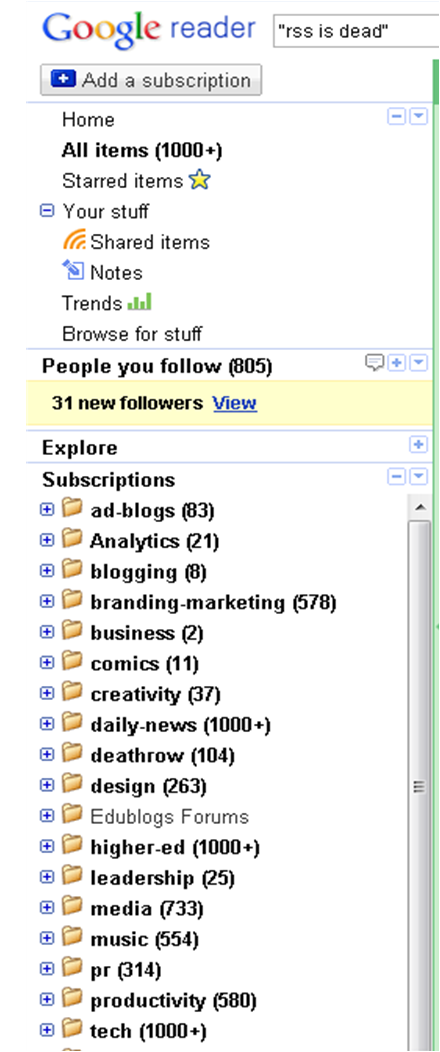
Here’s a peek at my RSS feeds folders. Everything is in its right place. All feeds are neatly tucked away into the right folder. Some single feeds are tucked away into multiple folders, which is another neat feature. So, blogs about higher ed marketing or higher ed PR show up in both “higher ed” and in “marketing” or “PR.”
(Click the image at right to enlarge.)
4. Sharing bonus content. Thanks to the Google Reader widget (the “Andrew’s Shared Items” box you see in the left sidebar of this blog), I can share selected, additional content from my Google feeds with readers of this blog. That way, in addition to seeing my posts, you have the opportunity to check out some of the other things I’m reading that I think may be of value to you. While most of the shared items are relevant to the general topic of this blog, I do post occasional diversions, such as this YouTube video of a talented acoustic guitarist/singer’s cover of a great song from the new Arcade Fire album. (I know that a few of you are fellow Arcade Fire fans, so I thought perhaps you might enjoy this discovery.)
5. Music. I used to try to follow a lot of music blogs. Now whenever I want to check out what’s new in the indie music scene, I just open my “Music” folder in Google Reader to get the latest from a dozen or so respected music blogs.
So, no, RSS is not dead yet. At least not for me.
What about you?
Happy Friday, and for readers in the U.S., Happy Constitution Day.

 Andrew Careaga