Friday Five: Spicing up social media

I'm in a shower
I'm in a shower
Look at your social media strategy. Now look at Old Spice‘s. Now look at yours. Now back to theirs.

Does your strategy look like theirs? No. Could it? I don’t know.

But there may be a few lessons higher education marketers could glean from Old Spice’s ridiculously successful social media campaign featuring the Old Spice Guy, actor Isaiah Mustafa (@isaiahmustafa on Twitter).

The campaign, carried out by Old Spice’s ad agency, Wieden+Kennedy, is already being hailed by Mashable as the archetype of a successful social media campaign. By using the @oldspice Twitter account (personified by Mustafa’s character) as an avenue to solicit questions for Old Spice Guy to answer on YouTube, the campaign elicited “almost unequivocally positive results” across social media platforms. “Hell, even the comments on YouTube were overwhelmingly positive — and that never happens.”

So, what worked for Old Spice that could work for your social media efforts? Here are five thoughts to ponder:

1. Integrate. Yes, Old Spice has a marketing budget that is sixteen bajillion times greater than even the most prosperous higher ed marketing department. The company spent a lot on television air time to build awareness of the Old Spice brand before executing the online campaign. But the point here is not about budgets. It’s about connecting your social media marketing and visibility efforts with your other marketing. Is social media integrated into your overall marketing strategy?

2. Imitate. It’s the sincerest form of flattery, they say. But too often it falls flat. By now, the Old Spice shark has probably been jumped. But one higher ed entity that seized the opportunity of parodying Old Spice Guy in a YouTube video was Brigham Young University’s Harold B. Lee Library. The library’s Study Like a Scholar, Scholar video is a clever send up. (Thanks to @radiofreegeorgy, et. al., for sharing the link via Twitter.)

3. Personalize it. Old Spice has done some great marketing over the years. But one key to success with this campaign was the way Wieden+Kennedy personalized the brand in the form of Old Spice Guy. Even beyond personalization, the campaign showed the ridiculously handsome and chiseled Mustafa to be a real human being. In one video response — this one to his daughter, Haley — he speaks to her directly, explaining that he was until recently just another unknown actor. How can we in higher ed move away from speaking in the institutional voice and better personalize our brands?

4. Take risks. Opening up the Old Spice brand to social media, soliciting questions and daring to respond with such immediacy, was risky. How willing are we to step out beyond our social media comfort zones and open ourselves up as Old Spice did?

5. Be prepared to respond — in Internet time. How long should we wait to respond to a comment or post on one of our social media venues? If the Old Spice campaign is the new standard, the answer is: Don’t waste a second. On the marketing blog mUmbrella, Tim Burrowes tracked the Old Spice Guy’s rapid response to Twitter questions. “In the last 24 hours,” he wrote, “I count 116 new Old Spice videos. Every one in response to a Tweet. Let’s say that again – 116 videos. Wieden + Kennedy must have an army of copywriters working on this.” Insane.

So, is the Old Spice campaign a true game-changer for social media? Is it the social media campaign our social media campaigns want to smell like?

I’m on a blog.
Friday Five: On ‘Open Leadership’

open-leadership-smallI just finished reading Charlene Li’s book Open Leadership: How Social Technology Can Transform the Way You Lead.

The book’s title is apt; there’s no way I could better describe what the book is about. It’s a quick read, and a good resource for anyone leading an organization — or a department within an organization — that is using social networking tools in any way. I obviously came to the book with a bias, having a love for the power of social media, so I’m not sure how people not so enamored with tools like Twitter would view the book and Li’s ideas about openness. But I took away quite a few things from the read. Here are five:

1. Openness can be structured. A lot of us tend to think of the idea of openness as chaotic — no structure, no governance, no rules. But as Li points out in Chapter 5, openness can be structured. In fact, it should be.

2. Think in terms of “covenants,” not policies. In that same chapter about structuring openness, Li introduces the idea of covenants as a means for setting expectations. When I think of that word covenant, my mind’s eye see this image of a wild-eyed, bearded old man stepping down a mountain carrying two stone tablets. But Li has caused me to reconsider that image. “Covenants,” she writes, “are promises that people make with each other, which differ form traditional corporate policies and procedures that dictate how things will operate within organizations. The philosophy behind covenants is more suited to openness strategies, because the promises, bargains, and contracts reflect a real trade-off and transfer of power and responsibility. When leaders open up and give up control, they trust that employees will do what they promise, that customers will respond and engage in a civil manner.” Li talks about “sandbox” covenants, in which an organization first defines the walls of its sandbox — “how big it will be, and what activities do and do not belong there.”

3. Different organizations do openness differently. Institutional culture can be a strong thing, and there is no one-size-fits-all strategy for managing openness in the social media sphere. Li discusses three organizational models — organic, centralized and coordinated — and points out that each has its benefits and drawbacks. For many college and university campuses, a coordinated approach, with strong centralized direction and guidance but with execution at the edges (the various departments and offices), may work better than the centralized approach.

4. I am a (gag) ‘Transparent Evangelist.’ Using the classic two-by-two matrix, Li breaks open leadership styles into four categories: the Cautious Tester (collaborative but pessimistic), Realist Optimist (collaborative and optimistic), Fearful Skeptic (independent and pessimistic) and Transparent Evangelist (independent and optimistic). As you might guess, “the Realist Optimist is the most powerful and effective of the open leader archetypes, somebody who can see the benefits of being open but also understands the barriers.” Fortunately, I have one or two Realist Optimists on my team who can drive our openness strategy. As for my archetype, Li says we “can play an important role in working with external stakeholders, especially customers and partners who are already eager to engage the organization. They can also help identify other optimistic open leaders in the organization, finding the other ‘zealots’ who will help support your open strategy.” I just wish Li hadn’t used that term “evangelist.” I’m so sick of it. Can I get an Amen, anyone?

5. Open Leadership extends beyond social media. Li’s focus with this book is to get leaders to be more open in the world of online communication. But I think many of the lessons of Open Leadership extend beyond that realm. Structured openness within an organization is a good thing, offline as well as on.

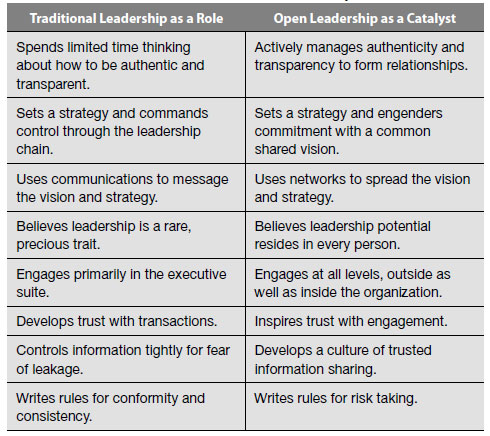
Friday Five bonus. Take a look at the table below from Chapter 8 of Open Leadership to see how open leadership (on the right) differs from traditional leadership. Where does the leadership of your organization fall?

Li_Tips_fromCh8_v1-1