
CASE Currents covers ‘Fear and Loathing in Web 2.0’

Hard to believe I haven’t already pointed readers to Fear and Loathing in Web 2.0, an article published in the September 2007 issue of CASE Currents. Especially since I’m quoted in the story, and rather prominently.

No matter. You’ve probably already seen it at Karine’s blog, or College Web Guy’s, or Andy Shaindlin’s, or over at templatedata. So I’m posting a link, too, just for the record.

Read it soon before it goes away (which happens by the end of October, I’m told). And note that Karine and Andy S. are also quoted in the piece. Aren’t we three quite the web 2.0 gurus? Just goes to prove the veracity of a statement by the late, great Hunter S. Thompson*:

When the going gets weird, the weird turn pro.

I’m not speaking for Karine or the other Andy, just for present company.

* The Currents article title derives its name from a couple of famous HST books.
Dealing with information overload: email-free Fridays

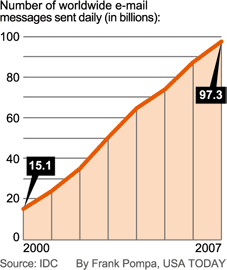
As I get ready to face the coming work week, and the inevitable crush of email notes, calendar scheduling and round-robin electronic Q&A, I’m thinking that the suggestion of “email-free Fridays,” as described in this USA Today report about email overload (link via AdPulp), looks pretty good.

email_surge.gifToday about 150 engineers at chipmaker Intel (INTC) will kick off “Zero E-mail Fridays.” E-mail isn’t forbidden, but everyone is encouraged to phone or meet face-to-face. The goal is more direct, free-flowing communication and better exchange of ideas, Intel principal engineer Nathan Zeldes says in a company blog post.

E-mail-free Fridays already are the norm at cell carrier U.S. Cellular (UZG) and at order-processing company PBD Worldwide Fulfillment Services in Alpharetta, Ga.

I’ve been trying to fight email bloat by keeping the inbox closed for most of the day and checking email just twice a day, as suggested by The low-information diet (PDF). But it doesn’t always work out. It’s too easy to slip into the old habit of leaving Outlook open and checking for messages every 10 minutes or so.

How do you fight the email monster? Do any of you have a campuswide or departmental policy to shut down email from time to time? If so, I’d love to hear how it’s working.