
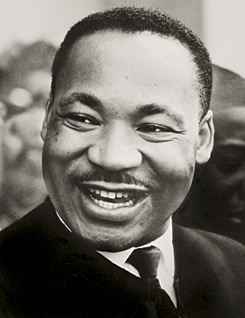
 As our nation honors the Rev. Martin Luther King Jr. today with a national holiday, and prepares to inaugurate our first black president tomorrow, I pause to consider a bit how King’s worldview and moral stance against evil has influenced my own life. I’m in no way attempting to compare my life with King’s, for I’m no civil rights leader, no martyr, no leader of any consequence by comparison. But I’ve long admired King not only for his leadership in civil rights, but more for his clarity of vision in the sense of moral and spiritual matters, as well as his PR savvy. The fact that he understood and used mass media to his advantage should not be separated from King’s quest for justice and equality, but it does point to the man’s ability to use the tools and systems of the temporal world to further more idealistic goals, and that’s something any of us who work with the media ought to understand.
One of the most poignant (brief) commentaries on King’s life that I’ve read comes from Philip Yancey’s book Soul Survivor: How My Faith Survived the Church. Yancey was a good ol’ Georgia boy when the civil rights movement started gaining traction in the early 1960s.
“When I was in high school,” he writes, “the same students who cheered the news of President Kenedy’s assassination also cheered King’s televised encounters with Southern sheriffs, police dogs, and water cannons. Little did we know that by doing so we were playing directly into King’s strategy.”
That strategy, from a media relations standpoint, was brilliant, for it opened the nation’s eyes to the tragedy and brutality of racism. “He deliberately sought out individuals like Sheriff Bull Connor and stage-managed scenes of confrontation, accepting jail, beatings, and other brutalities, because he believed a complacent nation would rally around his cause only when they saw the evil of racism manifest in its ugliest extreme.
“In that goal,” Yancey writes, “King succeeded spectacularly.”
But separate from what Yancey calls King’s “long view of faith,” that media relations success would have rang hollow. “Already convinced of the justness of their cause,” Yancey writes, the civil rights workers “wanted someone to lift their sights beyond the long string of disheartening failures.” King, with his long view that justice will triumph, was the man to do just that.
We now look back on the civil rights movement as a steady tidal surge toward victory. At the time, facing daily confrontations with the power structure and under constant intimidation from policemen, judges, and even the FBI, civil rights workers had no assurance of victory. We forget how many nights they spent in rank southern jails. Most of the time the present looked impossibly bleak, the future even bleaker. …
For King, the long view meant remembering that, no matter how things appear at any given moment, God reigns. Later, when the famous march from Selma finally made it to the state capitol, the building which once served as the capitol of the Confederacy and from which the rebel flag still flew, King addressed those scarred and weary marchers from the steps:
I know that you are asking today, “How long will it take?” I come to say to you this afternoon, however difficult the moment, however frustrating the hour, it will not be long, because truth pressed to earth will rise again. …
* * *
It seems the long view has been in short supply in our culture for many years. Witness what has happened on Wall Street, in our banking industry, and just about everywhere else you look in our culture, and you see the fruits of short-term, get-what-you-can-while-you-can thinking. Even in our educational system, sadly, the short view too often reigns. We live from fiscal year to fiscal year, from project to project. Even our long-range plans extend no further than five years out, and the goals are largely based on numbers, rather than the essentials King spoke of — the essentials of peace, justice and love.
What about us? Do we connect our day-to-day actions, our work, our lives, to a greater, nobler cause? Those of us in higher education ought to. It’s pretty easy, really. We’re in one of the most noble pursuits there is. I’m fond of quoting William Butler Yeats, who supposedly said that “education is not the filling of a bucket, but the lighting of a fire.” On my better days, I like to think that what I do helps to fan those flames of knowledge.
I can’t say I’ve always done the best job of taking the long view, or for contributing to King’s ideal of a world in which peace, justice and love reigns. But re-reading Yancey’s chapter on MLK today has reinvigorated me and encouraged me to think more about the long view — in my job, in my life, in my other pursuits. I hope this post encourages you to do the same.
 Andrew Careaga