
Note: With this post begins a series of book reviews of “books that matter” — or should matter — to higher ed PR/marketing/branding folks, as determined not by me, but by others in the higher ed marketing/PR/branding field. A few posts ago, I asked readers to submit their choices for the single best book that should be required reading for all higher ed marketing, branding and public relations practitioners. I’ve received several very good responses, and so I asked some respondents to write a review about their pick. (If you’d like to share your selection and perhaps write a review, there’s still time to complete the questionnaire.)
The first review in this series comes from Mark Greenfield (@markgr on Twitter). Mark is one of the most well-read higher ed marketing practitioners I know. He’s also a brilliant presenter, a lover of great rock’n’roll, and an all-around terrific person to know. I’m happy to kick off this series of “books that matter” reviews with Mark’s take on why his top pick, The Cluetrain Manifesto, matters for higher education.
The Cluetrain Manifesto
Review by Mark Greenfield
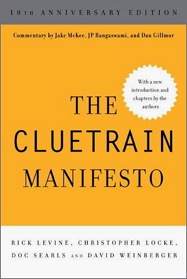 I am a voracious reader. My goal for the past 35+ years has been to read at least 50 books a year and I usually hit that goal. The majority of these books are work-related. So when Andy asked about the best marketing book of all time you might think that I would need some time to think about it. But this is an easy question to answer. The Cluetrain Manifesto, by Rick Levine, Christopher Locke, Doc Searls and David Weinberger, is simply the single most important book ever written about the web and marketing.
First published in 1999, Cluetrain is best described as a cross between In Search of Excellence and Fear and Loathing in Las Vegas. Provocative, pretentious and brilliant, this seminal book describes how the Internet means the end of business as usual. And if you dig deep enough it also means the end of higher education as usual. It’s influence on me can not be understated. I consider it my job manual.
Taking a page from Martin Luther, Cluetrain is structured around a list of 95 Theses. My favorites include:
#15 – In just a few more years, the current homogenized “voice” of business—the sound of mission statements and brochures—will seem as contrived and artificial as the language of the 18th century French court.
#16 – Already, companies that speak in the language of the pitch, the dog-and-pony show, are no longer speaking to anyone.
#23 – Companies attempting to “position” themselves need to take a position. Optimally, it should relate to something their market actually cares about.
#25 – Companies need to come down from their Ivory Towers and talk to the people with whom they hope to create relationships.
The book opens with a very important question. “What if the real attraction of the Internet is not its cutting-edge bells and whistles, its jazzy interface, or any advanced technology that underlies its pipes and wires. What if, instead, the attraction is an atavistic throwback to the prehistoric human fascination with telling tales? The web is touching our most ancient of needs: to connect.” Long before the terms Web 2.0 and social media entered our vocabulary, Cluetrain was talking about “markets as conversations,” transparency, authenticity, trust, and the need to speak human.
‘What if the real attraction of the Internet …
is an atavistic throwback to the prehistoric human fascination with telling tales?’
Cluetrain does a great job of explaining the historical context of marketing and public relations and how the web will return us to the days of the ancient bazaar, when marketing was based on creating relationships — and why this is a good thing. “The first markets were filled with people, not abstractions or statistical aggregates; they were the places where supply met demand with a firm handshake.” But the “Industrial Interruption” came along. Mass production led to mass marketing, which led to mass media. And therein lies the problem. “Corporate speech became mass produced messages jammed into a one-way spam cannon. Messages are worse than noise. It’s an interruption. It’s the Anti-Conversation. The awful truth about marketing is that It broadcasts messages to people who don’t want to listen. In today’s world the broadcast mentality isn’t dead by any means. It’s just become suicidal.”
The web changes everything. “The long silence — the industrial interruption of the human conversation — is coming to an end.” The only advertising that was truly effective was word of mouth and the “Word of Web offers people the pure sound of the human voice, not the elevated empty speech of the corporate hierarchy.”
My favorite rant in Cluetrain is about public relations. “Public Relations has a huge PR problem. People use it as a synonym for BS. The standard press release describes an ‘announcement’ that was not made, for a product that was not available, quoting people who never said anything, for distribution to a list of people who mostly consider it trash.”
Cluetrain takes direct aim at marketing jargon. “We have to stop using techno-latin which is a vocabulary of vague but precise-sounding words that work like blank tiles in Scrabble: you can use them anywhere, but they have no value. In TechnoLatin, a disk drive is a “data management solution.” A phone is a “telecommunications device.”
While many people may think Cluetrain is anti-marketing and anti-PR, that is not the case. Marketing and PR just need to return to their origins. The best of people in PR are not PR types at all. They understand they aren’t censors, they’re the company’s best conversationalists. “In the age of the web where hype blows up in your face and spin gets taken as an insult, the real work of PR is more important than ever.”
Cluetrain was the first web book I read that emphasized the importance of telling stories. “Most of our conversations are about stories. Stories are a big step sideways and up from information. We are human. Stories are how we make sense of things. Anything else is just information.” During the course of my consulting work, I always challenge the school I’m working with to rewrite their missions statement as a story.
‘Stories are a big step sideways and up from information.’
So is the Cluetrain applicable to higher ed? Absolutely. One of my favorite presentations is called “The Cluetrain Comes to Higher Ed, Will Anyone Take Delivery?” When I was developing this presentation I spoke with Cluetrain author Doc Searls on Twitter and he responded, “Gotta say the higher ed is a tough nut to crack”. IMHO, higher ed is about to implode and the institutions that follow the principles of Cluetrain are the most likely to survive. I’m thinking it may be time to dust of this presentation and present it again in 2013.
I’ve seen the future, and it’s The Cluetrain Manifesto.
 “The bigger they are, the harder they fall” is an adage that seems to hold true for big brands in social media these days. When big brands mishandle a situation in the social media sphere, the fallout can be significant for the companies.
 Andrew Careaga