
 On Nov. 10, 2008, the university where I work launched spacebook, a blog by NASA astronaut and Missouri S&T graduate Sandra Magnus. (I also posted about it that same day.) That same day, we launched our PR campaign announcing the site. We notified schools, the dozens of kids who participated in our campus’s aerospace camp last summer, alumni, bloggers, the mainstream media, state legislators, and our internal audience of students, faculty and staff. We sent targeted messages to groups via email, Twitter, our website, Facebook and many other avenues.
The result has been some pretty nice bit of buzz for our campus, both in the mainstream media of newspaper, TV and radio and in the new media world of blogs, microblogs and social networks. (We keep track of the main media mentions on our Delicious site and collect it all under a single category.)
It’s great to tell people about the great media coverage we’ve received. But what kind of conclusions can we draw about that coverage’s effectiveness to drive people to the website? There’s the anecdotal information, such as comments like this received on the blog: “Before you left for this mission, ksdk news channel 5 announced, ‘Belleville native heading into space’…” But as the saying goes, “The plural of anecdote is not data.” It’s a nice anecdote, but it isn’t really measurable.
So, how effective have our promotional efforts been to draw people to the site? For this mini case study, I’m going to share some information based on referrals.
Breaking it down
In the 10 days since the blog was announced, spacebook has seen 5,009 unique visitors. The breakdown looks like this:
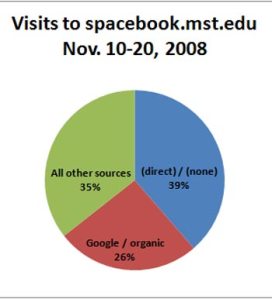
- Direct (no referral): 1,936, or 39 percent of the total
- Google (organic search): 1,288, or 26 percent
- Everywhere else: 1,785, or 35 percent
It’s the “everywhere else” category where we find the mainstream and social media at work. Below is a breakdown of traditional vs. social media referral sites (traditional in blue, social media in red):
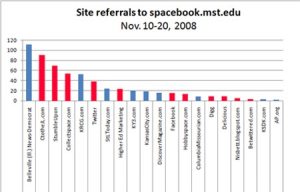
OK, the graphic is unreadable, even if you tilt your head to the left. So just let the pretty colors tell the story, and I’ll fill you in on a few details.
The top referrer among mainstream and social media was the Belleville (Ill.) News-Democrat, which is Sandra Magnus’ hometown newspaper. But the Nos. 2, 3 and 4 referral sources are all social media sources. Missouri’s two major daily newspapers, the St. Louis Post-Dispatch and the Kansas City Star, are the seventh- and tenth-place referral sources.
When lumped into two groups, the impact of social media as a referral source becomes more apparent.
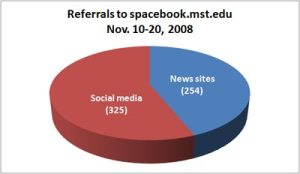
The social media side of the pie, like a Pac-Man with unhingeable jaw, appears poised to eat mainstream media for lunch. But the main news sites still appear to be a mouthful, and won’t be easy to swallow.
Conclusion: Social media is definitely a player in getting visitors to your website. But that’s really stating the obvious, isn’t it.
Now, don’t read too much into this little exercise. The fact that some social media tools, such as Twitter, outperformed main news sites in terms of driving traffic, doesn’t mean traditional media is not effective in building interest and buzz. In terms of “opportunities to view,” no doubt the Post-Dispatch and Star had numbers much higher than many of the websites that touted spacebook.
Plus, this is skewed somewhat by my own blatant promotion of spacebook on this blog and via Twitter. (It’s also been a regular link on the @MissouriSandT Twitter site.)
Still, it is kind of interesting to see where your traffic is coming from. And this data may help someone who’s interested in launching a PR campaign to drive visitors to the web.
 Andrew Careaga