
Friday Five: viral edition

Viral is all the rage, it seems — in video, in marketing, in sickness. Or at least it’s enough of a rage to give me enough Friday Five fodder.

  • Let’s start off with SCADshorts, a viral video campaign developed by the Savannah College of Art and Design. Developed by the Dandy Dwarves, a group of SCAD alumni who put their video production education to work, the campaign consists of a series of oddball videos — one a month — that are part of a puzzle prospective students must solve in order to win an iPod. Morgan Davis of erelevant offers his take on this clever campaign.
  • More about viral video from Karine Joly, who discusses how Vancouver Film School made the most of one graduate’s video, “Piece of Mind” (YouTube link), by creating and releasing on YouTube it’s own “making of” video (YouTube link). “In this 7-minute video,” Karine writes, “VFS manages to let this talented student promotes the Canadian institution, its professors and its offering – all this done by presenting the work that went into ‘Piece of Mind.'”
  • Great writing, unfiltered. Seth Godin extols the benefits of infectious prose that is free from corporate filters, and creates a mini-virus by uncovering some pretty decent, linkable bloggage. “The filter,” Godin writes, “is important, sometimes. It keeps us focused and on time and from veering too far in the wrong direction. But in a Long Tail world, the filter is actually better off gone.”
  • In what we hope will become a viral campaign across campuses, 70 presidents of U.S. colleges and universities have signed the Presidents Climate Commitment, a move to make college campuses more sustainable.
  • Virality is not confined to cyberspace. Take the underground press movement. It’s alive and well on a campus where you’d least expect it: right here at UMR, a predominantly engineering- and technology-oriented university. While the official student newspaper (The Missouri Miner) is threatening to sue the university and student council for cutting the paper’s budget, a group of students have created an alternative newspaper called The Mineshaft. (Tag line: “Where the real news is buried.”) This weekly publication sprang up in December. In the fine tradition of Soviet samizdat newspapers, The Mineshaft is printed on 8 1/2-by-11 paper, photocopied and distributed throughout campus. All the writers use pseudonyms, but according to the latest edition, that may change. (Writes Sybil, the editor in chief: “While we initially thought that anonymity would allow for all discussion to be on our content, we have found instead that the issue of who we are has just become even more controversial.”) The writing and reporting isn’t terrific — as I said, most of our students are here to study engineering, and we have no journalism program — but the spirit behind The Mineshaft is right.

The graying of the American college president

An American Council of Education report released earlier this week predicts “a major turnover in the leadership of American colleges and universities in the next five to 10 years” due to coming retirements of many college and university leaders, USA Today reports.

“Nearly half of the 2,148 leaders of public and private institutions who responded to the ACE survey were at least 60 years old,” the newspaper reports. “Only 14% of presidents were over 60 when ACE first surveyed presidents in 1986.”

The ACE report also presents the job of a university president in a less than flattering light. The decline in state funding, increased competition for students and dollars, and other factors make the job less appealing than in years past. The USA Today report quotes Patricia McGuire, president of Trinity University in Washington, D.C., who “said increasing demands of the job raise the question of whether the next generation will want to take the place of retiring presidents.”

“Time was when a college presidency seemed like a pretty nice job. The details were not quite so clear, nor the pressures,” [McGuire] said. “I think by illustrating both the range of tasks and the nature of the pressures, I think it raises some interesting issues about how the next generation would even view these jobs.

“On the one hand, they’re very prestigious. They pay well,” McGuire said. “On the other hand, there’s an enormous amount of stress. And that could be off-putting.”

Getting social with the online newsroom

The social media newsroom from Shift Communications
Todd Defren of PR Squared and Shift Communications — who brought you the social media news release (or SMR) — has been thinking about what a social media newsroom might look like, and recently introduced one concept (pictured above). Download the PDF for free.

Link via MarcomBlog, where Dee Rambeau expounds on the concept.


Getting personal on institutional blogs

Writer and social marketing consultant Jeneane Sessum‘s recent post about how much personality to inject into a corporate blog (and the Diva Marketing Blog post she links to) both offer some serious food for thought to we few who blog on behalf of our employers. While some of us do both, how much of our personal information should we share in a corporate (or, by extension, educational) blog? Sessum writes:

Questions — Can you write ‘personally’ without sharing details from your personal life? Can a professional blog be personal and professional too and still be ‘weighty’ enough to matter?

What are the risks of integraing or separating your “selve(s)” online. And what about other social spaces–profiles on myspace, orkut, friendster, facebook; professional connections on linkedin, ‘personalities’ on second life; photos on flickr; videos, podcasts and everything else Media 2.0? Are we becoming more dissociated or more integrated?

This hits close to home for me since launching UMR‘s name change conversations blog just under two weeks ago. I want the prose to be lively and conversational — or at least readable and certainly not “institutional.” But I try to maintain a professional distance in my writing on that blog.

I liken the approach to that of the newspaper editorial writers whose job it is to present the “platform” of their employer. If we really need an outlet for our own voices, there’s always the opportunity to create a personal blog (like this one, or this) to sate our egos and give voice to our souls. Here, I can tell you that I’m digging the new Rickie Lee Jones CD, and that although the new Bloc Party is inventive and a new direction, it pales in comparison to Silent Alarm. But I won’t bring these topics up on the institutional blog. It’s irrelevant, and not appropriate to the purpose or audience of the blog.

CollegeWebEditor.com gets a makeover

To celebrate her two-year anniversary in the blogosphere and her 300th post, CollegeWebEditor.com blogger Karine Joly plans to unveil an updated version for her blog on Monday, Feb. 12. The change isn’t a radical departure from the current look, but she’s reorganized a few things and has tweaked the interface enough to merit a mention.

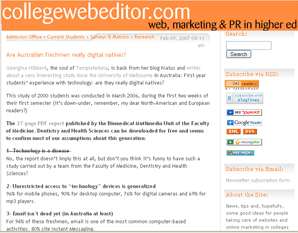
Here’s the current look:

CollegeWebEditor.com - the old look

And here’s what you’ll see starting on Monday:

CollegeWebEditor.com - the new look

Karine shared her plans with some fellow bloggers in an email on Sunday. To the chagrin of some readers (but not me), she decided to keep orange as a mainstay color. Among the new features, according to Karine’s email:

  • a selection of the best higher ed bloggers
  • a direct link (top tab) to Higher Ed TV, a growing selection of the best higher ed videos available on YouTube
  • an about page (top tab) with a photo (mainly for my mom ;-)
  • an attempt to make some money to pay the hosting bills via an integrated Amazon bookstore (I’m not holding my breath, though, with a 4% commission – and have just included a few books for now

So, drop by Karine’s place and let her know what you think about the new look. I’m sure she’ll continue to post some of the best content out there for higher ed marketing folk.