Fun with Twitter StreamGraphs

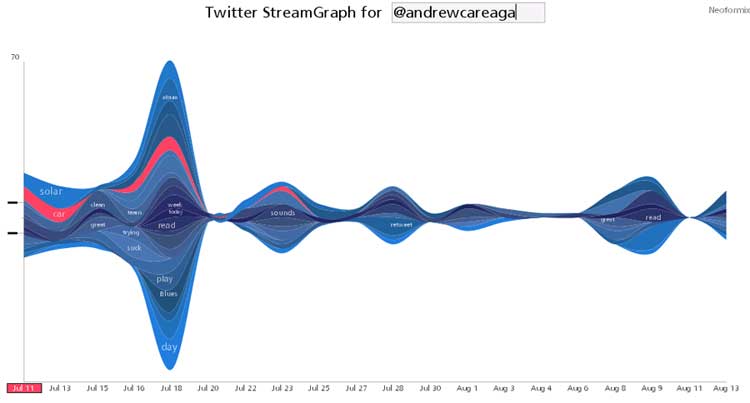
The Twitter StreamGraph shows the last 200 tweets from me (@andrewcareaga). Click to enlarge.
Will the creation fun new analytics toys for Twitter ever end? My latest obsession is Twitter StreamGraphs, a tweet- or term-visualization tool from Jeff Clark of Neoformix. (Hat tip: @esigler.)

Type any search term into Twitter StreamGraphs and it generates an interactive visualization of the past 200 posts on that topic. Same goes for a Twitter user’s name. At right is a thumbnail screenshot of my past 200 tweets. Click the image to enlarge.

I haven’t figure out how useful this visualization tool is. But it’s kind of fun to play around with. I’m sure it could provide some benefit to Twitter analytics, assuming Twitter ever turns into something worth analyzing.

Clutter vs. clarity

Question of the day: How do you deal with clutter?

I’m not talking about physical clutter — the piles of work on your desk or the boxes of stuff shoved underneath it. I’m talking about the verbal and visual clutter, the stuff that creeps into your articles, publications and web designs like weeds in your garden.

How does that clutter get there? After all, we’re the communications pros, right? We’ve all read Strunk and White (“Omit needless words!” is the mantra there), and we’re all schooled in the less-is-more aesthetic of design.

So we’re not the problem, right? It’s those other guys. Those professors who insist on cramming into your tidy news release an extra paragraph that describes the research in excruciating, scientific detail. That administrator who insists the announcement about a new research grant or faculty appointment includes a quote from every vice-something-or-other or every funding agency big-wig who was involved in the process of obtaining said grant or hiring said faculty member. The development officer who insists that the design include a crappy 72dpi photo of the donor — “Sorry, it’s the only picture we’ve got” — on the cover of the scholarship brochure. The Executive Council members who insist that your website design has omitted links to at least two dozen vitally important offices or departments, and they insist those links be retrofitted into the design.

They insist, insist, insist.

Desist!

How do we resist?

Then there’s the other issue: dealing with the designs and prose of other departments who come to you for help. (Those are the good guys. The renegades just do their own thing and you find out about it however you can.) As our department assumes more responsibility of “managing the brand,” we find ourselves dealing with more of these issues. Well-intentioned department admins and the PR chairs of student organizations come to us with their logo designs, newsletters, etc., and most of these items are cluttered. (And cliche-ridden. But that’s a topic for another day.)

From my experience, the student groups and admins usually appreciate our advice and guidance to cut the clutter. We dole it out as tactfully as we can. With other customers, we have to be blunt. Sometimes that bluntness comes across as arrogance. Other times, when it’s a political dilemma (often the case in academe), we offer our advice, then hold our nose and do what the customer wants.

But I digress. (Talk about clutter.) Back to the question of the day: How do you deal with clutter?

P.S. – I didn’t even touch on PowerPoint. But here’s a slideshow that presents the case against clutter quite well.

Wanted (still): electronic marketing whiz

That electronic marketing position I mentioned on this blog a few weeks ago? We’ve reopened the position. For some reason we’re having a hard time getting qualified applicants who want to come to Rolla, Missouri. It’s not a bad place to live, especially if you love the outdoors, fly fishing, canoing/kayaking on spring-fed streams, hiking, camping, etc. We also have wineries nearby, a Wal-Mart Super Center, indoor plumbing and other modern amenities. So, please, if you’re looking for a new challenge in the high-profile, fast-paced world of electronic marketing in higher education, visit our HR website for more info.

Seriously, this would be an ideal fit for someone who has an interest in convergence. It’s more than just a web position. And you’d get to work with some great people.

The other position I announced here, for the assistant director of sports information, yielded 18 applicants.

Wanted: Examples of great integrated marketing

For an internal evaluation of our communications operation, I’m seeking the wisdom of the crowd.

I’m looking for examples of institutions that are the best integrated marketing, and would welcome readers’ comments on this topic. For the purpose of this project, I’m using the BrandSavvy definition of integrated marketing, which is:

Integrated Marketing – coordination between a variety of communications and advertising to ensure the messages and imagery are consistently received by the greatest possible number of people across multiple venues.

For my research, I’ll be looking beyond the walls of academia. But knowing that many higher ed marketing experts read this blog, I’m looking for your insight. I’m looking for truly integrated marketing, meaning consistency of message in:

  • admissions
  • alumni relations
  • athletics
  • internal communications
  • electronic marketing (not just web communications)
  • PR and media relations
  • brand identity
  • graphic identity

So, if you would like to suggest a college or university you consider to be “best in class” in the realm of integrated marketing, please comment below and give me a reason or two why you believe this institution is best in class.

I look forward to hearing from you, and once I conduct some shirtsleeve research on this subject, I’ll be sure to post about it.

Thanks much.