
Recently, Academic Impressions writer Daniel Fusch chatted with Teresa Parrot and me about developing a social media strategy. (Teresa and I will co-present an Academic Impressions webinar on that topic in a couple of weeks.) Daniel’s article, Crafting a Social Media Policy, is hot off the press and featured in today’s “Higher Ed Impact” e-newsletter from Academic Impressions.
Month: June 2010
Friday Five: Twitter favorites edition
Five read- and/or view-worthy items plucked from this week’s Twitter stream:
- 4 tools for better Facebook marketing from HubSpot (via @cksyme). (P.S. – Check out Chris Syme’s wonderful blog, New Adventures of an Old SID.)
- Twitter usage in America, the results of a 3-year study by Edison Research and Arbitron presented on Vimeo in the form of a 44-minute webinar/slideshow. Some interesting tidbits here. (For instance, nearly 1/4 of Twitter users are African Americans.) If you want the full report, you can download it for free by signing up at this Edison site. (Via @ggrosseck.)
- Glenn Reynolds: the higher ed bubble is about to burst (via @EMGonline).
- ‘Sex between ideas is the source of creativity’ — a fascinating piece on the evolution of humans and creativity (via @gapingvoid).
- The Star Wars kid grows up, and is now a law student (via @NewsSocialMedia).
Have a good weekend.
Our national science education agenda
How is it that in the midst of the worst environmental disaster in U.S. history — a catastrophe that can be attributed at least in part to technological hubris — the Obama administration is proposing cuts to many national programs that are designed to expand education in science, technology, engineering and mathematics?
That was my first thought when I saw this item in Tuesday afternoon’s update from the Chronicle of Higher Education.
The Chronicle reports that as a follow-up to “a pledge to freeze spending unrelated to national security over the next three years, the White House is asking federal agencies to offer plans to shave 5 percent from their budgets by eliminating their worst-performing programs, and among them are some connected to higher education.” During a news conference on Tuesday, President Obama’s budget director, Peter R. Orszag, “singled out mathematics and science education, youth mentoring, and job training for cuts, noting that the federal government offers more than 110 programs focused on science, technology, engineering, and math education, 100 mentoring programs, and 40 employment programs,” the Chronicle reported.
As I read that brief account, two things struck me:
- How are math and science education programs “unrelated to national security”?
- During this time of national technological crisis, shouldn’t we be investing more in science, technology, engineering and mathematics (STEM) education?
Then I looked at the list of programs on the federal STEM funding list (PDF). Yes, a number of programs are slated for elimination or reduction. They include some that, based on title alone, appear to have some bearing on our national security (as well as our future as a leader in technological innovation). For instance, the number of Nuclear Regulatory Commission’s Integrated University Program items would be reduced from 15 to 5. I don’t know what that entails, but at a time when we’re hearing so much talk about the move from a carbon-based economy to a low-carbon one, it seems investment in nuclear energy education would be worth keeping flat at the least.
Furthermore, programs designed to attract more underrepresented minorities into the STEM disciplines appear to take a big hit. The National Science Foundation’s Historically Black Colleges and Universities Undergraduate Program would be cut from 32 participants to zero, and two other NSF programs for minorities — the Louis Stokes Alliances for Minority Participation and the Tribal Colleges and Universities Program — would go from 45 and 13 programs to zero, respectively. Maybe these are among the “worst-performing programs” referenced in the Chronicle brief.
But on further inspection of the STEM document, the NSF’s total number of programs would actually increase by 26 programs — from 1,151 to 1,177 — and overall, the number of STEM education programs would increase by almost 1 percent (from 3,681 to 3,718).
So, it appears to be a shell game. But an interesting one that may tell us something about our nation’s agenda for STEM education, or lack thereof. Perhaps this is the price we’ll pay as a nation for failing to reauthorize the America Competes Act last month.
From blogroll to graveyard
While doing some blog housekeeping this week, I decided to weed out a raft of blogs in the higher ed category of my blogroll. Gone from the roll are those higher ed blogs that were either extremely stale (no posts since 2009 or earlier) or missing in action.
These blogs have been purged. May they rest in peace:
http://emerille.wordpress.com/
http://radio-weblogs.com/0114870/
http://inspiredannualgiving.com/
http://www.karlynmorissette.com/
http://www.professional-lurker.com/
http://www.steincommunications.com/thescoop/
http://ubrander.wordpress.com/
I hated to let some of them go, because they were fine blogs in their day. But if they’ve been abandoned by their creators, why should I attempt to keep them on life support?
P.S. – If you are the owner of one of these blogs and you do start posting again, please let me know so I can resurrect your link on the blogroll.
P.P.S. – While housecleaning, I added four other noteworthy blogs to the higher ed blogroll: EMG’s Brand Manager’s Notebook, Ron Bronson’s edustir, Dave Olsen’s Mobile in Higher Ed blog and Rachel Reuben‘s blog.
P.P.P.S. – I know I also need to prune the other blogroll categories. (One of these days.)
What hath @BPGlobalPR wrought?
It had to happen, I guess. The popularity of the faux Twitter account @BPGlobalPR has spawned a legion of imitators. As Mashable reported recently, “The @[insert name here]GlobalPR Twitter account is a true blue meme.”
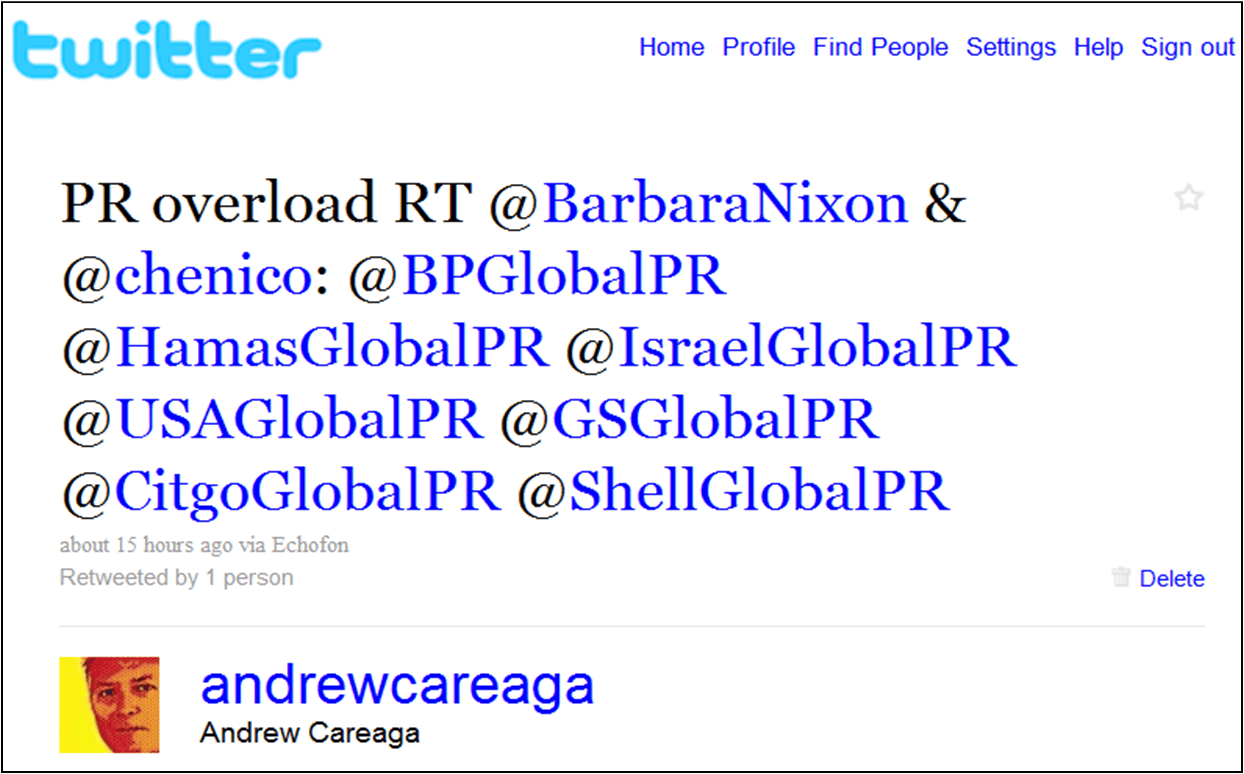
Faux Twitter accounts are nothing new. (Remember @FakeSarahPalin?) But it takes timing, originality and just the right level of acerbic satirical commentary to pull it off. The success of @BPGlobalPR comes from the mix of those three elements.
@IsraelGlobalPR may also have what it takes to separate from the pack of imitators. The account’s timing was impeccable — it launched the same day Israeli commandos raided that flotilla headed for Gaza — and its focus is narrow enough and its voice consistently in character. But other copycat GlobalPR accounts, such as @USAGlobalPR, are just horrible imitations. My Twiter pal @KyleJudah and I agree that this slew of faux Twitter copycats are more lame than meme-worthy.
Maybe the whole @[insert name here]GlobalPR meme just needs better PR. Sadly, I don’t think @PRGlobalPR is up for that challenge.