
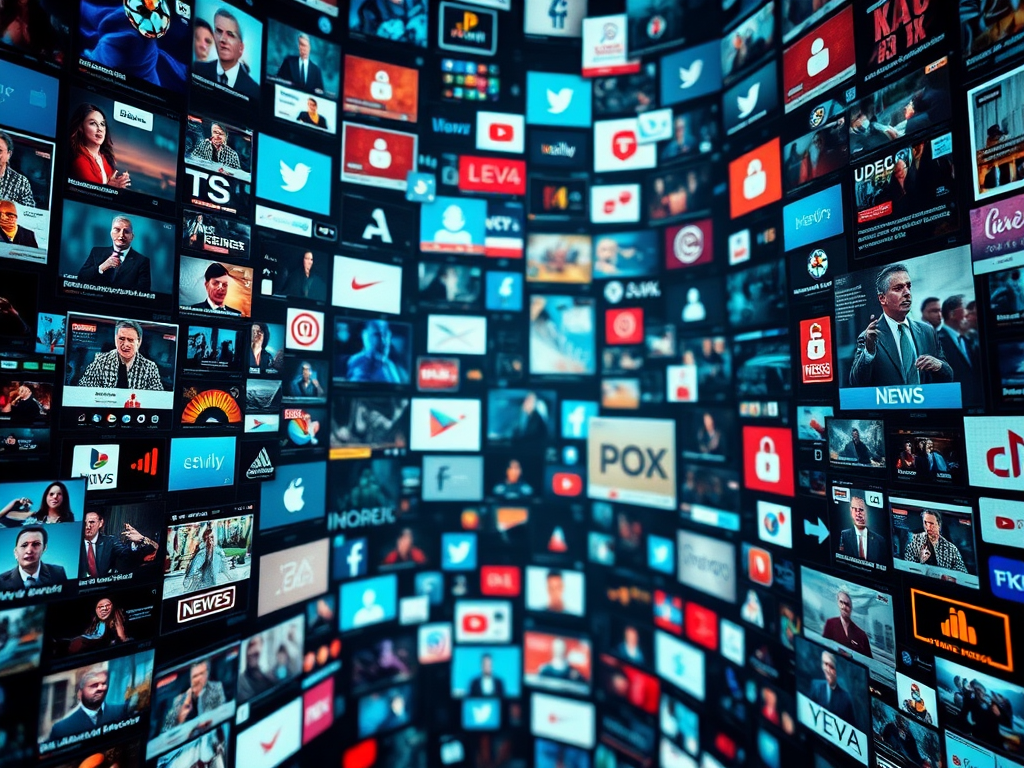
I’d gotten sick and tired of the news — and even more weary of the distortions and reverberations of news and pseudo-news that skittered around the social media universe like ripples from a thousand stones thrown simultaneously into a sludgy pond. Stories and rumors of Haitian immigrants eating cats and dogs, the backlash to Taylor Swift’s announced support for Kamala Harris, the hate and vitriol spewing forth on cable news and X, which Elon Musk, despite his supposed commitment to making the platform a space for free speech, has turned into a raging hate machine — all of it was taking its toll on my soul and psyche.
So I decided to heavily curtail my consumption of news and news-related information. I could go without news for a week, I thought to myself. It wouldn’t be easy for an info-junkie like me, but I would do my best.
I typically receive about 30 or so emails from news and opinion sources throughout each day. Some of the sources send out multiple emails throughout the day. I take full responsibility for subscribing to some of the add-on newsletters or breaking news updates, so I’ve brought a lot of it on myself.
For a full week, I deleted each message without opening. I deleted every email from the New York Times, Washington Post, Wall Street Journal, CNN, Axios, Missourinet, The Free Press, The Neutral, Breitbart (which I read just to see what the crazies are feasting on), Anna Cox Richardson (my daily dose of sanity), and others.
I also curtailed the time I spent on social media, especially X, although I still peeked in on that site to catch up with what authors and literary magazines are doing, usually by consulting my X/Twitter list of such mags. I also dropped in there and on LinkedIn to post links to my latest blog posts, and scanned Facebook to wish people a happy birthday or leave the occasional thumbs up on someone’s post.
Here are a few things I’ve learned:
- Weaning myself from the blur of news feeds was easier than I thought it would be. I don’t really miss regular data dumps, and as I begin day 8, I’m experiencing no symptoms of withdrawal.
- It felt liberating. Giving myself permission to not be up on the news and commentary was like removing a heavy stone from my chest. I could breathe again.
- I’m spending more time reading the writing craft newsletters that I receive in my inbox. Most of these are weekly or monthly notes, so they don’t feel overwhelming, and they seem to be spaced out, in some organic rhythm, so that they don’t all arrive at once, say, on a Wednesday morning.
- I’m spending more time writing and editing. I’m not spending enough time writing and editing, but even a few extra minutes here and there helps.
- There’s never a right time to go on a media/social media fast. The day I began this experiment was the same day a man was arrested outside of a golf course where Donald Trump was golfing. Apparently, the guy was going to attempt to assassinate the former president, although I don’t know that for sure. I’m sure you could Google that if you want the scoop. That, of course, was big news. And I missed all of it.
Reducing ‘infobesity’
Several years ago, when paper memos reigned and fax machines were all the rage, I read a book called Data Smog: Surviving the Information Glut. The publisher called it “a trenchant and informed critique of the impact of data smog — information overload — on individual well-being and our society as a whole.” Although I don’t remember much about the book now, I’m sure it was trenchant for its time. But I doubt the author could have imagined what was to come.
Yesterday morning, as I was happily deleting the overnight emails, I paused before deleting the latest missive from a guy named Michael Woudenberg, who publishes a weekly newsletter called “Polymathic Being.” It was the title for this week’s edition that caught my eye: “Avoiding Infobesity.”
This issue could not have been more timely. (Actually, it could have, if it had arrived right before I began my media diet. But I probably would have been too overloaded with trying to keep up with all the day’s news to have noticed it.) Woudenberg writes about the very issue I had been battling, and does so quite well. He writes:
Let’s take a moment and think of information like we think of food. We know that a diet of ultra-processed, commercially produced, marginally nutritious, and sugar-laden food, in large quantities, leads to physical obesity and subsequent health issues.
Information follows the same pattern. News media commercially churns out a never-ending torrent of information. Social media influencers are ultra-processed and contrived while the algorithms feed us sugar-laden clickbait. Our information diet typically contains limited mental nutrition to keep our brains fit and healthy.
Then add in the opinions that most problems can be solved with more information. If only we had just a bit more we’d be able to overcome all social ills. Terms like ‘low information’ or ‘uninformed’ voters are used as a pejorative and the solution is always to pour more and more information down the throats of audiences. If we top it off by blocking access to opposing information there’s no balance to our diet.
Counterintuitively, this approach is also guaranteed to backfire. More information is not better because we are not cognitively wired to make better decisions based on more information. We are wired for exactly the opposite and all this information is just making us cognitively obese, out of shape mentally, with decision fatigue.
If you get only one thing from that passage, let it be this one:
More information is not better because we are not cognitively wired to make better decisions based on more information. We are wired for exactly the opposite.
This is a dense essay, as are most of Woudenberg’s, and takes some time to read and absorb, but I do suggest you give it a read, even if it takes a few sessions. I’ll be revisiting it and some of the sources he links to. It certainly is helping me consider my news and social media habits in a different light.
As for my experiment: I plan to continue to limit my intake. I’ll probably unsubscribe from some of the sources I routinely scan, and I will continue to curtail my presence on social media, especially the seedier side (e.g., the main feed) of X/Twitter.
AI-generated image.

 Andrew Careaga
Just don’t get so abstemious that you curtail blogging.
I doubt that will happen anytime soon!