

Today is Indigenous Peoples’ Day in the U.S. It’s celebrated on the second Monday of October, the same date as Columbus Day, to honor the history, culture, and contributions of Native Americans. What better way than to share some of the writings of Native American authors? Here are a few I recommend.
Reservation Blues, by Sherman Alexie

I’m embarrassed to say I’m only now reading Reservation Blues, the 1995 debut novel by Sherman Alexie, a Native American writer who grew up on the Spokane Indian Reservation in Washington State. That reservation is the setting for much of this novel’s story, beginning with the mysterious appearance of famed bluesman Robert Johnson — who, according to legend, made a deal with the devil to become the most masterful guitarist who ever lived. Fittingly, Johnson meets reservation storyteller Thomas Builds-the-Fire at a crossroads, leaves his magical guitar in Thomas’ care, and sets off to search for Big Mom in the mountains. Guitar now in his possession, Thomas starts a Native rock’n’roll band, Coyote Springs, with two other men from the reservation. In one of their early gigs, they meet sisters, Chess and Checkers Warm Water, and their band expands.
I first discovered Alexie’s writing in the ’90s, when I read one of his stories in an annual Best American Short Stories anthology (I forget which). From there, I discovered his short story collection The Lone Ranger and Tonto Fistfight in Heaven, which weaves together stories that feature some of the same characters as Reservation Blues. Both books, and I assume much of Alexie’s other works, offer readers insight into the struggles of reservation life, as well as glimmers of hope.
Sherman Alexie also publishes his musings on a terrific Substack. Check it out if you want to read more of his work.
The Night Watchman, by Louise Erdrich
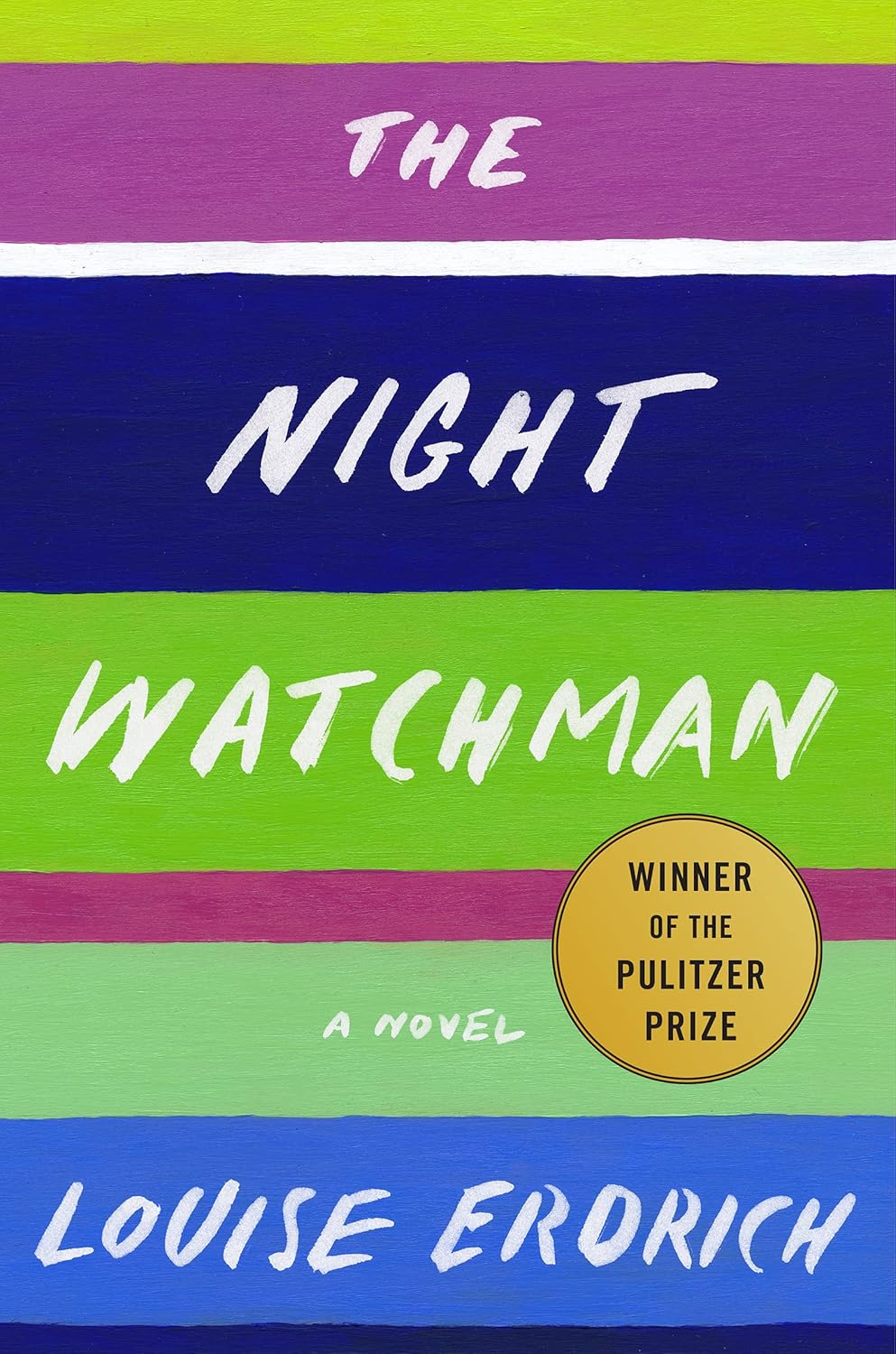
Louis Erdrich has been writing great fiction since the late 1970s. An enrolled member of the Turtle Mountain Band of Chippewa Indians, she based The Night Watchman on the real-life experience of her grandfather, who was a Chippewa Council member in the 1950s and worked as a night watchman at a jewel bearing plant near the Turtle Mountain Reservation. As a council member, he fights against a new “emancipation” bill in Congress that threatens his tribe’s rights to their land and their very identity. The story of the night watchman (Thomas) intersects with others on the impoverished reservation, including Pixie, who works at the jewel bearing plant and wants to be known by her real name, Patrice; her sister, Vera, who Pixie/Patrice sets out to find after she left for Minneapolis and never returned; and a young Chippewa boxer named Wood Mountain. Erdrich’s wonderful storytelling, honed from a young age (her grandfather would give her a nickel for every story she told him), shine in this novel, which won the Pulitzer Prize in 2021.
Erdrich’s latest novel, The Mighty Red, was just recently released. I’m looking forward to reading it soon.
There There, by Tommy Orange

What a strange title for a book, I thought upon first learning about Tommy Orange‘s debut novel, There There. It sounds like words to pacify someone suffering from some minor ache — like a mother trying to soothe a child who skinned a knee — but missing a comma. But Orange, a member of the Cheyenne and Arapaho tribes of Oklahoma and a native of Oakland, California, borrowed those words from Gertrude Stein’s much-quoted statement about their mutual hometown. (Of Oakland, Stein once said, “there is no there there,” a statement that has been misunderstood as meaning Oakland has no character, when in fact Stein was referring to the house she grew up in, which no longer existed.)
While Alexie and Erdrich write mainly about Indian reservation experiences, Orange focuses on the lives of Native Americans who live in an urban place. The story follows 12 Native Americans all traveling to a big powwow in Oakland Coliseum and their interconnected lives. The Amazon.com description describes it well: There There has “’so much jangling energy and brings so much news from a distinct corner of American life that it’s a revelation’”’ (The New York Times). It is fierce, funny, suspenseful, and impossible to put down — full of poetry and rage, exploding onto the page with urgency and force. There There is at once poignant and unflinching, utterly contemporary and truly unforgettable.”
After you’ve read There There, you’ll want to read Orange’s follow-up, semi-sequel novel, Wandering Stars, which came out last February.
What did I miss?
What other Native American writers should we know about? Sound off in the comments.
Image by Quinn Dombrowski from Berkeley, USA, CC BY-SA 2.0 https://creativecommons.org/licenses/by-sa/2.0, via Wikimedia Commons

 Andrew Careaga