

Today is Indigenous Peoples’ Day in the U.S. It’s celebrated on the second Monday of October, the same date as Columbus Day, to honor the history, culture, and contributions of Native Americans. What better way than to share some of the writings of Native American authors? Here are a few I recommend.
Continue reading “Some Indigenous Peoples’ Day reading (with videos)”Tag: book reviews
Friday Five: Q&A with Roy Adler and Tom Hayes, authors of ‘University Marketing Mistakes’
 I’m working on a review of a new book from CASE titled University Marketing Mistakes: 50 Pitfalls to Avoid. The authors, marketing profs Roy D. Adler (Pepperdine) and Thomas J. Hayes (Xavier), bring plenty of higher ed experience to the discussion. They also got a lot of help from the higher ed community, as each of the pitfalls outlined in the book are based on real-life examples from the trenches.
Adler and Hayes were kind enough to respond to my pre-book-review Friday Five questions for this blog. I gave them the option of combining their comments into a single response for each question. The responses are below.
1. Why did you decide to write this book?
As marketers, we saw the same mistakes being made again and again at different institutions across the country. Part of the problem is that marketing is not yet fully integrated and understood within the Academy. The result is that schools continue to make mistakes that are violations of the most basic marketing principles. That said, we noticed that even experienced marketers can become overwhelmed by their responsibilities and allow things to fall through the cracks. So the dual purpose was to boil Marketing 101 down for those new to the job so they would avoid mistakes, and to remind experienced marketers of potential pitfalls that may require attention. In the end, we can all learn from each other.
We thought that a book of short, humorous, based-on-real-life cases would be a good vehicle to involve the reader and create some aha moments. All of the cases were based on real situations, and each case concludes with a “marketing lesson” so that a similar situation can be avoided. We’ve found that important life lessons can best be learned if leavened with a dose of humor, and we hope our readers agree.
2. Spoiler alert: You actually describe 53 pitfalls, rather than the advertised 50. Of those 53, which one do you believe is the most common pitfall in higher ed?
There are about 3,600 4-year colleges in the U.S. and each one would place a different set of pitfalls among their top ten. But the biggest category of pitfall is probably lack of research. In terms of payback-per-dollar-spent, investment in quality research is probably the best investment a university can make. That is why we devoted eight of our 53 cases to that area. By the way, we presented 53 cases instead of 50 because we always try to exceed expectations.
3. I see you’re planning a second edition, so I guess that means we have even more mistakes to learn from. Care to give us a hint of one of the “new” pitfalls?
The content of the new book is being kept under wraps, but a good portion of it will be dealing with issues created by the encroachment of new, flat-world technology on universities. Universities, on the whole, have have historically been very resistant to change, and we will add some insight on the issues of if, when, and how to incorporate specific changes into your school.
4. This is a bit off-topic from the book, but what single piece of advice would you each give readers who are interested in a career in higher ed marketing?
Study marketing, and especially the marketing of services across industries! Education is a very expensive service in terms of both time and financial investment, and every service needs to manage expectations and over-deliver results. No industry is like education, of course, but many of the challenges other industries have met are surprisingly like the ones we are facing in education today. Learn from the experiences of others.
5. Which college or university really is the best-kept secret in higher education?
After an extensive analysis of all 3,600 American universities, the authors have determined that there is a tie for first place between Pepperdine and Xavier. By coincidence, those are the two schools where the authors teach.
—————-
Now playing: The White Stripes – Bone Broke
via FoxyTunes
A little more conversation: ‘Beyond Buzz’ book review
A couple of weeks ago, I published an email interview with Lois Kelly, author of Beyond Buzz: The Next Generation of Word-of-Mouth Marketing. I promised to review the book, and so I have. Read on.
Book review: Beyond Buzz: The Next Generation of Word-of-Mouth Marketing
Lois Kelly
(2007, AMACOM Books)
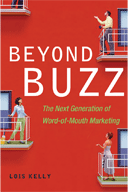 Eight years ago, four guys who saw a future for the Internet in the midst of the dot-com bust wrote The Cluetrain Manifesto, a thin text that espoused the virtues of something called “conversational marketing” — the idea that marketers should forsake one-way messaging (talking at customers) and buzzword-laden obfuscation for two-way discussions with customers and plain speaking. According to the Cluetrain authors, the Internet’s open, interactive and disintermediated nature freed consumers from the tyranny of traditional advertising — they could now discuss brands openly on forums and in blogs — and was changing the rules of marketing forever.
Picking up where Cluetrain left off — and bringing conversational marketing into the offline world, too — is communications consultant Lois Kelly. Kelly’s book Beyond Buzz: The Next Generation of Word-of-Mouth Marketing (2007, AMACOM Books) offers a practical guide for communications and marketing practitioners who want to infuse their branding and marketing approach with a little more conversation.
Usually, I’m wary of books with terms like “beyond (insert buzzword — like buzz? — here), or “next generation of (enter current marketing trend here)” in the titles. Usually because such books fail to deliver on the titles’ promises. But Kelly’s book isn’t one of those. Beyond Buzz lives up to its promises with detailed, real-world examples of how how conversational marketing works in a variety of organizations (including higher education). In addition, she provides practical tips and techniques to get people in any organization talking like real people — and listening to their customers.
The author is the co-founder of Foghound, a strategic communications firm based in Marblehead, Massachusetts, where her list of clients includes Dunkin’ Donuts, SAP and Sun Microsystems. She also has a solid background in digital marketing, having led one high-tech marketing firm and hold the VP title with another, so she has the credentials to talk about conversational marketing in the online world.
Beyond Buzz advocates involving people at all levels of an organization — from the CEO to the sales rep and secretary — in conversational marketing. “One step,” she writes, “is to create conversational marketing approaches, such as salonlike meetings, online customers communities, more regular radio talk show-like conference calls, and more conversational sales meetings.” She rightly acknowledges that these tools should not replace traditional marketing approaches, but augment them.
But what good are these tools if organizations have nothing interesting to say? Kelly urges marketers, PR people, CEOs, sales reps and others to pull together to find the organization’s point of view and incorporate it into the marketing messages. “A good point of view gently (or not so gently) smacks people in the face and gets the response, ‘That’s interesting. Tell me more,'” Kelly writes. “It lures people into the conversation, sparking dialogue that helps us understand issues, products, and companies in mutlidimensional, rational, and emotional ways.”
Kelly guides the reader through techniques designed to help articulate an organization’s point of view, then offers ways to uncover “talk-worthy ideas” in your organization, as well as ideas for building a conversational mindset and “talk” culture. She’s even included checklists and templates in the back of the book to help readers incorporate the ideas in the workplace.
Most refreshing, from my perspective as a higher ed marketing, was discovering that Kelly is more attuned than your average marketing writer to the challenges and issues facing non-profit groups and universities. (Her involvement on the board of a non-profit probably gives her a broader perspective.) In one section about nine themes that get people talking, for example, she points out how former Harvard President Lawrence Summers created some conversation with his ideas about the gender gap in engineering and the sciences. “Sometimes,” she writes, “shaking things up offends people so much that any good intentions are obliterated.” That’s what happened to Summers, whose “style more than content” was the reason his speech offended so many. “Summer likes to provoke people to get them into the type of intellectual food fights that generate meaty discussions. He is a classic contrarian — arrogant, intense, challenging, and insightful.”
With Beyond Buzz, Kelly has given anyone in the marketing business a work that is also challenging and insightful. For some of us, it might even be contrarian. Let’s hope it gets more of us talking.