
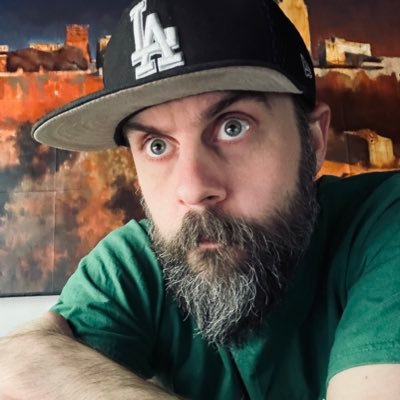
If you’re into crime fiction with a dash of noir and grit lit, you ought to check out the writings of Casey Stegman. Not only does Casey write some of the genre’s most captivating short stories and flash fiction around, he also dives into the genre through a monthly column for MysteryTribune called Murder in the First. That’s where Casey introduces readers to “debuts within the genres of crime, mystery, grit-lit, and all things dark.”
Coming soon: you’ll find one of Casey’s short stories in At the Edge of Darkness, a special crime/horror anthology that comes out October 29, just in time for Halloween.
- You have an interesting background that includes time working in the film business, studying political theory at the graduate level, and even appearing in KISS makeup in a Hillary Duff video. Given your background and life experiences, what led you to pursue a career as a writer?
I’ve always wanted to tell stories. From an early age, I was (poorly) drawing comic books and putting on plays with my friends. Somewhere around age 12 or 13, my passion for storytelling led me to film. I initially thought I wanted to be a director. And knowing I needed to get on-set experience, I asked my mom to sign me up for extra work in high school. Then, after I left high school, I opted to start working as a production assistant. I found my first full-time job in the music video/commercial division at Quentin Tarantino’s production company, A Band Apart, where I worked on videos for a number of artists, including: Fountains of Wayne, Jessica Simpson, and Hilary Duff.
But in my mid-20s, I realized that I wanted to go back to school and earn a college degree (especially since no one else in my family had one). So I enrolled in community college and worked full time until I earned enough credits to transfer to UCLA. I’d intended to be an English major, but fell in love with political theory. I’ve always been interested in the history of politics, particularly the history of conflict and power. And so those classes really resonated with me. I ended up with a BA in political science (with a focus in political theory) and women’s studies. From there, I decided to go for a graduate degree, and was accepted into the PhD program for political theory at UNC-Chapel Hill.
At the same time I was working on my PhD, I was writing screenplays with a dear friend and we ended up selling a few to some independent producers. But as anyone who’s sold a script will tell you: a purchase doesn’t mean that it’s automatically going to get produced. That said, my (limited) success in screenwriting made me realize that a future in academia wasn’t for me. And so I left graduate school in 2016 as an ABD (All But Dissertation), and started working as a creative copywriter. I got to work on some big campaign work, as well as branded films and commercial spots.
Then in 2018, my mom passed away and I faced a bit of an existential crisis about what I wanted to do for the rest of my life.
My mom had been a huge influence and an early supporter when it came to my love of storytelling. But since becoming an adult, I have always done creative work for other people. I’d never done something truly for myself, that was a pure distillation of my own creative interests and influences. I’d also always wanted to write prose fiction, but had only really dabbled at that point. My mom’s untimely passing crystalized my understanding that we don’t know how much time we have left on this planet and that we should strive for the things we want, instead of waiting for some future point down the road.
And so in 2019, I started down the path that I’m currently on. It took me a while to find my groove and my voice, as well as several years until my first story acceptance. But it’s been the most exciting creative journey I’ve been on yet.
- Most of your writing falls into the noir/crime/grit-lit genre(s), correct? What is it about that style of writing that most appeals to you, both as a writer and a reader.
As mentioned above, the reason I pursued study in political theory was because I’ve always been fascinated in the subject of conflict and power. That’s pretty much a constant throughout the history of political thought, going all the way back to the ancients.
That same subject is also at the heart of crime fiction and is what makes it so damn interesting. Whether the protagonists are criminals or law enforcement or everyday people in extraordinary circumstances, good crime fiction is about these characters navigating worlds in which power is central and where conflict over that power is what drives them and the story.
And as a longtime reader of classic and contemporary authors in the genre, I knew it was the one I wanted to write in from the jump. I felt I understood the genre boundaries the best and could play well in this sandbox. Whereas with other genres — like sci-fi, fantasy horror, and romance — I didn’t really feel like I had a deep enough understanding. At least initially. As time has gone on, I’ve started to dabble a bit more in horror. Those stories are still rooted in crime. But I’m taking baby steps.
- What two or three writers have most influenced you and why?
The biggest is Elmore Leonard. In my early days as a burgeoning teenage filmmaker, I fell in love with the work of Quentin Tarantino (hence why I applied to work at his production company). His films led me directly to Leonard, whom I read voraciously. His “style absent of style” — as he referred to it — was so refreshing and interesting to me. He put all the emphasis on the characters and, of course, their dialogue. He’s obviously been an influence on a number of contemporary writers. And so I’m not unique here. But I think for me, as a reader and as a writer, Leonard first taught me the importance of letting the characters guide the story, rather than just the plot.
Another big influence is Raymond Carver. Again, not alone here. I know a number of writers, especially in the grit-lit space, who’ve been influenced by Carver. But I think what struck me upon first reading Carver was how much his characters resonated with me personally. I grew up in the southeastern part of Los Angeles County, outside the city, in the small working-class communities that popped up after World War II. My family was mostly blue collar. Carver’s characters seemed like them and the people they hung out with. Also his stripped-down prose style and ability to craft realistic-sounding dialogue really gelled with what first attracted me to Elmore Leonard — despite their end products being vastly different.
The last influence I’ll mention is Walter Mosley. When I first read Devil in a Blue Dress after seeing the movie as a teenager, I knew I’d just read one of my all-time favorite novels. From then on, I became a huge fan of the Easy Rawlins series. But more so, I became a fan of Mosley, especially since he’s a writer who has tackled so many different genres, yet maintained a consistent style. He also has this remarkable ability to blend humor with serious drama. And all the while, he’s able to render characters so three-dimensionally. (I also found inspiration from the fact that, before he became a writer, Mosley had been a PhD student in political theory.)
- Tell us a bit about your latest writing project.
My latest novel project is set in 1977. It follows two former TV variety show actors who find themselves thrown back together and must navigate an increasingly crazy night in San Francisco as gangsters, corrupt cops, and a murderous pair of lovers chase after them.
I’m in between the 1/3 and 1/2 point. And really loving every minute of the writing experience. I’m hoping to get a solid draft done by the end of the year.
- Finally, what advice would you offer aspiring writers?
I still consider myself a newbie. And so I’m not sure how helpful my advice is. Especially since I am still discovering a lot of new things out there in the writing world.
But what I will say is that I’ve found the old adage of embracing rejection to be very helpful. More often than not, your work is going to be rejected. In fact, it’s very rare that your work will get published.
I saw some bit of advice somewhere that said if twenty percent of your submissions are getting published, then you’re doing very, very well. It really made me think about batting averages and how .300 is considered damn good, while .400 is nearly impossible. All in all, you’re going to strike out more than you’re going to hit the ball. And that’s okay.
As long as you embrace rejection and realize it’s not about you, then you’ll do well.
So, to all the writers reading this: go out there and start collecting those rejection slips. Somewhere along the way, you’re bound to break that streak. And, when you do, I can’t wait to read what you publish.
Follow Casey on X/Twitter at @cstegman.

 Andrew Careaga
I think I’d like to read some crime fiction short stories right about now! Thanks for the post! I’m going to check him out!
I think you’ll enjoy his writing, Mark!
Definitely struck a chord!