
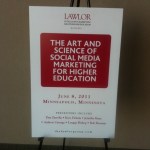
 I’m a day too late to post the customary Friday Five, but I did want to share some key takeaways I gleaned from my recent trip to Minneapolis for The Art and Science of Social Media Marketing for Higher Education, a one-day workshop put on by The Lawlor Group.
Since I’m a day late, I’m going to make it up to you by providing an extra takeaway — a Saturday Six of bullet points. Also, if you hurry, you’ll find more about the conference via the Twitter hashtag for that event, #tlgsm. But hurry, because hashtags, like fruit flies, tend to have short life spans.
1. Brands can learn a lot from evolutionary biology. I’ve been thinking a bit about the evolution of brands and branding at least since the mid-2000s, when I read Al and Laura Ries’s book The Origin of Brands. Dan Zarrella has been thinking about this, too, and during his kickoff session at the workshop — titled “The Science of Social Media Marketing” — offered several great points to ponder about evolution, branding and marketing. Just as species evolve and thrive by their ability to adapt to the forces of nature, so brands most able to adapt to ever-changing cultural, social and economic pressures will do well. This is an important point for those of us in higher ed to keep in mind, especially these days.
You can hear much more from Dan about these and other issues by viewing his one-hour presentation on this topic. Yes, an hour is a long time to spend watching a video about social media, but you won’t be disappointed. You’ll also find that his conclusions about what works in social media is backed by research. (Thanks to Karine Joly, who first directed me to that presentation in this post a couple of months ago.)
2. Facebook: The Jersey Shore of social media. Facebook has become the most mainstream of social media. Brands wanting to connect with Facebook users should learn to “write for Snooki,” as Dan put it. But maybe without all the F-bombs. Just keep it simple and to the point.
3. It’s OK to tell (or ask) people what to do. In their presentation about listening and strategic planning, Jennifer Kane and Kary Delaria, both of Kane Consulting, made the point that people don’t mind being told what to do. It’s OK to tell (or ask) people to “like” an article on Facebook, for example. This correlates to what Dan Z. mentioned about retweeting. His research found that the phrase “please retweet” or “please RT” in a Twitter post were among the most retweetable words.
4. Size, frequency and timing matter. In the debate about quality vs. quantity, quantity wins. According to Dan Zarrella’s research, the larger the number of followers a brand has on Twitter, the more fans on Facebook, etc., the greater the chances are that the brand’s messages will be shared more broadly. Likewise, the more frequently a post is shared on Twitter, the greater the odds that it will be retweeted. But beware of over-sharing. Link fatigue could set in among your fans or followers.
In terms of timing, Dan’s research suggests that click-through rates for information posted on social media increases during the weekend, even though social media activity tends to slow down on the weekends.
5. Stay positive. Nobody likes a Debbie Downer. Not in real life. Not in social media. So if you want to build your brand in the social media sphere, avoid getting negative. Stay upbeat. Related: Don’t talk about yourself all the time, either. Just as no one likes to talk to the person at a cocktail party who only talks about himself, no one will pay much attention to your brand if you’re only talking about yourself. Dan Z. suggests finding “combined relevance” that connects your brand to the interests of others.
Here’s a real-world example of combined relevance in action: Earlier this week, a minor earthquake struck east of Rolla. I tweeted about the event and asked our followers if anyone felt it. The tweet had nothing to do with our brand, so to speak, but it was relevant on a few levels: geography, a shared experience, and the fact that we offer majors in geology, geophysics and geological engineering — disciplines that attract students interested in quakes. The result: half a dozen retweets and interactions with five followers.
6. Lougan Bishop rocked Twitter. I had the good fortune of co-presenting on a panel with Lougan and Dan Z. I talked about blogging, while Dan talked about Facebook and Lougan opined about Twitter. Lougan did a terrific job talking about Twitter and reinforcing what others had said earlier in the day. Check out his presentation (on Slideshare or below).
In all, I had a great time presenting, meeting new people, reconnecting with a few earlier acquaintances, and learning from my peers. I really appreciate the opportunity and thank John Lawlor of The Lawlor Group for putting on an exceptional workshop.
P.S. – I’ve also posted my presentation for your viewing pleasure.

 Andrew Careaga