
Friday Five: not that you asked, but…

The Internet is full of unsolicited advice. Some of it is even useful. Here are five bits of counsel that may interest you:

  1. For writers: Five easy steps to editing your own work, by Anna Goldsmith of The Hired Pens, guest blogging at CopyBlogger.
  2. For marketers struggling with ROI of social media: Valeria Maltoni of Conversation Agent offers some ideas about measurement as part of a marketing meme making the rounds.
  3. For communicators, marketers, history buffs and closet socialists: FutureLab offers a lesson in mass communications with Soviet Propaganda – The Art of Mass Persuasion. Posted by Ilya Vedrashko on Thursday, the 90th anniversary of Russia’s Bolshevik Revolution, it features Vedrashko’s slide show of images that “showcase some of the tools and techniques used by the Soviet AgitProp (agitation and propaganda) as well as other governments, democratic and otherwise, and how some of the imagery was borrowed by brand marketers.” Makes you wonder who really won the cold war.
  4. For web designers and managers: Sam Jackson’s take on why college and university web sites don’t make the grade.
  5. For alumni relations folks: Andy Shaindlin (alumni futures) introduces a new Facebook group just for you.

Bonus link: discovered later but for everyone — be they writers, editors, designers, marketers, bosses, bureaucrats, teachers, students … anyone and everyone: 10 Simple, Sure-fire Ways to Make Today Your Best Day Ever. Just gloss over the metaphysical portions if you like (although I recommend reading the whole thing). If you don’t read it today, read it before you go to work on Monday.

—————-
Now playing: The New Pornographers – Adventures In Solitude
via FoxyTunes
Facebook and the Long Tail

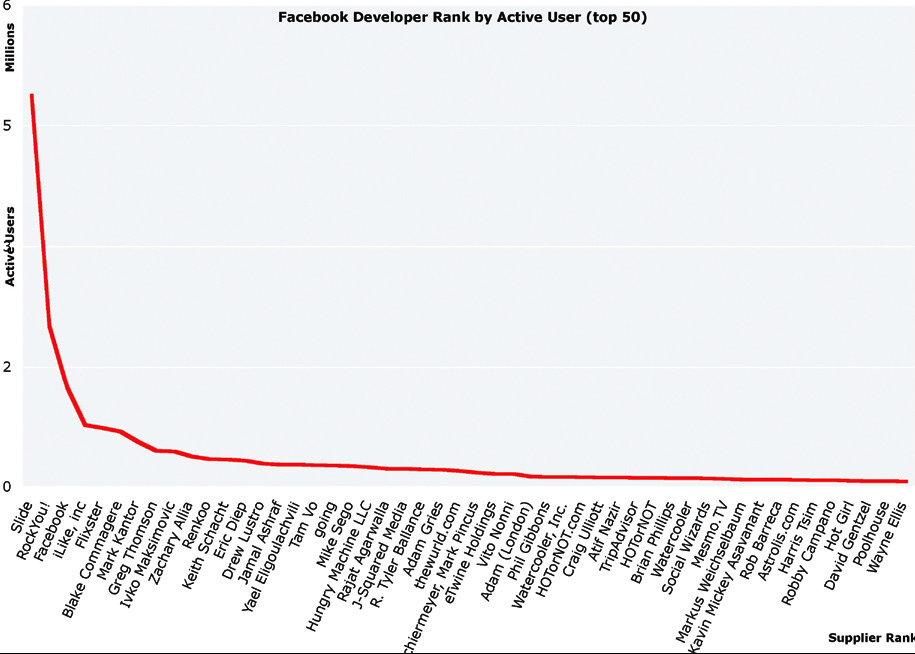
Researchers at O’Reilly just issued a report about how the economics of The Long Tail work — or don’t work — in the ever-expanding universe of Facebook applications. As Tim O’Reilly explains, the report has both good news and bad news about Facebook apps.

The good news has already been widely disseminated: there are nearly 5000 Facebook applications, and the top applications have tens of millions of installs and millions of active users. The bad news, alas, is in our report: 87% of the usage goes to only 84 applications! Only 45 applications have more than 100,000 active users. This is a long tail marketplace with a vengeance — but unfortunately, the economic models (for developers at least, though not for Facebook itself) all rely on getting into the very short head.

This chart puts it in perspective (click to enlarge):

facebooklongtail.png

Via BoingBoing.

Friday Five: Purging the RSS feeds

So many interesting links. So little time. I’ve starred so many must-share tidbits in my RSS reader over the past several weeks that I could never share them all with you. So I went through the list, purged the no longer relevant stuff (all that “breaking tech news” that happened in late August), and winnowed it down to something a bit more manageable. Here’s a judicious sampling of linky goodness for your weekend reading pleasure:

  • The end of web 2.0 as we know it, as predicted by CrunchGear columnist Seth Porges. Porges predicts that human laziness will be web 2.0’s undoing, and I’m inclined to agree. We just don’t have the gumption to keep up with all our social networks, RSS feeds, etc. Give us the lazy way out and we’ll take it, every time.
  • Web 3.0 lives in a van — “down by the river,” I’m tempted to add. Marketing Pilgrim points us to two entrepreneurs who are defining web 3.0 on the road.
  • /. turns 10. Hard to believe that Slashdot, the granddaddy of all social networks, precursor of blogs, celebrates a decade on the net this month. Great interview with Slashdot founder CmdrTaco.

    Our desires are incredibly simple: We look for stories that will generate a good discussion. I’m not looking at big-picture, long-term repercussions from our posts. When I look back at 10 years of doing this, it’s nice to see all the good we’ve done. But that’s not the goal. The goal is to provide interesting content for our readers.

  • BuzzMachine ponders: Can we stop seeing it as news when some company opens up an island on Second Life?

  • Google: the 800-pound social networking gorilla?
    This is a couple of weeks old now, but the story is that Google is about to enter the social networking business in a month. Scobleizer pointed to a TechCrunch post about Google testing an app to rival Facebook. According to TC, Google will unveil the new app on Nov. 5.

I, crisis communications expert

[shameless self-promotion]
Just thought I’d let readers know that I, a guy who usually tries to get reporters to interview other people, was interviewed myself as a *ahem* media expert by InsideHigherEd.com for a follow-up story to the whole Dalhousie/Facebook/puppy murder flare-up (Proving you’re not a puppy murderer, by Andy Guess).
[/shameless self-promotion]

Guess’ story views the Dalhousie situation — a resurgent Facebook group of 22,000-plus members that accuses Dalhousie of conducting inhumane research on puppies — in terms of crisis management in the age of social networks:

One of a public relations officer’s worst nightmares is a lie that won’t go away, and Dalhousie University recently confronted a doozy: that it was experimenting on cuddly, doe-eyed puppies and kittens.

Normally in such situations, a university might take steps to release information that rebuts the charges, or it might make contact with the source of the allegations. But in this case the statements in question were online, contained within a group on the social-networking Web site Facebook, and accessible to anyone with an account. The group … was founded by someone who apparently was never even a student there.

Now, after an inital attempt to have the group removed from Facebook failed, the university is considering its legal options. “It’s a clear case of defamation,” said Charles Crosby, media relations manager at Dalhousie, in Halifax, Nova Scotia. The case illustrates not only how a university confronts allegations, but the evolving ways in which damaging information is spreading from multiple, uncontrollable sources online.

This case raises some interesting issues about communicating in the social media sphere. Dalhousie, the InsideHigherEd story points out, “is highlighting highlighting efforts by other students to counter the original group. One, a Facebook group called “Stop People From Spreading Lies About Animal Cruelty At Dalhousie”, was started by a student who works in a laboratory at the university. Still, they’ve got an uphill battle: Only a little over 400 members have joined that group, which can’t match the visceral hook of a vulnerable beagle puppy displayed on the original’s page.”

When I received Guess’s email query to chat about crisis communications in the web 2.0 world, I wasn’t mcuh up to speed on the latest developments at Dalhousie, so we spoke in broader terms of how colleges and universities might handle such crises. My lone quote is rightly buried in the story (paragraph nine, if you’re looking). Guess quotes some better experts, such as Rae Goldsmith of CASE and Teresa Valerio Parrot of SimpsonScarborough, whose quote at the end of the story wraps it all up nicely.

Of Boing Boing, taglines, Facebook and Paris Hilton: a Thursday afternoon cache cleaning

Contextless links:

Our university’s most popular summer camp made the blog big time today with a mention on the world-famous Boing Boing. Goodie for us. Naturally, we blogged about it and linked to a relevant YouTube video.

paris_hilton.jpgThat’s Professor Paris to you, bub. Paris Hilton has been offered a cool million bucks to teach a one-hour “How to Build Your Brand” seminar. She’s also given an exclusive interview to People magazine.

All Facebook, all the time. Jeff Jarvis brings us the unofficial Facebook blog.

Not enough Facebook for ya? Check out Facebook in 40 years.

Tips for writing taglines: from the L.A. Times and Igor, via Snark Hunting.

How to build a social media strategy. Some good pointers, based on real case studies from real companies, with a link to where you can get the full report, or chapter-by-chapter summaries.

Strumpette puts PR in perspective. Now this is a good end-of-day read. All I can say is, I’m glad I don’t work for a toothpaste company today.