
 Don’t be a robot.
That seems to be the mantra among many higher ed marketing thought leaders these days.
“Being a robot” refers to the practice of using RSS feeds to push content into the social media sphere.
For instance, if you write a news release or blog post at your university and then use RSS to push that same information to your university Twitter or Facebook site (or both), you have gone robotic.
The argument goes something like this:
The social mediasphere is all about conversation and engagement. And nobody wants to talk to or engage a robot, right? Robots have no human voice. Robots are inauthentic.
Besides, the content of your news release is either:
- written in an institutional voice, or
- written expressly for the traditional news media (journalists)
Nobody but journalists are interested in reading your news releases. Or so the conventional wisdom goes.
Then there’s the fact that your social media platforms — Facebook, Twitter, MySpace, LinkedIn, etc. — target different audiences, which have different information needs. People on Twitter may want one thing, people on Facebook may want another.
There’s more to the argument against robots, but those are the main points, as far as I can tell.
These are all valid arguments, to a point. But they generalize and overstate the issue. For instance, the idea that news releases are written for the press only is fallacious — or should be. These days, if your college or university news releases are written expressly for journalists, then you’re missing a huge opportunity. You’re missing a huge audience of content-hungry bloggers, tweeters, remixers and collectors who are eager to redistribute all sorts of content — even your news releases. If this is news to you, then you might want to check out David Meerman Scott’s book, The New Rules of Marketing and PR.
Also, remember that official information doesn’t have to be boring.
Humans, robots, borgs
There are some distinct advantages to harnessing the power of RSS to help you meet your social media objectives. And I think higher ed communicators ought to embrace that power.
 This doesn’t mean you have to be a robot. But you may have to become a borg.
Technically, of course, a borg is more than just some sort of human-robot hybrid. According to Wikipedia, borgs are “cybernetically enhanced humanoid drones” made up of “multiple species,” not just humans, and they make decisions through a hive mind. But this is just a disclaimer for those Star Trek geeks who might be reading. For the purpose of my argument, and to stretch the robot metaphor further, let’s talk about the borg as a hybrid of human and robot.
So, if RSS feeds into the social mediasphere is the invasion of the robots, then a combination of automated RSS and human “voice,” typed in by an actual human being, is the borg. Does this make sense?
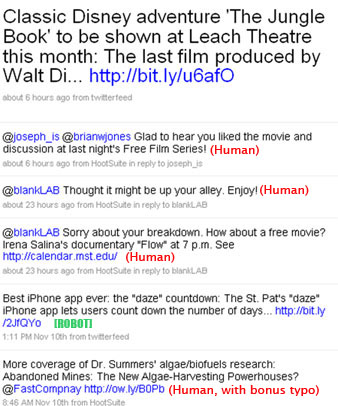
Here’s a screenshot of recent updates from the Missouri S&T Twitter account. This gives you an idea of the how the borgian process works. It’s a mix of automated feeds and personal updates, retweets and replies. The most recent update (the one at top) is an RSS feed of a news release, which also is fed to our Facebook site (a major no-no, according to the anti-robots), and the rest are labeled either “human” or “robot” in case you can’t tell the difference. (By the way, the most recent update got its first “like” thumbs up on Facebook just a few minutes after it posted there.)
Becoming a social media borg is a happy compromise for a number of reasons. Among them:
- Thanks to RSS, you have a great way to share official content across multiple platforms.
- People actually like to interact to official content such as blog posts and news releases.
- If you’re strapped for time to spend with your social media communities, the RSS feed option allows for a more streamlined and efficient approach. I’m all about streamlining processes and automating those things that can be if it means we can devote our valuable staff time to those things that absolutely require the human touch.
I know I’m among the minority when it comes to the debate about authenticity. Or at least, judging from what I see on Twitter and the higher ed blogs, I assume I’m in the minority. But maybe there’s a silent majority of borgs out there awaiting their liberator.
Borgs! Romans! Countrymen! Lend me your URLs! And your RSS feeds!
P.S. – The odd thing about the anti-robot crowd is that some of them have no problem including Twitter update widgets on their blogs or websites. These widgets push the person’s latest tweets to a blog sidebar. Look to the left sidebar, scroll up, and you’ll find my status updates from Twitter right there. See? I’m not above using such a feed. But then again, I’m a borg.
P.S.S. – You will be assimilated. LOL.
 Andrew Careaga