
Friday Five: 5 on 5

We’re having a Friday Five special today. Each Friday Five item includes five tips, giving you 25 takeaways in all today. Yes, we’re over-delivering this morning. But fear not. We’ll make up for it once we get to the office.

  1. The 5 big myths of social media, from Rohit Bhargava’s Influential Marketing Blog, dispels the idea that social media is all about going viral, that you need a community manager, and so on. Good read. Thanks to Andrew Swenson for sharing via Twitter (@wordpost).
  2. Social marketing for celebrities: five lessons from Neil Young. Here’s another one by way of @wordpost (he’s been retweeting some good stuff lately). This piece from Huffington Post contributor Andrew Cherwenka extracts sound advice from Young’s successful and prolific musical career and applies it to the social media sphere. Noting that the folk rock legend is not the most web-savvy of celebrities — Young “has no official Facebook fan page, and his website is a Flash disaster stuck in the ’90s” — Cherwenka points out that “Canada’s legendary mutton-chopped musician was leveraging 5 key principles of social marketing decades before the Internet came to be.” Hey hey, my my, this is good info for anyone wanting to engage in social media marketing.
  3. 5 apps to tap into the Internet’s infinite playlist. While we’re on the subject of music, these five apps will help you tune in to Neil Young or any other musician whose work is floating around in the Internet cloud.
  4. 5 brands tapping into your brain. This FastCompany piece also gives a nice overview of the concept of neuromarketing.
  5. Your future in five easy steps: Wired guide to personal scenario planning. Worried about the future? Worry no more, my friend. Just follow these five steps to envision “a clearer view of what the future may hold and of the most advantageous route through it.”

Have a good weekend. Stay strong.
Friday Five: blog of the beast edition

I was originally going to title this post “Friday five: of Twitter and teens, robots and brands.” Then I found out that today’s post is number 666 for this blog. Oooh. Scary. I thought about conjuring up some frightening doomsday posts, but in this economy, things are scary enough. Plus, I already had this stuff in the hopper, even before Thursday’s big Twitter/Facebook meltdown, which was apparently a huge denial-of-service attack aimed at bringing down one socially networked guy in the Republic of Georgia. Talk about overkill, scorched earth, using the atom bomb to kill a fly, etc.

Anyway, on to the five, which is just some interesting stuff I gleaned from the web, Twitter, etc., earlier in the week.

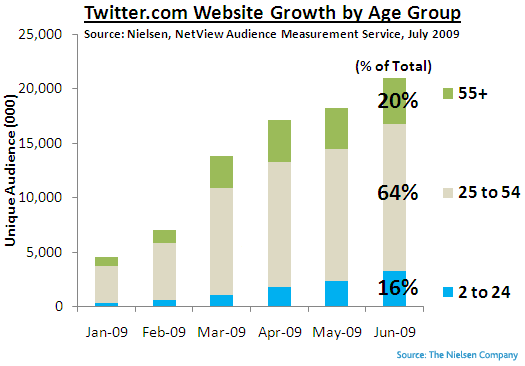
  1. Teens don’t tweet, eh? Earlier this week, Mashable reported that the percentage of the under-25 age group in the United States using Twitter is only 16 percent. This despite the fact that that age group makes up 25 percent of Internet users in the U.S., and everyone knows that that age group is the most tech-savvy of them al, or so goes conventional wisdoml. But what the Mashable story and the other headlines miss is the apparent healthy growth in the number of young tweeters since January (see chart; click it to enlarge). It looks like the better question may be, What is behind the apparent growth of twittering teens? (P.S. – When the news of this study broke on Wednesday, it became a trending topic on Twitter, and apparently plenty of the people tweeting about it were, in fact, the under-25 group.
  2. You’ve read the book. Now see the slidedeck. One of the essential elements of The Cluetrain Manifesto — a must-read book for anyone involved in online communications — is its 95 theses. Now they are available as a slideshow. (Thanks to @markgr for the link.)
  3. 10 Facebook marketing resources, via @EMGonline (Educational Marketing Group’s Twitter feed).
  4. Gah! Robots! They’re in Twitter! They’re on Facebook! Gahhh!
  5. A more social definition of brand. “For years I’ve thought of a brand as the image of a company in its customer’s mind. … [T]oday, thinking about the new corporate communications landscape, it struck me that a brand is more like the ongoing contact between company and customer.” A thoughtful and thought-provoking post from Engaging Experience (via @mStonerblog).

Have an enjoyable weekend. I’ll see you around on Twitter or possibly Facebook — unless they get hit again. If so, then maybe on the blogosphere. They can’t get every blog, can they?