
Facebook, the World Series and combined relevance

Since meeting Dan Zarrella at a social media workshop last June, where he presented his “Science of Social Media” talk, I’ve been experimenting with some of his principles for spreading ideas via social media. One of his principles — that of combined relevance — has been of particular interest to me, and during the World Series, I had a chance to put it into practice on behalf of our university.

I bet you thought I’d shut up about baseball by now, more than a week after my favorite team, the St. Louis Cardinals, won the World Series. But even if you aren’t a baseball fan, I think you’ll find that this topic has a bit of combined relevance for you as a higher ed marketer. So, please bear with me.

Zarrella explains combined relevance as the merging of “two seemingly distinct interests,” and it works in social media because it connects organizations with the interests of their audiences in unexpected ways. Combined relevance finds a connection with audiences that often have little to do with an organization’s brand or sales pitch.

“By combining two apparently unrelated niches,” Zarrella writes, “you can create a piece of content likely to go viral with people who just happen to be into both things.”

In Zarrella’s oft-cited case, the two unrelated niches were “gadgets and Victorian era intoxicants.” (You really need to read his post to fully appreciate where he’s coming from.) For me most recently, the two niches weren’t quite so exotic. I combined professional baseball with a graduate of our university.

After St. Louis’ comeback in Game 6 of this year’s World Series, in which hometown boy David Freese shone by tying the game in the ninth inning, then hitting the game-winning home run in extra innings, our department learned, via our alumni office, that Freese’s father was a graduate of our university. So we decided to test the theory of combined relevance on our Facebook site with the following post connecting our institution with a baseball hero.

Here’s a fun fact for all you St. Louis Cardinals fans out there. David Freese, the St. Louis hometown boy who hit the game-winning home run in last night’s Game 6 of the World Series, is the son of Rolla grad Guy Freese, CE’75. How cool is that?

This single post resulted in a significant spike in activity on our site. As of yesterday (Tuesday) afternoon, the post has garnered:

  • 3,610 impressions
  • 138 likes
  • 10 comments (including one from us)

Here’s what the post looked like:
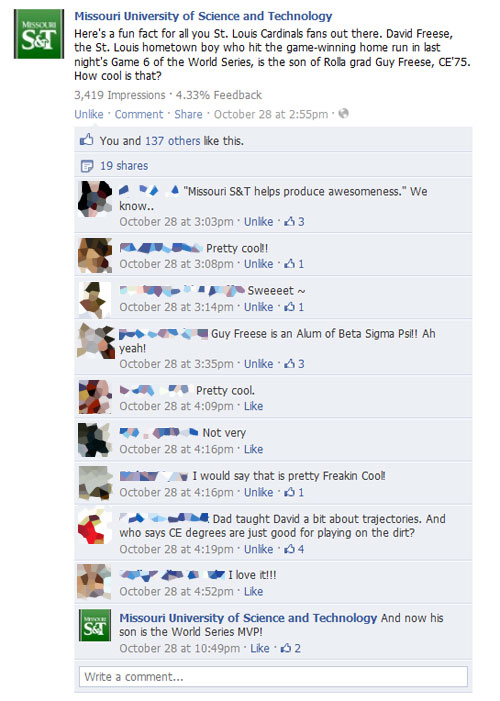
Using combined relevance -- in this case, the World Series and a Missouri S&T graduate's family connection -- on our Facebook site

That may not sound like much to some of you, but those numbers represent one of the most viewed postings on our Facebook site. And, according to Facebook’s algorithms, also one of the most viral. It’s virality score of above 11 percent was more than four times higher than the runner-up for the month of October.

Of course, we can’t always make combined-relevance connections to occasions as prominent as the World Series. But we can still find ways to connect our institutions to relevant topics being discussed in the social media sphere. The key is to be attuned to what our audiences are talking about. On one warm October day, quite a few of our Facebook fans were interested in baseball, and they apparently liked that we were interested in it, too.
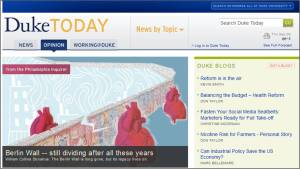
Duke’s opinion page spotlights faculty expertise

The op-ed page has been a staple of newspapers for decades, home to syndicated columnists and guest contributors who share a broad array of expertise with a paper’s readers. Many colleges and universities have been successful in placing articles by their own academic experts in the op-ed pages of prominent newspapers. Duke University is one such institution. Duke’s office of news and communications regularly distributes faculty-authored articles monthly to 20 major newspapers across the U.S. and Canada.

Recently, Duke unveiled an op-ed page of its own online. The opinion section of Duke Today shines the spotlight on the campus’s essayists and essays.

Screenshot of Duke Today's opinion page - today.duke.edu/opinion

Keith Lawrence, director of media relations for Duke’s office of news and communications, shared more insight about this initiative via a recent email exchange.

Higher Ed Marketing: Why did Duke decide to create this site? Briefly, what is your vision for the opinion section of Duke Today?

Keith Lawrence: Duke has an active service that distributes faculty op-ed articles to newspapers across North America. Dozens of our professors have worked with us to publish their articles in major papers through this service and other channels. More recently, a growing number of our professors have embraced social media, such as Facebook, blogs and Twitter. We launched this new site to capture in one place all of the incredibly rich content they’re producing – not only to highlight them personally, but also to advance Duke’s mission of “knowledge in service to society.”

HEM: Who is your main audience for this site and what results are you hoping for from that audience?

Lawrence: The audience is varied. We’re hoping faculty, staff and students will visit the site regularly, and we’re also promoting it to alumni, parents and others. Duke’s Office of Federal Relations will share pertinent content with government officials. As with Duke’s popular site on iTunes U, we hope this new opinion site will also find an audience with people who don’t have a personal connection to Duke but are interested in ideas and intellectual content they can’t find elsewhere.

HEM: Duke has built a strong presence on the nation’s op-ed pages over the years, thanks to your op-ed service. As traditional newspapers struggle with declining readership, what is the future of your op-ed service?

Lawrence: We believe op-ed pages at major newspapers will continue to play a vital role for the foreseeable future. Millions of people who care about the news still read these pages, which exert significant influence on policy makers and opinion leaders. We have no intention of scaling back on that front.

Simultaneously, we’re pursuing new channels, such as through social media, to reach people, especially younger audiences. This opinion site pulls together our older and newer approaches, combining the articles faculty have written for traditional op-ed pages with the opinions they’ve begun writing for blogs and other new forums.

HEM: Is there anything else you’d like readers of this blog to know about the site?

Like the rest of your audience for “Higher Ed Marketing,” we’re always looking for better ways to help our university tell its story. We hope your readers will take a minute to check out our site and share with us any thoughts or suggestions they have about it. We know we can learn from them. I can be reached at keith.lawrence@duke.edu.