There has been a lot written lately about the declining state of the U.S. brand of higher education, and it has me worried. Let me tie a few of these threads together for you, and you tell me if I’m worrying needlessly or if there really is something to this.
Let’s start with this week’s Newsweek cover story, The Three-Year Solution: How the reinvention of higher education benefits parents, students, and schools. The author, U.S. Sen. Lamar Alexander of Tennessee, comes with pretty decent credibility in terms of his knowledge of higher education. He was secretary of education under the Bush I administration and served as president of the University of Tennessee for four years. He’s also one of the few high-profile U.S. politicians who seem genuinely interested in higher education. While the decline of American higher ed is not the subject of his essay, he begins by comparing our system with the broken U.S. auto industry.
“[A]s with the auto industry in the 1960s,” when the Big Three had more than 80 percent of the U.S. market share, “there are signs of peril within American higher education. It is true that the problem with car companies was monopoly, whereas U.S. colleges compete in a vibrant marketplace.” But “in some ways, many colleges and universities are stuck in the past.” The assumption is that higher education lacks the leadership to effect the type of change needed to confront a new economic reality.
America falling
Now, let’s rewind to a couple of weeks ago and The Chronicle of Higher Education‘s cover story, America Falling: Longtime Dominance in Education Erodes (subscription required). Contrasting the growth and investment in higher education overseas with the budget woes and aging facilities of U.S. universities, the article paints a gloomy picture.
Back to the current issue of Newsweek again for this from Fareed Zakaria’s latest column about how China’s stimulus program is positioning that nation for future growth via investments in infrastructure and new technology. “China will spend $200 billion on railways in the next two years, much of it for high-speed rail. The Beijing-Shanghai line will cut travel times between those two cities from 10 hours to four. The United States, by contrast, has designated less than $20 billion, to be spread out over more than a dozen projects, thus guaranteeing their failure.”
We don’t need no education?
If you’re not yet worried, my fellow Americans, click on this Oct. 8 column by economist Paul Krugman in the New York Times, The Uneducated American, and weep.
Most people, I suspect, still have in their minds an image of America as the great land of college education, unique in the extent to which higher learning is offered to the population at large. That image used to correspond to reality. But these days young Americans are considerably less likely than young people in many other countries to graduate from college. In fact, we have a college graduation rate that’s slightly below the average across all advanced economies. …
There’s no mystery about what’s going on: education is mainly the responsibility of state and local governments, which are in dire fiscal straits. Adequate federal aid could have made a big difference. But while some aid has been provided, it has made up only a fraction of the shortfall. In part, that’s because back in February centrist senators insisted on stripping much of that aid from the American Recovery and Reinvestment Act, a k a the stimulus bill.
As a result, education is on the chopping block. And laid-off teachers are only part of the story. Even more important is the way that we’re shutting off opportunities.
Depressed yet?
Please bear with me as my inner Debbie Downer shares one more bit of anxiety-inducing news before I move on to the “what can be done” portion of this post:
Last June, I posted this item reporting on the release of a report titled “The College of 2020: Students” (executive summary [PDF]). The portion I quoted then still troubles me today:
The traditional model of college — four years away from home learning and growing into adulthood — will continue to wane. It will still have a place in higher education, but it will be a smaller piece of the overall picture.
… More students will attend classes online, study part time, take courses from multiple universities, and jump in and out of colleges. The average student will be older, and will demand more options for taking courses to make it easier for them to do what they want when they want to do it. And they will make those demands for economic reasons, too. The full-time residential model of higher education is getting too expensive for a larger share of the American population. More and more students are looking for lower-cost alternatives to attending college. That trend will assuredly open doors for more inexpensive online options.
It isn’t the change that worries me. It’s wondering whether our higher ed system has the ability and will to adapt to the change. “The challenge,” the executive summary notes, “will be to provide all those different learning methods simultaneously and be flexible enough to change the methods as the market changes.”
My 4-step prescription
So, what can be done about this mess? Is the American system of higher education — what even Lamar Alexander, in his Newsweek piece, calls “the best higher-education system in the world” — in such dire straits that it cannot emerge unharmed? Is it already too late for us? Have we been too busy rearranging the deck chairs on the higher ed version of the Titanic to notice the gaping hole in our stern? (Yes, communications, marketing, PR: I’m talking to you — I mean, to us. Pogo’s immortal words apply here.)
How arrogant would it be for me to try to suggest remedies for our ailing higher ed system. My perspective is limited: 18-plus years in higher education, which is quite a lot, but all of that time has been spent at a single public land-grant university with a specialization in engineering, science and technology. But let me offer a few ideas anyway.
1. Put students first. Yes, it sounds like a no-brainer. But anyone who has been in traditional higher education for even a few weeks knows how hidebound and inflexible many of our institutions are, and how faculty-centric they are. Five years ago, I interviewed one of our engineering management professors for an alumni magazine issue about distance learning. This guy was a big deal back in the days of Total Quality Management, and he was an adherent to the W. Edwards Deming philosophy of TQM. He also worked with GM in the ’90s as a quality management consultant, so take this for what it’s worth, knowing that fact. Anyway, during that interview and in subsequent conversations, he and I spoke a lot about “turning education upside-down.” I wrote about this in a blog post last March.
The professor’s role switches now from expert/judge to coach. When I was younger, I saw myself as the major source of knowledge for my students. Now I have to be an educational manager and provide many paths to learning so students can easily navigate through a course — to put the students more in control of their educational experience and provide opportunities for all students to learn and realize their potential.
You’ve got to turn the educational process upside-down and put the student at the center. It’s a bit humbling, because as a professor you lose some control. But the reward for that is better student learning and much better retention.
In a Q&A sidebar to Lamar Alexander’s essay, Robert Zemsky, a professor at the University of Pennsylvania and the author of a new book on education reform, says higher education needs to “move away from talking about a fixed knowledge base that is anything but fixed and talk about ways of accessing that knowledge base over a period of a lifetime.”
That’s right in line with the thinking of that professor I interviewed half a decade ago. It will require some shift of our national paradigm in order to create the sea change that is needed. But “Once you slip into this world of trying to look at education in a different way,” he said, “innovation looks normal.”
Which leads us to the second thing:
2. Make innovation the norm. From everything I’ve read, one of the strengths and the beauties of our higher education system in the U.S. is our willingness to experiment, to innovate, to be creative — in our labs, in our classrooms, across our campuses. This innovative and entrepreneurial spirit must be embraced. It’s the key to our success. “Higher education is America’s best industry,” writes Fareed Zakaria in his 2008 book, The Post-American World. Even if our system “is too lax on rigor and memorization — whether in math or poetry — it is much better [than other nations’ systems] at developing the critical faculties of the mind, which is what you need to succeed in life. Other educational systems teach you to take tests; the American system teaches you to think.”
Given the emphasis lately on test scores and outcomes, maybe we should take a closer look at what actually matters in the real world. Test scores are easier to measure than critical thinking skills. But what does that ultimately mean?
Innovation and experimentation mean trying out new methods of education, as well, such as Lamar Alexander’s suggestion for a three-year degree. (Many colleges are already doing this, as Ron Bronson pointed out months before Newsweek. But Ron is always ahead of the curve.) Again, this ties into my first suggestion of becoming more student-focused in our universities.
3. Invest in our future, just as China is doing. That means using federal funding to transform our nation’s infrastructure and develop new technology. If we must have bailouts and stimulus packages, why not focus these on areas that will position our economy for a greener future, rather than trying to prop up old-tech monopolies. Included in that infrastructure should be first-rate educational facilities for our nation’s colleges and universities.
Finally:
4. Worry, but not too much. I hope that some of the information I’ve presented here has given you some things to think about, and maybe made you a little uneasy about our future as a nation, and as higher ed marketers. I know that a lot of people worry about the United States’ role in this highly competitive global economy, and we should worry about it. But we shouldn’t worry obsessively. (I’m preaching to myself, too.) Competition is healthy in any enterprise. But let’s step back for a moment and view our higher ed system as not a system in and of itself, but as part of a larger ecosystem that includes pre-college education, post-college life, continuing education — a continuum or a stream that has many forks and tributaries. Then put that larger system within the context of our global system, and see if we can appreciate our system not for being “the best” necessarily, but for its contributions to this global system.
To paraphrase Zakarias and The Post-American World once again, maybe we don’t need to worry so much about America losing its edge. Maybe we need to acknowledge that the rest of the world is finally catching up, and that that is not necessarily a bad thing. It does require a shift in our way of thinking and of seeing ourselves and the rest of the world, however.

 Don’t be a robot.
 This doesn’t mean you have to be a robot. But you may have to become a borg.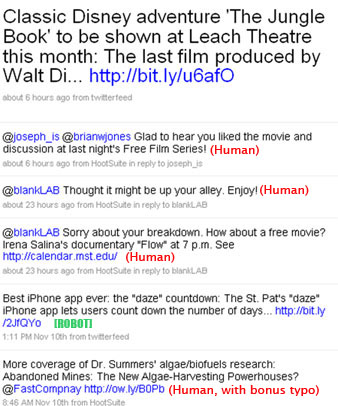
 Andrew Careaga
