
I was originally going to title this post “Friday five: of Twitter and teens, robots and brands.” Then I found out that today’s post is number 666 for this blog. Oooh. Scary. I thought about conjuring up some frightening doomsday posts, but in this economy, things are scary enough. Plus, I already had this stuff in the hopper, even before Thursday’s big Twitter/Facebook meltdown, which was apparently a huge denial-of-service attack aimed at bringing down one socially networked guy in the Republic of Georgia. Talk about overkill, scorched earth, using the atom bomb to kill a fly, etc.
Anyway, on to the five, which is just some interesting stuff I gleaned from the web, Twitter, etc., earlier in the week.
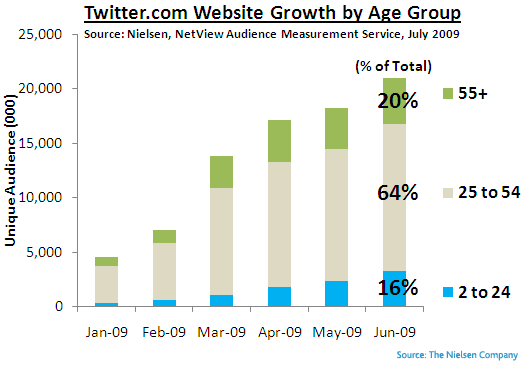
 Teens don’t tweet, eh? Earlier this week, Mashable reported that the percentage of the under-25 age group in the United States using Twitter is only 16 percent. This despite the fact that that age group makes up 25 percent of Internet users in the U.S., and everyone knows that that age group is the most tech-savvy of them al, or so goes conventional wisdoml. But what the Mashable story and the other headlines miss is the apparent healthy growth in the number of young tweeters since January (see chart; click it to enlarge). It looks like the better question may be, What is behind the apparent growth of twittering teens? (P.S. – When the news of this study broke on Wednesday, it became a trending topic on Twitter, and apparently plenty of the people tweeting about it were, in fact, the under-25 group.
- You’ve read the book. Now see the slidedeck. One of the essential elements of The Cluetrain Manifesto — a must-read book for anyone involved in online communications — is its 95 theses. Now they are available as a slideshow. (Thanks to @markgr for the link.)
- 10 Facebook marketing resources, via @EMGonline (Educational Marketing Group’s Twitter feed).
- Gah! Robots! They’re in Twitter! They’re on Facebook! Gahhh!
- A more social definition of brand. “For years I’ve thought of a brand as the image of a company in its customer’s mind. … [T]oday, thinking about the new corporate communications landscape, it struck me that a brand is more like the ongoing contact between company and customer.” A thoughtful and thought-provoking post from Engaging Experience (via @mStonerblog).
Have an enjoyable weekend. I’ll see you around on Twitter or possibly Facebook — unless they get hit again. If so, then maybe on the blogosphere. They can’t get every blog, can they?
 Andrew Careaga