
Facebook, the World Series and combined relevance

Since meeting Dan Zarrella at a social media workshop last June, where he presented his “Science of Social Media” talk, I’ve been experimenting with some of his principles for spreading ideas via social media. One of his principles — that of combined relevance — has been of particular interest to me, and during the World Series, I had a chance to put it into practice on behalf of our university.

I bet you thought I’d shut up about baseball by now, more than a week after my favorite team, the St. Louis Cardinals, won the World Series. But even if you aren’t a baseball fan, I think you’ll find that this topic has a bit of combined relevance for you as a higher ed marketer. So, please bear with me.

Zarrella explains combined relevance as the merging of “two seemingly distinct interests,” and it works in social media because it connects organizations with the interests of their audiences in unexpected ways. Combined relevance finds a connection with audiences that often have little to do with an organization’s brand or sales pitch.

“By combining two apparently unrelated niches,” Zarrella writes, “you can create a piece of content likely to go viral with people who just happen to be into both things.”

In Zarrella’s oft-cited case, the two unrelated niches were “gadgets and Victorian era intoxicants.” (You really need to read his post to fully appreciate where he’s coming from.) For me most recently, the two niches weren’t quite so exotic. I combined professional baseball with a graduate of our university.

After St. Louis’ comeback in Game 6 of this year’s World Series, in which hometown boy David Freese shone by tying the game in the ninth inning, then hitting the game-winning home run in extra innings, our department learned, via our alumni office, that Freese’s father was a graduate of our university. So we decided to test the theory of combined relevance on our Facebook site with the following post connecting our institution with a baseball hero.

Here’s a fun fact for all you St. Louis Cardinals fans out there. David Freese, the St. Louis hometown boy who hit the game-winning home run in last night’s Game 6 of the World Series, is the son of Rolla grad Guy Freese, CE’75. How cool is that?

This single post resulted in a significant spike in activity on our site. As of yesterday (Tuesday) afternoon, the post has garnered:

  • 3,610 impressions
  • 138 likes
  • 10 comments (including one from us)

Here’s what the post looked like:
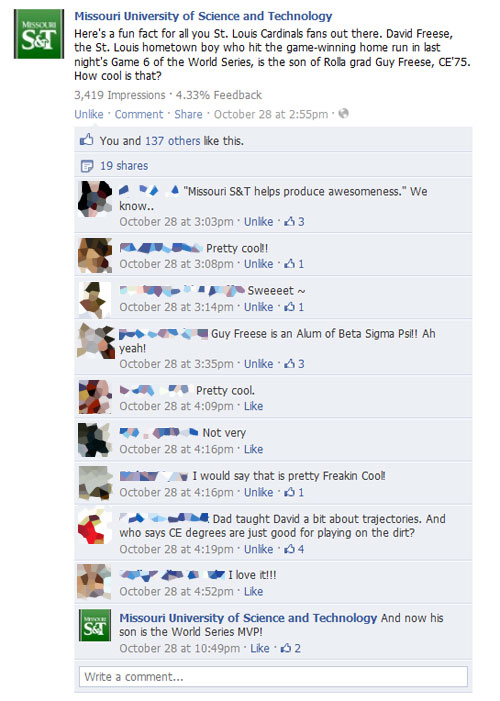
Using combined relevance -- in this case, the World Series and a Missouri S&T graduate's family connection -- on our Facebook site

That may not sound like much to some of you, but those numbers represent one of the most viewed postings on our Facebook site. And, according to Facebook’s algorithms, also one of the most viral. It’s virality score of above 11 percent was more than four times higher than the runner-up for the month of October.

Of course, we can’t always make combined-relevance connections to occasions as prominent as the World Series. But we can still find ways to connect our institutions to relevant topics being discussed in the social media sphere. The key is to be attuned to what our audiences are talking about. On one warm October day, quite a few of our Facebook fans were interested in baseball, and they apparently liked that we were interested in it, too.

Friday Five: While I was out edition

So now that the baseball postseason is over and the St. Louis Cardinals are World Series champs for the 11th time in their history (#gocards, #11in11), I can’t use that as an excuse for not blogging anymore. So I thought I’d ease back into the higher ed blogging scene with a Friday Five recapping some of the things that have made higher ed news while I was distracted.

1. HighEdWeb 2011 happened in Austin, one of the coolest cities in the universe. This is old news for all of you, I’m sure. In fact, you were probably there, right? It seems like most of the higher ed marketing community was there, judging from my Twitter stream. But if you missed it, you can catch the highlights from many of the sessions via Link: The Journal of Higher Ed Web Professionals, which recruited a phalanx of bloggers to cover the conference. Some really good stuff there. If you’re looking for additional context, check MeetContent‘s summary of content-related takeaways from the conference, or read what Tim Nekritz, the Geddy Lee of the higher ed marketing world, has to say about what a Johnny Cash cover band can teach us about project management.

2. Meet the Innovator, a new video interview series from Higher Ed Live, will make its debut next week. Unlike HEL creator Seth Odell’s (mostly) weekly live broadcast, Meet the Innovator will consist of a series of pre-recorded interviews “that will highlight education innovators and spotlight the impact their work is having on our industry. From start ups rethinking the digital delivery of educational content to classroom instructors and higher ed administrators making transformational changes in their fields, this series will introduce the industry to thought leaders and influencers who are making a difference and fueling the change our industry so desperately needs.” I’m looking forward to this one.

3. Why the fuck should I choose Oberlin? came down the pike and captured a lot of attention. At first, my inner 15-year-old said, “Fucking brilliant.” Then my 51-year-old kicked in and shook his jaded head. The site is obviously unofficial and based on other popular sites that drop the F-bomb into their titles. Georgy Cohen first brought this site to my attention earlier this week with her post A dash of WTF FTW, and with her followup post, Georgy dissects the site in the context of “the real Internet.”

When I see WTFSICO, I see a reflection of any number of popular single-serving sites that come down the pike, go viral (like, legitimately viral) and spark a huge amount of sharing, conversation and attention. In short, what I see is the real internet. I don’t see a time-delayed facsimile that has been vetted by committees and upheld by established best practices, and in the process had all the life, authenticity and relevance wrung right out of it. I see a real-time cultural echo.

In higher ed, we far too often call that a risk.

Well stated, Georgy. Darn well stated, even.

4. Social media success, Aggie-style. A story from Texas A&M’s news site discussing the university’s success with social media.

5. Overcoming “insecurity work” — good stuff from FastCompany about how our data-driven, report-driven work creates insecurity and can harm productivity, via @johntlawlor.