
Those wild and crazy AP Stylebook editors are at it again, updating their staid collection of writing rules to reflect the fluid atmosphere of the Internet world.
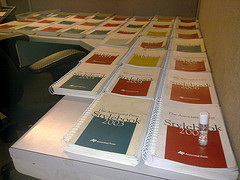 In case you missed the news, the editors of the Associated Press Stylebook announced on Friday that the book was changing its use of “Web site” to “website.”
The news came to many of us via a modest @APStylebook tweet. Those who subscribe to the AP’s Online Stylebook received this more complete email notification:
Editor’s Note: A separate entry on website has been added to note a style change from Web site.
+-+-+-+-+-+-+-+-+-+-+-+-+-
website
A location on the World Wide Web that maintains one or more pages at a specific address. Also, webcam, webcast and webmaster. But as a short form and in terms with separate words, the Web, Web page and Web feed. See Web.
As you can see from the email announcement, the AP has made only a tiny departure from its conservative stance on Internet terms. It’s keeping some of the “big ‘W'” terms intact.
But judging from the reaction in the Twittersphere yesterday, you’d have thought the Vatican had just announced that it was allowing gays into the priesthood. AP Stylebook finally was a trending topic on Twitter, and coverage of the announcement by Mashable — that arbiter of all things relevant in the online world — was Mashable’s most retweeted link of the day on Friday. (Too bad for Mashable’s more pop culture-oriented retweetable topics, such as the Glee in 60 seconds video and the sudden Facebook popularity of South Park loser Kip Drordy.)
In the higher ed twittersphere, there was much jubilation over the announcement. But it also means some work ahead for those who have been following the AP’s book as though it were holy writ. It put folks like J.D. Ross, director of new media at Hamilton College, into update mode almost immediately: “Only 1,540 instances of ‘Web site’ on our Web… er, uh website… this will be fun!”
I’ve never considered myself or the campus I work for as rogues, but we’ve been using “website” since the early 2000s. In a January 2009 post about whether or not it made sense to capitalize Internet or revise it to internet with a little “i” (I doubt we’ll see the AP do anything as radical as lowercasing that term), I explained that our campus has “veered away from the AP rules for our own in-house style when it comes to Internet terms. We’ve looked to other sources for guidance — namely, Wired Style: Principles of English Usage in the Digital Age, by Constance Hale and Jessie Scanlon. As a result, we changed our style way back in the early 2000s to lowercase ‘web,’ combine (and lowercase) ‘website’ and dehyphenate ’email.'”
Here’s our rationale, from our in-house style guide:
Missouri S&T uses a combination of Wired and Associated Press styles when writing about the Internet. Because most of our audiences are Internet-savvy, we feel more comfortable embracing the less formal style of Wired as opposed to the conservative approach of the Associated Press Stylebook.
In some ways, the AP is a lot like the Vatican. It creates rules and issues pronouncements that many of the laity don’t take all that seriously anymore. Both institutions are struggling with their role in modernity.
But the AP differs from the Vatican in one important way: The AP sought input from the laity. Sally Jacobsen, deputy managing editor for projects at the AP and one of three Stylebook editors, explained that the editors “had invited readers and users of the Stylebook to offer us some suggestions for a new social media guide that we’re including in the 2010 Stylebook, and we got a very good response and a large number of people who favored ‘website’ as one word.” (Source: Some Cheer, Jeer AP Change from ‘Web site’ to ‘website’, by Mallary Jean Tenore at the Poynter Institute.)
Still, I’m amazed at how many people in higher education follow the AP Stylebook nearly to the letter. Even Mashable, in its much-tweeted report, refers to the AP Stylebook as “still the standard for all things grammar and punctuation in the news world” and confesses it has stuck with the AP’s “Web site” rule until only “several months ago.” I’m not sure exactly how long ago “several months” is, but it sounds as though our conservative little tech campus in the Midwest was well ahead of the curve in adopting the use of “website” some “several years ago.”
I think I’ll propose we start calling the Internet the “innerwebz.” Maybe it’s time for a LOLcats stylebook. O hai! There’s an idea!
Photo: “The old school rules, spiral bound” – by AllaboutGeorge on Flickr

 Andrew Careaga