This just in (related to today’s post): Newspapers fold as readers defect and economy sours (CNN).
Today’s edition of my home state’s largest daily newspaper, The St. Louis Post-Dispatch (known online as stltoday.com), debuts a new look, a redesign that has trimmed the paper’s width to save some money. But I’ve got to give the paper a failing grade for explaining the reasons behind the redesign.
In Sunday’s editor’s note explaining the changes, the P-D committed the cardinal sin of journalism. It buried the lead.
The editor’s note starts out by attacking the attackers:
Starting Monday, you will see changes in your Post-Dispatch. We know it is popular in some circles in many cities these days to bash the newspaper industry, to say that nobody is reading us any more, that we are losing money, that we are dinosaurs, that we will be gone soon.We beg to differ. The media landscape is radically transforming, no doubt about that. But we believe we will be here to provide strong public service journalism in the Post-Dispatch, enterprise you won’t find anywhere else, and analysis and perspective as we continue to make sense out of complex issues.
Not until the fourth paragraph do you read about the most significant aspect of the redesign:
No, we are not as thick as we were a couple of years ago. No question. Yes, on Monday you will notice that our pages are a bit narrower — 11 inches wide. Like most newspapers, we are reducing the width of the paper to conserve newsprint and reduce costs. We plan to run the same number of pages as now.
The letter — signed off by the P-D’s editor and managing editor — goes on to tell us about the new design’s great benefits. Stuff like “a newsy, classic approach to the news of the day” on a front page designed “to convey depth [but with less page width – me], usefulness and urgency.” And “larger print” and “an easier-to-read experience,” “a new nameplate on the front page that better integrates STLtoday.com and the Post-Dispatch — a reflection of how we have integrated our print and digital operations to give you more high-quality journalism.” And so on.
This kind of timid, backing-into-the-story style of writing is a sure-fire indicator that newspapers are in trouble. (As if we didn’t know that already.) The journalists have been hijacked by sales or circulation. Do you know what kind of a grade I would have gotten if I had turned in something like that in J-School? A big, fat F, that’s what.
To be fair, I have not yet seen the newly designed St. Louis Post-Dispatch, so I guess I shouldn’t be ladling out the hatorade so freely. I may love the new “newsy, classic approach” and the “easier-to-read experience.” I’m sure my aging eyes will appreciate the larger, darker font size. But what I fear is that the new design will continue down the rabbit hole of chasing the trivial and the inane — the “fluff” that John C. Dvorak describes in his Feb. 13 column Newspaper Publishers Are Idiots, which is well worth reading (hat tip to College Web Guy for posting the link).
Newspapers are in a hell of a jam. Another thoughtful (and dense) piece about the state of the print news media comes from Clay Shirky, who, in his piece Newspapers Are Thinking the Unthinkable (hat tip No. 2 to College Web Guy), compares the current tumult in digital communications to the early days of the communications revolution wrought by the printing press.
During the wrenching transition to print, experiments were only revealed in retrospect to be turning points. Aldus Manutius, the Venetian printer and publisher, invented the smaller octavo volume along with italic type. What seemed like a minor change — take a book and shrink it — was in retrospect a key innovation in the democratization of the printed word. As books became cheaper, more portable, and therefore more desirable, they expanded the market for all publishers, heightening the value of literacy still further.
That is what real revolutions are like. The old stuff gets broken faster than the new stuff is put in its place. The importance of any given experiment isn’t apparent at the moment it appears; big changes stall, small changes spread. Even the revolutionaries can’t predict what will happen. Agreements on all sides that core institutions must be protected are rendered meaningless by the very people doing the agreeing. … Ancient social bargains, once disrupted, can neither be mended nor quickly replaced, since any such bargain takes decades to solidify.
And so it is today. When someone demands to know how we are going to replace newspapers, they are really demanding to be told that we are not living through a revolution. They are demanding to be told that old systems won’t break before new systems are in place. They are demanding to be told that ancient social bargains aren’t in peril, that core institutions will be spared, that new methods of spreading information will improve previous practice rather than upending it. They are demanding to be lied to.
There are fewer and fewer people who can convincingly tell such a lie.
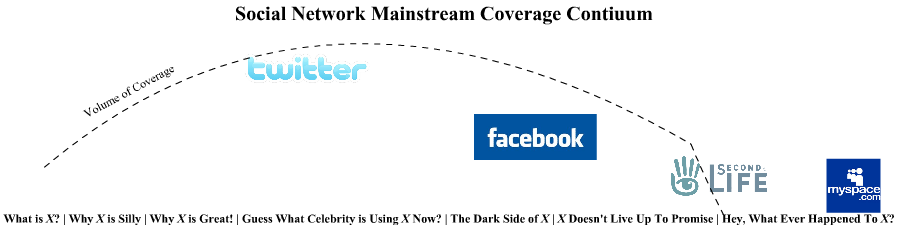
Meanwhile, adding to the tumultuous times, newspapers (and the rest of us) face the micromedia revolution. Everything is going micro. Facebook, Twitter and their ilk are micropublishing and micrbloging platforms, and they have taken off. In just a few short months, my number of connections on Facebook (OK, “friends,” if you will) has doubled. The same thing is happening with Twitter. More people are spending their time in these social spheres to share thoughts and ideas, and with Facebook especially, new apps come online every day to make it easier to share interests and ideas. (Just yesterday I discovered that a Facebook friend from college was using an app called LivingSocial to share top five lists, a la High Fidelity, and guess what I did? I signed right up and started posting my own top fives. Some enjoyable, fleeting, superficial connections with fellow Facebookers ensued.)
Part of this micromedia movement involves the convergence of Facebook (which now looks and acts more like Twitter with its stream of status updated), Twitter, LinkedIn and other social networks. Alumni Futures‘ Andy Shaindlin ponders this coming convergence and its impact on networks — from walled gardens to more fluid streams.
But what does this talk of microblogging, micropublishing, microcommunications — what does it have to do with the newspaper business?
Without a doubt, the news media are obsessed with the latest technology, and have been for ages. How many journalists are on Twitter these days? I follow dozens, and a few even follow me back. And the allure of the latest trend is strong. Reporters want to be reporting about the latest buzz. That’s what news is all about, right?
Well, when the latest buzz is all about trivial matters — and can be shared in 140 characters or fewer, or with a quick link to your top 5 favorite ’80s hair bands — maybe it’s time to rethink the role of journalism and, to a greater extent, the established institutions of journalism, such as newspapers.
As Shirky points out, we can’t clearly see the path ahead amid the chaos of our communications revolution. But Dvorak suggests one perspective that may help newspapers survive (at least some of them). Shirkey suggests we look backward, at how newspapers were before the Civil War era.
Early newspapers consisted of local stories, summaries of events, and listings of items such as ship departures and other notices. There were no recipes, feature stories about dogs, or full-page advertisements for movies.
Then somewhere along the way, newspapers became more entertaining than informative. The writing was often flowery and dramatic. Columns written by personalities joked around about the events of the day. There were cartoons and horoscopes. If I wanted to know what ships were coming in and out of port carrying a shipment of Honda cars, where would I find it? Some papers carry notices like this in the financial pages, but most do not.
Celebrity gossip, entertainment news, stock quotes, sports scores — all of this information is easily accessible online. “Individual sites and technologies simply do certain things better than old-fashioned newspapers can,” Dvorak writes.
As for micropublishing — passing along news tidbits from online sources, sharing lists of your favorite movies and TV shows, publishing photos from your vacation or sharing tunes or cartoons with your buddies — Facebook seems to be the perfect medium for such enjoyable, trivial pastimes. But newspapers, God love ’em, seem to want a piece of the action, too. I agree with Dvorak’s suggestion for the newspaper business — that it “just needs to return to its roots, and focus on providing densely edited and directed information of importance as decided by a trustworthy source. And it should leave the fluff to the Internet.”
Not that everything on the Internet is fluff. (Case in point: this lucid blog post.) But you get the idea.

 Andrew Careaga