Brad Ward has been doing some digging into how colleges and universities are using Twitter, and posts some interesting stats on his blog.
Brad’s observations are preliminary, but worth pondering. He’s keeping an eye on some 400 higher ed Twitter accounts, making this probably the most comprehensive study of how colleges and universities use Twitter. Among his findings:
Of the 400 accounts we are tracking, 26% did not follow anyone new in the past month.
The 400 accounts averaged a 93.3% growth in # of followers over the past month.
A small handful of schools are in the top 10% of # of followers, # of following, and # of updates.
Admission offices usually have the lowest # of followers out of all types of accounts.
There’s more to digest in Brad’s post, so I suggest you go read it. Brad says it’s time for us to get serious about Twitter and make it work for us.
P.S. — Pay no attention to that whole Nostradamus thing in Brad’s post. It was just a timely observation. (But, yeah. I nailed it.)
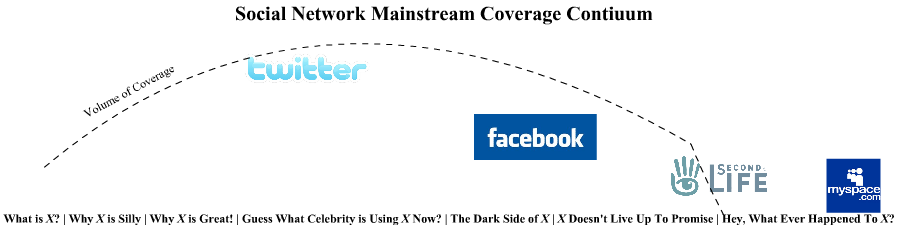
Now that Twitter is all the rage among mainstream media (a point I touched on in yesterday’s mediamorphosis post), it’s only a matter of time before journalists turn their attention to the Next New Shiny Toy (whatever that is, or will be). At least that’s the argument Jay Moonah makes in his post describing the seven phases of mainstream media coverage of social media. He even illustrates it for us with the following chart:
The continuum of social media coverage, via Media Driving (click image to enlarge)
Moonah shows how media coverage of social networks follows a predictable arc, the rise and fall in seven steps:
What is X? — Pretty self-explanatory, early stories (perhaps in the form of sidebars or other short formats) explaining what the social network is, at least at a rudimentary level.
Guess What Celebrity is Using X Now? — This is about where Twitter is at right now — hey, look at which music star or mayor or basketball player is using it!
The Dark Side of X — This is where the Twitter coverage is (IMHO) most likely headed next. Remember stories about people having affairs on Second Life or Facebook bullying? Watch for similar stories about Twitter very soon.
Hey, What Ever Happened To X? — Seen any mainstream media stories on Myspace lately? Even though the social network is still used regularly by millions of users (probably far more than use Twitter) I don’t recall seeing a lot of stories about it specifically, except perhaps as part of laundry list of services lumped in with Facebook and Twitter. And perhaps that’s a good thing for Myspace — it’s possible that it is now just taken for granted as part of the landscape of services that we use online, like search or email. It will be interesting to see if Twitter gets to the same place before it falls off the mainstream media radar, and more interestingly if coverage of the NEXT big thing in social networks follows the same pattern.
Will the coverage of Twitter follow this predictable path? So far, it seems to be.

 Andrew Careaga