
So there’s a new “measurement” tool for Twitter users that gauges the annoyance factor of the “tweeps” (twitter peeps) you follow. It’s called follow cost, and it calculates your average number of Twitter updates (tweets) per day as well as the average number of daily updates for your last 100 posts to determine your short-term tweet trend. Those figures are then converted into milliscobles. According to (jeff)isageek.net, one milliscoble “is defined as 1/1000th of the average daily Twitter status updates by Robert Scoble,” who happens to be a very prolific tweeter.
So, with Scoble setting the annoyance bar, let’s look at where I come in.
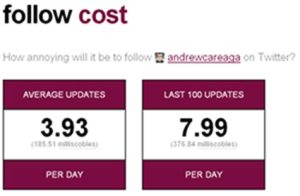
A mere 185.51 milliscobles per day, on average. Not very annoying, if you ask me. But the trend of my last 100 updates shows the annoyance level rising. I’ll try to tone it down a bit.
How about some of our other favorite higher ed bloggers who also tweet? Here are a few of them.
@bradjward out-Scobles Scoble in his last 100 updates — a very high annoyance level. Which is funny, because Brad’s one of my favorites to follow.
@kylejames is not far behind @bradjward, and also easily clears the Scoble bar.
@karinejoly is one of the least annoying higher ed bloggers on Twitter. But followcost fails to factor in Karine’s ability to send a timely Twitter nudge to HigherEdExperts presenters who are cutting close their deadlines to get presentations to her. Albeit infrequent, those updates can be annoying.
I understand the premise behind followcost. It’s conveying the opportunity cost of following every single update of these twitterers. But who does that? Who has the time?
 Andrew Careaga