
Dealing with information overload: email-free Fridays

As I get ready to face the coming work week, and the inevitable crush of email notes, calendar scheduling and round-robin electronic Q&A, I’m thinking that the suggestion of “email-free Fridays,” as described in this USA Today report about email overload (link via AdPulp), looks pretty good.

email_surge.gifToday about 150 engineers at chipmaker Intel (INTC) will kick off “Zero E-mail Fridays.” E-mail isn’t forbidden, but everyone is encouraged to phone or meet face-to-face. The goal is more direct, free-flowing communication and better exchange of ideas, Intel principal engineer Nathan Zeldes says in a company blog post.

E-mail-free Fridays already are the norm at cell carrier U.S. Cellular (UZG) and at order-processing company PBD Worldwide Fulfillment Services in Alpharetta, Ga.

I’ve been trying to fight email bloat by keeping the inbox closed for most of the day and checking email just twice a day, as suggested by The low-information diet (PDF). But it doesn’t always work out. It’s too easy to slip into the old habit of leaving Outlook open and checking for messages every 10 minutes or so.

How do you fight the email monster? Do any of you have a campuswide or departmental policy to shut down email from time to time? If so, I’d love to hear how it’s working.
Facebook and the Long Tail

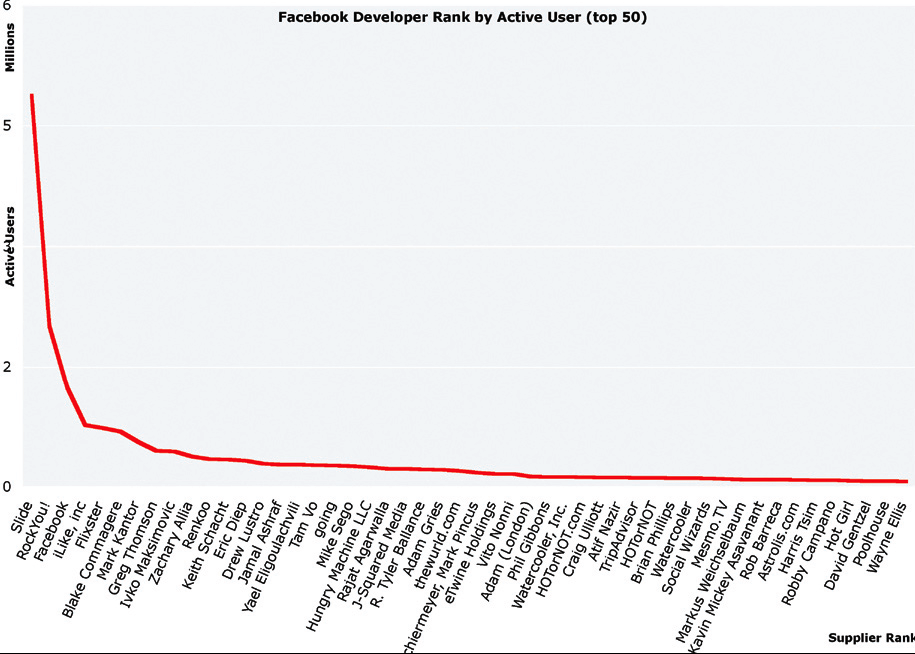
Researchers at O’Reilly just issued a report about how the economics of The Long Tail work — or don’t work — in the ever-expanding universe of Facebook applications. As Tim O’Reilly explains, the report has both good news and bad news about Facebook apps.

The good news has already been widely disseminated: there are nearly 5000 Facebook applications, and the top applications have tens of millions of installs and millions of active users. The bad news, alas, is in our report: 87% of the usage goes to only 84 applications! Only 45 applications have more than 100,000 active users. This is a long tail marketplace with a vengeance — but unfortunately, the economic models (for developers at least, though not for Facebook itself) all rely on getting into the very short head.

This chart puts it in perspective (click to enlarge):

facebooklongtail.png

Via BoingBoing.

Friday Five: Purging the RSS feeds

So many interesting links. So little time. I’ve starred so many must-share tidbits in my RSS reader over the past several weeks that I could never share them all with you. So I went through the list, purged the no longer relevant stuff (all that “breaking tech news” that happened in late August), and winnowed it down to something a bit more manageable. Here’s a judicious sampling of linky goodness for your weekend reading pleasure:

  • The end of web 2.0 as we know it, as predicted by CrunchGear columnist Seth Porges. Porges predicts that human laziness will be web 2.0’s undoing, and I’m inclined to agree. We just don’t have the gumption to keep up with all our social networks, RSS feeds, etc. Give us the lazy way out and we’ll take it, every time.
  • Web 3.0 lives in a van — “down by the river,” I’m tempted to add. Marketing Pilgrim points us to two entrepreneurs who are defining web 3.0 on the road.
  • /. turns 10. Hard to believe that Slashdot, the granddaddy of all social networks, precursor of blogs, celebrates a decade on the net this month. Great interview with Slashdot founder CmdrTaco.

    Our desires are incredibly simple: We look for stories that will generate a good discussion. I’m not looking at big-picture, long-term repercussions from our posts. When I look back at 10 years of doing this, it’s nice to see all the good we’ve done. But that’s not the goal. The goal is to provide interesting content for our readers.

  • BuzzMachine ponders: Can we stop seeing it as news when some company opens up an island on Second Life?

  • Google: the 800-pound social networking gorilla?
    This is a couple of weeks old now, but the story is that Google is about to enter the social networking business in a month. Scobleizer pointed to a TechCrunch post about Google testing an app to rival Facebook. According to TC, Google will unveil the new app on Nov. 5.

Attempting a new world speed record

[blatant promo for my university]

s-t-land-speed-vehicle.jpgA group of students from the university where I’m employed (to do flackery, no less) is in a remote and desolate portion of Nevada attempting to break the collegiate human land-speed record. On our Experience This! blog, we’re using video, photos and text to report on the adventures of Jerrod Bouchard and his crew as they attempt to set the new world record.

Bouchard is pedaling a specially designed recumbent bicycle — which looks nothing like any bicycle you’ve ever seen — to speeds (so far) as high as 59 mph. (The record is 61.5 mph.) We’ve got a blogger, a photographer and a videographer on the scene to capture the event. Note the prominent display of the “Missouri S&T” word mark on the team’s vehicle and uniforms.

[/blatant promo for my university]

Campuses no strangers to controversial speakers

Yes, Iranian President Mahmoud Ahmadinejad’s recent speech at Columbia University was controversial. But college campuses have a tradition of bringing controversial speakers to their campuses. U.S. News & World Report lists a few of them to jog your memory. Via University Business.