Wednesday morning catch-up: Edu blogger winners, #CASECMT,

A little middle-of-the-week catchup on news higher ed folks should know about:

Congratulations to The Old College Try (aka DW) for winning the grand prize in the Edu Blogger Scholarship competition. DW won for her entry Top Distance Learning Marketing Challenges, and Karine Joly announced the winners today on her blog, CollegeWebEditor.com. Congrats also to Shelley Keith and Heidi Cool for winning the random drawings.

#CASECMT is the hashtag to follow this year’s CASE Conference on Communications, Marketing and Technology, which gets going today. Paul Redfern (@coachfern for you Twitter tweeters) is the chair of this year’s event, and it looks like he’s got a good lineup of faculty.

Today is the final day to nominate a higher ed blogger for the EduStyle higher ed blogger award. Karine Joly offers 10 nominees for your consideration.

Reflections on 2008 and all that claptrap

This being the final day of 2008, I suppose I should do what many bloggers do at this time of year and reflect, or resolve, or predict, or puff on my Meerschaum pipe, stroke my chin thoughtfully and opine about the state of higher education, marketing, PR, the media, Twitter, Facebook, indie music or some other topic I frequently touch on here.

Or maybe I should hike my khakis up a la Matt Foley (video) and toss some motivational bromides your way — tell you to hire good people and get out of their way, or to quit micromanaging, or to be proactive, learn to do more with less, tighten your belts, or lose weight and stop smoking the doobies.

But who am I to dispense advice? Look, I’m a blogger. Even worse, I’m on Twitter. I tweet dozens of times a day. Sometimes I even tweet from my couch while watching a football game. It’s obvious I don’t get out much. I’m the last person you should seek out for advice, or take advice from.

No. I’ll leave the Dear Abby duties to some other blogger. The best I can muster on this final day of the year — and really, isn’t it just a random date? sure, we get the day off tomorrow, and lots of football, but does that much really change after midnight? — the best I can muster is a quick click-through of some things that were on my mind and on this blog in 2008. That, and to wish you a Happy New Year and the best for 2009.

Higher ed marketing’s year in review

January — Predictions that Facebook was on the wane may have been slightly exaggerated, especially considering that I now have more Facebook “friends” from my high school graduating class than I had actual friends in high school. I blame that on the 30-year reunion that took place last summer. Later that month, Judy Gombita of PR Conversations took me to task for bashing Facebook and for being such a Twitterphile. Anyway, if you needed proof that I suck at making predictions, there you have it. The mighty Facebook lives, and I’ve got the high school connections to prove it.

February — A tragic month for higher ed. The Northern Illinois University shooting was front and center for many of us. I posted the news as soon as I found out about it, and that post led to a follow-up about the role higher ed (and other bloggers) play in writing about such tragedies (Blogging about campus tragedy: public service or exploitation?). That same month, a pioneer in crisis communications, Christopher Simpson, lost his battle to cancer at age 52. I also asked, Should universities Tweet?, a question that seems mildly irrelevant today, and I belatedly wished Karine Joly’s blog, College Web Editor, a belated happy third birthday. And early in February, BlogHighEd.org was born.

MarchTwitter had its busiest day ever at the height of SXSW Interactive, and as March Madness descended, Drivl.com unveiled the worst Division I mascots ever (h/t The Old College Try). March was the month my reading preferences were validated by Seth Godin, my social networking addiction was clarified, and my long-awaited but brief, superficial review of University Marketing Mistakes elicited this response, among others:

andrew, since it is taking you too long to have the review, may i have a suggestion? Pls make a running review of the book and post it on this blog.

It may seem your patrons may look for other bloggers that can provide it.

You have attracted my attention with your promised review of the book. I guess the best way is for me to buy one.

I guess so.

April — I spoke at and blogged from the CASE Communication, Marketing and Technology Conference in San Diego, where I met a couple of folks who have since gone on to create great higher ed blogs of their own: Paul Redfern of Gettysburg College, who blogs at Higher Ed Web Marketing, and Eduardo Merille of Florida Atlantic University. Caltech’s Liz Allen, who doesn’t blog but should, became my first (and so far only) guest blogger in April with her take on the CASE conference. Also in April, my post about using del.icio.us as a PR measurement tool got some blog buzz, and I got a good fortune cookie at the Chinese buffet.

MayAddict-o-matic and the LOLinator were highlights of the month. Blog fatigue was setting in. But I did manage one serious post summarizing a weighty study about the state of PR.

JuneKarine Joly discovered the secret to my amazing YouTube popularity, I co-presented at a PR conference in Baltimore, and went on and on about pitching to bloggers and on Twitter. Tim Russert died, I posted insight from Newsweek science writer Sharon Begley, and rallied higher ed bloggers to represent in the Ad Age Power 150. Well, tried to rally, anyway. Best post of the month: the informafore’s dilemma.

July — Right before Independence Day, I posted mini-reviews of three books marketing and PR types ought to read, shared five videos of a great summertime song, introduced a blog our department created for a big solar car race, and celebrated a Twitter milestone.

August — Posted reflections on Barack Obama’s visit to campus (which happened in July), more crap about Twitter, and Intern Mike’s five takeaways from his summer job in our office.

SeptemberPosted about rebooting my workflow for fall but that’s all I did: read about it. I didn’t do it. Maybe I should try again. New Year’s resolution? More importantly: I blogged about Talk Like a Pirate Day and gave you more cowbell.

OctoberTook part in Blog Action Day; wrote about beating the recession blues; jumped on the Is blogging past its prime? bandwagon; posted something that I thought was pretty insightful, only to later realize that it was just more blather borrowing from other ideas floating around the blogosphere-twittersphere collective semi-consciousness.

November — Dipped my toe into the analytics waters again with a post attempting to analyze our campus’s spacebook PR campaign and another post looking at Google analytics info for this blog from November 2007-November 2008. Ate turkey for Thanksgiving.

DecemberCoined the term Facebookgate™, exploiting all of Brad J. Ward‘s investigative work for my own glory. What better or more fitting way to end the year?

#CASECMT: social networking for alumni groups

The original post contained some incorrect information about Caltech’s alumni base. This updated post reflects the correct numbers. The offending blogger has been duly reprimanded.

Once again I’ve fallen behind on my plans to summarize last week’s CASE Conference on Communications, Marketing and Technology. But you know how it is, once you get back to the office and get sucked in. So it goes.

Anyway…

Elizabeth Allen of the Caltech Alumni Association (and recent guest blogger in this space) put together a nice presentation on how alumni groups can use social networks to connect with alumni. She focused on three social networks Caltech Alumni Association is using– LinkedIn, Facebook and the photo- and video-sharing network Flickr. I was most interested in the LinkedIn angle, since that’s the network many people tap for connecting professionally.

Caltech Alumni started the LinkedIn group in 2005 without a lot of fanfare. According to Liz, Caltech sent two email newsletters to some 20,000 13,000 alumni with known email addresses, and also worked with LinkedIn to send a note to LinkedIn members who indicated they were Caltech alumni. (There’s also a link to and description of the LinkedIn group from the alumni association website.) From those low-cost efforts, Caltech Alumni has a LinkedIn group of 2,017, or 10 15.5 percent of the emailable alumni. (Update: Caltech has about 20,000 alumni in total, not 20,000 emailable, as I originally stated in this post. Caltech has email for about 13,000 of those alumni. Thanks, Liz, for setting the record straight.)

Why does this work for Caltech? In one sense, it makes the association more relevant, because through LinkedIn the association is facilitating global connections. Alumni from across the globe are part of the Caltech organization even if they live in regions where no alumni chapter exist. Also, using LinkedIn leverages that site’s mission of helping people build business and employment networks — something that’s important for a technological university like Caltech. (This is a model that could work for our campus, since many of our graduates also are in the science and engineering fields.)

Caltech also uses Facebook (with an alumni group and an alumni page, where Liz can send RSS feeds of events) and Flickr for sharing photos of events, etc. Caltech made a conscious decision to use third-party social networks instead of creating a separate, exclusive network hosted by the alumni association. The reasons: third-party validation (especially from LinkedIn, I would assume), and most alumni who are into social networks are already online in those venues, so why make them create yet another password and log in yet another time?

If anyone has questions about Caltech’s use of social networking, I’m sure Liz would be happy to respond. You may email her at elizabeth AT alumni.caltech.edu.

#CASECMT: Elizabeth’s take

Elizabeth Allen, one of the presenters at last week’s CASE Conference on Communications, Marketing and Technology, graciously accepted my request to guest-blog about the conference. Her post is below. Liz is assistant director of communications for the Caltech Alumni Association (that’s “Caltech,” one word, little “t,” as I learned last week), and she did a great job presenting about using social networks to connect with alumni. If you’d like to get in touch with Liz, email her at elizabeth AT alumni.caltech.edu.

+++++

One of the things I enjoyed at last week’s Communications, Marketing and Technology Conference in San Diego was the opportunity to interact with colleagues from a varied set of backgrounds, institutions, and geographic locations. Most remarkable (to me) was the diversity of the roles and departments of each of the attendees. This lively group of more than 140 consisted of web developers, communications coordinators, executive directors, writers, pr staffers, VPs, webmasters and designers. They represented departments such as Admissions, Public Relations, Alumni Relations, the President’s Office, Student Affairs and Campus Diversity.

Communications and technology positions have moved well beyond the “tech person” in a dark room filled with whirring servers, hammering out html code and java script. Today, communications and technology are an integral part of every event, program and service we provide to prospective students, current students, parents, alumni and donors. The diversity of participants in San Diego reflected this paradigm shift: regardless of their department or their role in it, everyone came to learn more about using technology to connect with their constituencies.

The faculty presentations reflected the change too. We each represent a particular segment of our institutions, but the solutions and ideas in our presentations apply to many program areas and departments. Casey Paquet showed an example of Eckerd College’s holiday card. Its primary function is a recruitment tool for the admissions office – yet it has proven very popular with current students, families, alumni and beyond. Colgate University’s Tim O’Keeffe demonstrated how a blog post with news of the passing of William F. Griffith (“Dean Griff”), is still generating comments, four months after it went live. The post was intended as general university news, but alumni have used it as a forum to share their memories and condolences for the beloved administrator.

Clearly it’s important to stay informed about the communications efforts across your campus, regardless of the department. Each of their endeavors may have direct connections and benefits to you and your division – and vice versa. Though technology has the power to bring us closer together, many of us still seem to be operating in a “silo” mentality. Instead, take the initiative: learn how you can bolster communications efforts on your campus, and think of ways other
departments can help you in turn.

Elizabeth Allen
elizabeth AT alumni.caltech.edu

#CASECMT: that meme is on a (Rick) roll

bustedtees_rickroll.gifThis Rickroll meme is on a serious roll, well beyond the confines of viral web pranks and into the real world. It’s an interesting example of how a meme can take on a life of its own.

Here’s YouTube footage from a “rickmob” flash mob that gathered on Friday at Liverpool Street Station. CNN has picked up on the scent, commenting on how pranksters voted Rick Astley’s big ’80s hit to be the song as the New York Mets’ new theme cheer. The result: some loud “Bronx cheers” from the stadium crowd (h/t for CNN link: Eddie Merille via Twitter). There’s even a muppet rickroll (h/t: Matt Herzberger via Twitter). And t-shirt seller BustedTees hopes to cash in on the meme by offering a Rick Roll’d t-shirt.

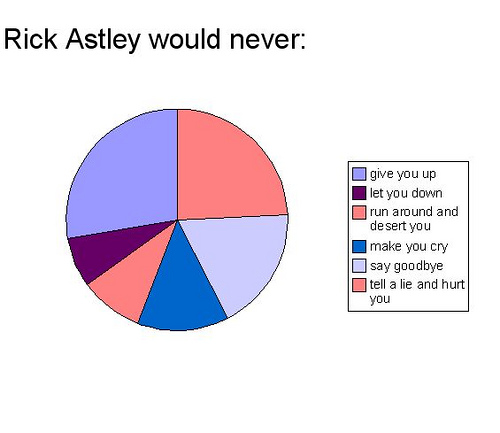
rickroll_chart.jpgI even tried my hand at a rickroll during the recent CASE conference, inserting this chart (among other joke slides) into a presentation on measurement and analytics. (Click image for larger version.)

I’m not sure the audience knew they’d been rickrolled. But if any of them are reading this, now they know. You’ve been rickrolled!

—————-
Now playing: The Rolling Stones – Sympathy For The Devil
via FoxyTunes