
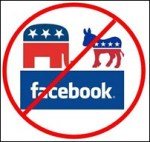
Off-topic: How to hide political posts on Facebook

With the Republican National Convention now in our rear-view mirror and the Democratic National Convention about to convene, we political junkies are sating ourselves with the constant streams of information coming from all directions. But some of us may grow weary of the vitriol being tossed about on Facebook by those misinformed supporters of the wrong side in this election. The trouble is, many of those people are family members and actual friends and co-workers.

So what can you do? To unfriend them on Facebook because of their political leanings could lead to unintended consequences in real life.

Thanks to a browser extension Social Fixer for Facebook, you can effectively remove those posts from your Facebook news stream without endangering friendships. (Hat tip to Christopher S. Penn, who shared Social Fixer in a recent edition of his email newsletter. Visit his site to subscribe.)

Penn highly recommends this tool, and not only to sanitize your stream from political posts. “Take everything you don’t love about Facebooks, from sanctimonious holier-than-thou religious posts to the endless cesspool that is politics and quarantine or just obliterate it all.”

This blog post from Social Fixer explains how to set up your filter.

While installing the add-on, Penn suggests adding the following to the filtering string:

/politic|obama|romney|republican|democrat|conservative|liberal|election/

I doubt I’ll be using this add-on — at least not yet. I tend to enjoy the vitriol, and if you’re a friend of mine on Facebook, you may have noticed a posting or two in which I express my own political leanings. Philosophically, I prefer the messiness of political discourse, even though I realize how unlikely it is that I’ll ever change the views of those on the wrong side who are posting their own views, any more than they’ll change my views. Also, I tend to pay more attention to my Twitter stream than to Facebook. Twitter is just my preferred social media venue and platform.

Still, hearty discussion of politics is beneficial to the common good of a democratic society, right? We can learn from each other. We can reason together. Right? Right?

A future-friendly Friday Five (links from @dmolsen’s #hewebar session)

I had the chance to soak up some wisdom from one of higher ed’s brightest people when it comes to the mobile web, Dave Olsen, during the opening day of HighEdWeb Arkansas. I’ve known Dave virtually for a long time now, and have always found him to be very generous with his ideas, resources and knowledge. I found out that Dave is just as generous and knowledgeable in person.

Dave’s workshop presentation was about making your organization future-friendly, and, at least during the first hour of his session — that is, until Twitter decided to shut down — those of us in attendance were doing a good job relaying Dave’s bits of wisdom to the twitterverse via the #hewebar hashtag.

Oh, well. I was planning to do a wrap-up on Dave’s session for this week’s Friday Five anyway. The absence of Twitter just forced me to do things differently. I had to write things down from Dave’s session — with a pen, on paper — rather than tweet them in the moment, stream-of-consciouslike. These written-down things include a bunch of URLs to great resources that can help you make your organization (and web presence) more future-friendly. Here are five links worth sharing.

P.S. — In an effort to more purposefully think and behave in a future-friendly way (something Olsen suggests), I bring you this Friday Five on a Thursday. You’re not really reading this in the future, it just seems that way. [Mind=blown]

  1. The future-friendly manifestoThis is your starting point for all things related to the future-friendly movement. Take a deep breath and a zen-like approach as you read immutable truths about the days ahead — thing like “Disruption will only accelerate” and “The standards process will be painfully slow.” But don’t lose heart. Persevere beyond the first paragraph to discover hope for the future.
  2. Future-Ready ContentThis excellent article by Sara Wachter-Boettcher, a content strategist and writer, offers a glimpse into the world of content strategy for a future-friendly web world. It boils down to anticipating the personal preferences of various users — Sara uses a recipe as a great example — and breaking your content into micro components that can recombine in different ways. Good stuff.
  3. Mobile web best practices. Dave Olsen recommends this site for anyone wanting to learn more about the, well, best practices pertaining to all aspects of the mobile web — from content strategy and design to user experience and development.
  4. Mobilekarma.com. Once you decide on a future-friendly web strategy, you’ll need a way to test prototypes on various types of devices. Olsen recommends this site for buying secondhand, unlocked mobile devices for testing.
  5. Go mobile at Texas A&M. For anyone seeking a template for planning an institution-wide mobile strategy, Texas A&M’s approach is the gold standard, Olsen says. This site includes plenty of documentation and ideas to help you move forward.

Dave’s HEWebAR presentation in its entirety will be posted on his Slideshare site as well as on EDUniverse (along with all the other HEWebAR presentations).